
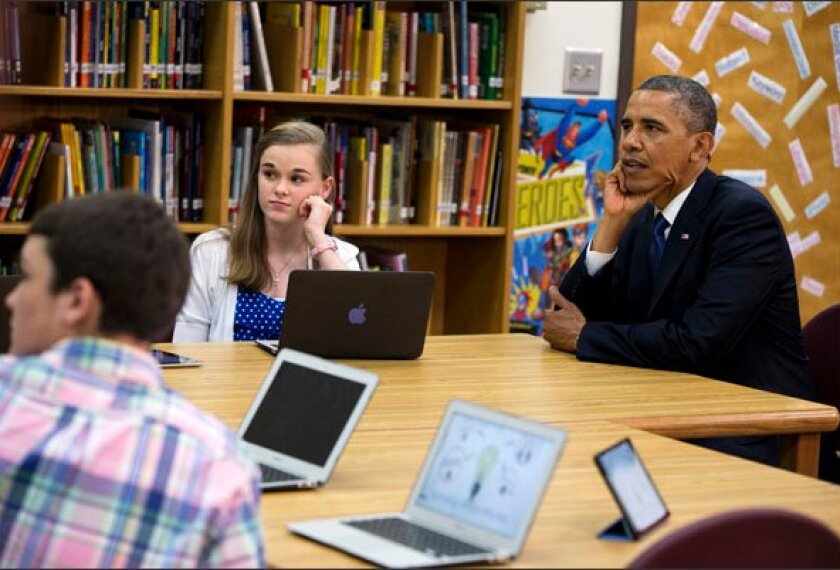
President Barack Obama is calling for an ambitious overhaul of the federal E-rate program, a step that many education and technology advocates have been urging for years to improve what they see as schools’ badly out-of-date technological capabilities.
The administration intends to ask the Federal Communications Commission to consider rechanneling and increasing funding through the program, which is derived from telecommunications fees, with the goal of giving 99 percent of the nation’s schools access to high-speed broadband and wireless Internet within five years.
Mr. Obama’s plan, dubbed “ConnectED,” also calls for the U.S. Department of Education to lead an effort, using existing federal funding, to boost teachers’ skills in using classroom technology, widely regarded as a shortcoming for many of today’s educators.
Senior administration officials, in a briefing with reporters, did not offer a firm estimate of the price tag for the proposed E-rate changes, which would have to be approved by the FCC. It would be left to the commission to determine the exact mechanism to raise the necessary funds, those officials said.
But if fees need to be raised, it would result in a temporary charge of no more than $5 in additional, annual fees on phone bills, they said. Those officials described the proposal as a significant but “one-time capital” expense, which would raise “billions” for schools, though they did not provide an exact dollar amount.
Mr. Obama officially announced the effort during an appearance Thursday to the Mooresville, N.C., school district, where he appeared with U.S. Secretary of Education Arne Duncan. The 5,500-student system has recast its approach to integrate technology throughout curriculum and instruction.
The president noted that just 20 percent of U.S. students have access to “true high-speed” Internet in the classroom, while in South Korea—often touted as one of the world’s highest-performing education systems—that number is 100 percent.
“In a country where we expect free Wi-Fi with our coffee, why shouldn’t we have it in our schools?” Mr. Obama said.
Avoiding Congress?
The White House argues that its plan also will foster innovations and benefit schools in indirect ways, such as by encouraging more education technology companies to develop products focused on improving K-12 learning, as opposed to other technology tools.
Mr. Obama’s proposal emerges amid a rancorous political environment in Washington, yet it would appear it has the potential to receive a hearing insulated from at least some of the partisan clamor. Administration officials say the plan would not need the approval of a divided Congress, but would instead be considered by the FCC, which governs the E-rate program.
The FCC is a five-member panel, of which no more than three members can be Democrats or Republicans, with the president appointing the chairman. Mr. Obama recently nominated Tom Wheeler, a Democrat who is a venture capitalist and former wireless- and cable-industry official, to the chairman’s post.
Ajit Pai, the sole Republican currently serving on the panel, which has two vacancies, declined a request for comment on Mr. Obama’s plan.
The president’s proposal to change the E-rate program would go through a federal rulemaking process, during which public comments would be accepted, a senior administration official said.
Created by Congress in 1996, the E-rate program aimed at providing all schools and libraries, particularly those in poor and rural communities, with communications services, including the Internet. The program is managed by the Universal Service Administrative Co., a nonprofit organization. Schools and libraries do not obtain funding directly from the program, but instead apply to receive discounts on the costs of service. The amount of the discounts to schools varies, with greater amounts going to poorer applicants.
But demand for E-rate dollars now outstrips available funding. Districts requested almost $5 billion for projects this year, but the program’s funding is capped at less than half that amount. School officials say it has not kept up with the strain caused by the proliferation of mobile devices, wireless systems, and online exams. According to the White House, the average school today has roughly the same connectivity as the average American home, but schools serve 200 times as many users.
Universal Availability
The president’s plan calls for nearly all the country’s students to gain access to Internet broadband at speeds of at least 100 megabits per second, with a target of 1 gigabit per second, in addition to high-speed wireless connections. (The goal reflects the reality that some schools may choose not to take part, administration officials said.)
One and a half megabits of broadband is enough to allow one student to stream a standard-definition online video, said Evan Marwell, the CEO of Education Superhighway, a San Francisco-based nonprofit that advocates improving Internet access in schools. Placing 1 gigabit per second in schools would allow every child in a school to watch a streamed video at the same time—the kind of standard schools will be forced to meet as they use technology to personalize learning for students, he said.
“This is exactly what needs to happen to upgrade our schools to improve digital learning in classrooms and bring next-generation assessment into the classroom,” Mr. Marwell said of the president’s proposal.
The administration did not specify what kinds of technology improvements that new money would pay for in districts and schools. Mr. Marwell said he would prefer that districts partner with telecommunications companies to use new E-rate money to establish fiber-optic cable networks for K-12 systems. They also could establish and improve wireless systems to boost connectivity within schools and districts, he added.
John Harrington, the CEO of Funds for Learning, an Edmond, Okla., organization that consults with schools and districts on E-rate funding, agreed that fiber-optic cable would be a good option for many districts, and the one that would be the surest way to meet growing connectivity needs. But those systems could not be added easily in some districts, particularly rural ones, which might instead consider a host of wireless and other tech options, he said.
The FCC would be wise to give districts flexibility to choose the technology they want, he argued.
The goal should not be to “define the technology,” Mr. Harrington said, but rather to “define the target you’re after.”
Gauging Resistance
Resistance to the president’s efforts could come from those who object to raising fees, as well as from telecommunications providers that worry changes to the current system would hurt their business, a number of observers said. Determining how much E-rate funding is made available for various schools’ needs could also provoke discord, Mr. Harrington added.
One major telecommunications provider, AT&T, offered a positive initial response to Mr. Obama’s proposal, while describing the funding system for the E-rate as outmoded.
The Universal Service Fund “must be modernized for this plan to work,” said Randall Stephenson, AT&T’s chairman and CEO. “The very cumbersome rules surrounding the current E-rate program simply must be streamlined and made more efficient. We are convinced this can be done while still ensuring that the funds are properly collected and spent.”
One of the technological hurdles facing many of the nation’s districts is the expectation that they will administer online tests aligned to the Common Core State Standards, beginning in the 2014-15 academic year. Many school officials have said their tech systems are not ready to handle that load.
A senior administration official said the E-rate proposal is designed to improve schools’ overall technology capacity, not to address state testing concerns, specifically.
Nonetheless, the festering anxiety about the upcoming common-core exams is weighing on school officials, who would likely embrace any financial help that could come through the E-rate program, said Keith Krueger, the CEO of the Consortium for School Networking, a Washington organization representing school technology leaders.
“They’re a big wake-up call,” he said, “and one of the reasons why we need to make an infrastructure investment.”


