Members of the Texas board of education have directed writers of new social studies standards to reinstate two cherished holidays and solidify the positions of prominence of two historical minority figures.
In the latest go-round of revisions of academic content standards in a state where the task is often rife with controversy, the board told writers not to delete Christmas and Rosh Hashana, as had been proposed in a draft. It also rejected calls from some Texans to downplay Thurgood Marshall, the first black U.S. Supreme Court justice, and Cesar Chavez, the well-known organizer for farmworkers’ rights, as some reviewers had recommended.
At a meeting this month, the board heard testimony from five of six reviewers who had been appointed to make recommendations for the new standards. They also listened to testimony from representatives of most of the standards-writing teams.
What’s included in Texas social studies can have an impact on education nationwide because it is one of the biggest textbook-adoption states, meaning decisions are made at the state level about which books can be bought with state money. Publishers often look to Texas standards when deciding what to put in textbooks used throughout the country.
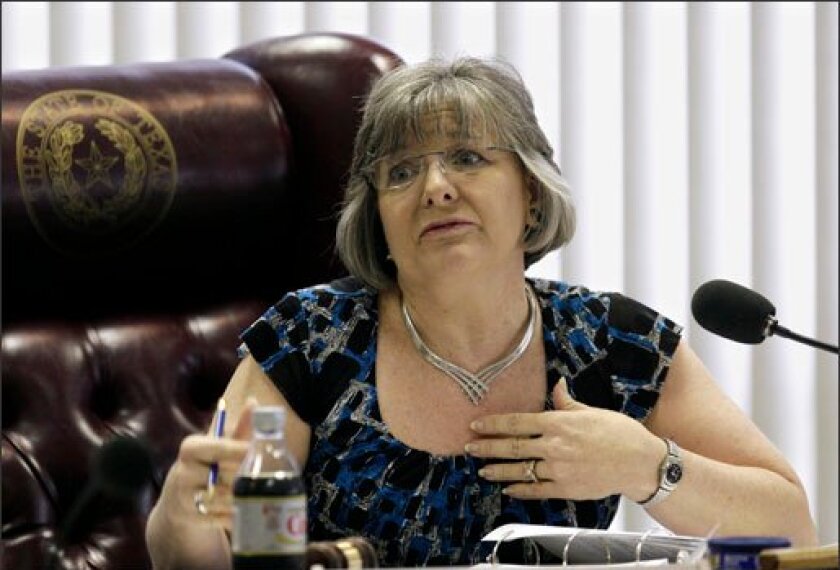
“The writing teams have left Cesar Chavez and Thurgood Marshall in the same grades they’ve always been taught. The concern that we would eliminate them is unfounded,” Gail A. Lowe, the board’s chairwoman said in explaining the guidance its members gave to writing teams at the meeting.
In addition to the inclusion of Justice Marshall, as in the current social studies standards, Ms. Lowe added, they make several references to the Supreme Court case Brown v. Board of Education, which struck down racially segregated schooling. The late justice, as a civil rights lawyer, successfully led the fight for school desegregation.
“Thurgood Marshall’s legacy has been strengthened in our standards, not removed,” Ms. Lowe said.
Another controversial matter that had cropped up was which religious holidays would be included in the standards.
Ms. Lowe said that the writers of the 6th grade social studies standards proposed deleting Christmas and Rosh Hashana, the Jewish new year, from the current standards because they were trying to select only one holiday for each of the five major world religions. They left in the proposed standards Easter as a Christian holiday; Ramadan as a Muslim holiday; Yom Kippur as a Jewish holiday; and Diwali, a festival of lights recognized by Hinduism and Buddhism.
“We heard immediately from constituents that that was a change they didn’t want made,” Ms. Lowe said. She said the board gave “clear direction” to the standards-writers to put Christmas and Rosh Hashana back in because they are so familiar to many students in the United States.
Evolution Comparison
So far, according to Ms. Lowe, the debate over the social studies standards hasn’t been as contentious as what occurred over evolution when Texas was revising its science standards. (“Retooled Texas Standards Raise Unease Among Science Groups,” April 8, 2009.) She said she believes that’s because state board members have been “more cohesive” in their expectations of the social studies standards and the direction they’re giving the writing teams.
During the rewriting of the science standards, Don McLeroy chaired the board. He was ousted from that post when he failed to gain sufficient support from state lawmakers for his reappointment. Some complained that the board had become consumed with divisive social and cultural issues under the leadership of Mr. McLeroy, who still holds a seat on the panel.
Debbie Ratcliffe, a spokeswoman for the Texas Education Agency, said that “social studies has the potential to be more controversial than the evolution debate because there are more topics that people feel passionate about, and people understand history better than they do science.”
She said the board has indicated it wants a balance in the standards of historical or influential people who are considered to have liberal and conservative perspectives.
Some critics have been arguing that one political persuasion deserves more weight than another in the final document.
Jesus Francisco de la Teja, a history professor at Texas State University-San Marcos, one of the reviewers who testified at the Sept. 17 meeting, said in an interview last week that the most vocal critics of the proposed standards seem to focus on whether certain historical or influential individuals are cited. But many of those individuals are named as examples that teachers can refer to in lessons; the standards don’t require educators to teach about them.
“My opinion is we might do better to avoid some of these controversies by getting rid of all examples,” he said, and name only people, places, and events that are required teaching.
At the board meeting, state Rep. Eddie Rodriguez, a Democrat, asked the board not to downplay Mr. Chavez, the late founder of the United Farm Workers.
Yannis Banks, a spokesman for the Texas chapter of the National Association for the Advancement of Colored People, called for the inclusion of Justice Marshall, saying that omitting him would be an insult to his legacy. In the draft proposal discussed at the meeting, the justice had been added to the 8th grade standards and remained in the 1st grade ones.
The board is slated to receive a second draft of the standards in October, followed by another round of discussions in November. It expects to hold a final vote in March.


