Roger Brown has a habit of asking the same question over and over again. In his polite but direct British manner, he challenges principals, teachers, and students to explain how they know if they’re improving.
“I suspect that you’re actually making very significant progress,” he said recently, over lunch, to a group of teachers at the International High School at Prospect Heights in Brooklyn. “But can you prove that progress?”
Soon, all of New York City’s public schools will be similarly pressed. The nation’s largest school system has hired Mr. Brown’s employer—Cambridge Education, based in the English city of the same name—to help design a process for judging how well schools make decisions about instruction.

| |
| (Requires Macromedia Flash Player.) |
Adapted from the school inspections used in England, the quality reviews are slated to become part of a new accountability system here in the 2007-08 school year. About 100 of the city’s 1,400 schools, including the Prospect Heights international school in Brooklyn, have opted to take part in a pilot test this spring.
The aim is to balance outputs, such as tests scores, with a more qualitative snapshot of how schools are functioning. Much of the three-day visits focuses on a school’s use of data and other information to determine how to meet the needs of its students.
New York isn’t alone in importing the approach. Cambridge Education, which does inspections as a government contractor in England, has assessed charter schools in the United States since 2000. Recently, the company evaluated regular public schools in Connecticut that were targeted for intervention under the federal No Child Left Behind Act.
James S. Liebman, the chief accountability officer for the 1.1 million-student New York City system, said the reviews are a vital part of the district’s evolving improvement agenda. By prodding schools to justify their decisions, the visits are meant to encourage self-examination about efforts to raise student performance.
“This is, in a real way, part of the support or training for schools to enable them to make the kind of progress we’re asking for,” Mr. Liebman said.
Lessons From Abroad
The quality reviews mark a significant shift in strategy for New York. Since Mayor Michael R. Bloomberg gained control of the school system in 2002, his handpicked schools chancellor, Joel I. Klein, has led efforts to standardize teaching methods through new systemwide curricula and professional development.
But in recent months, Mr. Klein, a former U.S. assistant attorney general under President Clinton, has pledged more flexibility for schools. Rather than a reversal in course, he argues, decentralization is the next logical step after setting common expectations and building the skills of principals and teachers.
In looking for models, New York leaders found those in England especially relevant. With a national education law analogous to the NCLB act, the country has sought to balance standardization with local control. In fact, New York City’s department of education hired Sir Michael Barber, an architect of England’s school improvement strategy, as an adviser.

“They have been implementing a reform over the past decade or so that has very similar underpinnings,” said Kristen Kane, the chancellor’s chief of staff.
In the English method of inspections, district leaders here saw a way to hold schools accountable without dictating teaching methods. Coordinated in England by the national Office for Standards in Education, the inspections are intended to gauge not just a school’s progress, but also its ability to improve.
The International High School at Prospect Heights got a glimpse of the process last month. For three days, Mr. Brown, a former principal—or “head teacher”—moved about the building, doing one-on-one interviews, holding focus groups, and observing classes. All the while, he took notes on a laptop computer.
In classes, he prompted students to explain what they were working on, and whether they could have done such work before.
“Do you think by coming here you’ve made better progress than if you went to another high school?” he asked students assembled to meet him.
A key feature of the review was its “case studies,” in which Mr. Brown met at length with the teachers of two students to examine the youngsters’ work and talk about their progress.
The international school shows both the value and the challenge of the reviews. Now serving students in grades 9 and 10 in its second year, the school has a mission to serve recent immigrants. Its 215 students hail from more then 30 countries. To keep them from falling between the cracks, the school puts a high premium on teamwork among teachers and students.
For the most part, Mr. Brown was impressed. In classes, students participated actively in their lessons, and often worked together. Just as important, they seemed happy to be at school, as did the teachers. For a group of students considered at high risk of dropping out, Mr. Brown said, that’s a significant accomplishment.
But he also noted the school’s difficulty in using data to drive instruction. At a school where students speak 19 different languages, and which emphasizes project-based learning as a way to keep students engaged, finding objective measures with which to plan adjustments in instruction isn’t easy.
‘Leading Indicator’
In a meeting with Principal Alexandra Anormaliza on his last day, Mr. Brown suggested working within a network of 9 high schools with similar missions to come up with benchmarks that make sense to school leaders.
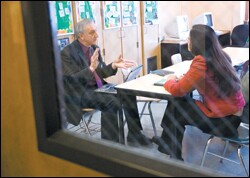
Ms. Anormaliza said she agreed with the general thrust. Although initially somewhat apprehensive about the review, she found its tenor reassuring. As he’s trained to do, Mr. Brown offered feedback and asked for critiques of his own impressions throughout the three-day visit.
“It’s like here are two colleagues having a conversation about what it means to create this particular school,” Ms. Anormaliza said.
For now, the visits are without specific consequences. But in two years, when the city education department plans to have its own administrators do them, each school will get a score: “well developed,” “proficient,” or “undeveloped.” The scores, and short narratives justifying them, will be made public.
New York district leaders don’t plan to ignore more-objective measures, of course. Schools also will get letter grades, from A to F, based on test scores, attendance rates, and other data. But by adding a more nuanced picture, the reviews will provide what Mr. Liebman, the top administrator for accountability, calls a “leading indicator.”
“It sometimes takes two years for changes that are happening at a school to filter down into visible results,” he said. “When deciding what the consequences should be, this could be important to say, ‘Let’s give that school a little bit more time, because they really seem to be focused on the right things.’ ”
Not surprisingly, the quality reviews haven’t sparked as much debate among teachers and principals as has the prospect of grades based on student outcomes. Indeed, some groups that have expressed concerns about the letter-grade ratings say the quality reviews could be beneficial.
“When done properly, they can be very helpful to an administrator by focusing on a vision for a better school, so long as they’re not done in an intimidating manner,” said Peter McNally, the first vice president of the Council of Supervisors and Administrators, the union representing the city’s principals.
Cambridge Education is betting district leaders elsewhere will agree. After working mostly with a handful of charter school groups—including the Knowledge Is Power Program, or KIPP, network—the company is setting up a permanent division on this side of the Atlantic.
Trevor Yates, the vice president of the recently incorporated U.S. firm, Cambridge Education LLC, said it’s assembling a team of consultants in the United States, and plans to open a headquarters in New Jersey. He expects to find an ample market.
Said the Englishman: “People are realizing that what I call the ‘scores on the door’—the examination results—do not give a true indication of the education taking place in schools. This is getting at what are you really trying to do.”