One of the more controversial ideas to emerge from Georgia Gov. Roy Barnes’ education reform commission is to provide students an escape hatch from low-performing public schools through a state-financed voucher program. Another is establishing an education accountability agency within the governor’s office.

|
Gov. Barnes’ apparent interest in a voucher plan might seem unusual for a Democrat. But observers say they are not surprised that the freshman governor—who chairs the reform commission himself— would want control over what could be the centerpiece of his education agenda when the legislature convenes in January.
“He has spent a tremendous amount of political capital on school reform,” said Kelly McCutchen, the executive vice president of the Georgia Public Policy Foundation, a conservative think tank. “We’ve never had a governor who could do this.”
Designing an accountability system was one of the four tasks assigned to the 64-member commission when it began meeting in June. The commission’s accountability committee has spent most of its time reviewing programs in other states, including North Carolina and Texas, and formulating its own system of possible rewards for schools that meet their goals, along with interventions in schools that perform poorly.
But the plan raises questions about the role of the Georgia Department of Education and its leader, Republican Superintendent Linda C. Schrenko, who in June speculated whether the commission was simply “a front for a power grab and an attempt to take this office away from me.”
At a Nov. 17 press conference held to release data about certain statewide programs, Ms. Schrenko, who has already announced plans to run for a third term in 2002, made clear that she considered her department capable of fulfilling the functions that might fall under the accountability office. And in a press release, she said: “It has been the centerpiece of my commitment to Georgia voters to make public education in Georgia accountable to Georgia taxpayers.”
Gary Ashley, the executive director of the Georgia School Boards Association, said he would support the office being set up independently from the department. But an accountability agency directly responsible to the governor would be unusual.
Voucher Debate
In a long list of interventions for low-performing schools, the accountability committee as a last resort has suggested the idea of vouchers—publicly funded scholarships to enable students to attend private schools.
The list also includes requiring such schools to write improvement plans, giving parents the option of enrolling their children in another public school, closing the schools, offering exemplary teachers financial incentives to teach in schools where students were not achieving, and even setting up state-run schools, presumably as charter schools, in the neighborhoods with low-performing schools.
While current law allows the state to create “special schools,” local school boards now have chartering authority in the state.
While some observers doubt Georgia will put a voucher program in place, most agree that Gov. Barnes is open to the idea.
“Personally, I think it’s a good idea,” Mr. McCutchen said.
But Mr. Ashley noted, “We need to make sure all schools are good places to learn.”
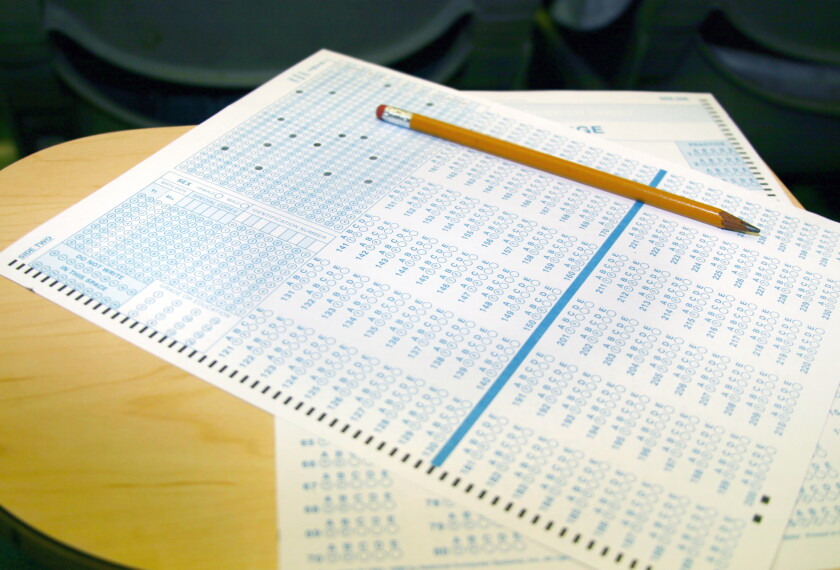
As for testing students for accountability purposes, criterion-referenced exams, which test students on the curriculum they’ve been taught, will most likely be given from kindergarten through 8th grade. High school students would take end-of-course tests.
Gwinnett County, the state’s largest school district, has received attention for establishing its own accountability system and was praised for its efforts by the state school board.
The 103,000-student district’s “gateway” tests, which will count for the first time next spring for student promotion, will be given in grades 4, 5, 7, 8, and 10.

|
Under the Gwinnett County plan, the test results will be used to make judgments about whether students advance to the next grade—a policy that has sparked outrage from some parents concerned that otherwise good students may perform poorly on the high-stakes test and be held back. In response to those concerns, the district school board set cutoff scores lower than those recommended by teachers; the passing scores will increase gradually over five years.
An appeals process is in place and the board approved an automatic review procedure that will apply to 4th and 7th graders who make C’s or better but fail the gateway test.
A ‘Giant Step’
The committee of Gov. Barnes’ commission that focused on creating a more “seamless” educational system in the state has also made recommendations, including getting rid of the state’s two different diplomas (college track and technology-career track) and replacing them with one diploma that “reflects a combination of rigorous academic and career-related courses,” according to the committee.
Of all the areas within the purview of the governor’s commission, the least is probably known about how the state’s school funding formula, in place since the 1980s, might be changed. Gov. Barnes made clear to panelists that adding taxes to the budget is not the answer.
“They need to address equity, and they do not have the money to do it well,” said Franklin Shumake, a former state education department official who publishes a newsletter about the commission’s work. “If you redefine equity now, there are going to be winners and losers.”
The commission is scheduled to hold its final meeting Dec. 16, after which a final report will be released.