Special Education Photo Essay

Students Making Connections Through Art

By Education Week Photo Staff — June 03, 2014 3 min read
  • Save to favorites
  • Print

Emile Wamsteker, a West Orange, N.J.-based photographer, spent a day at PS4Q @ Skillman, a school for students with severe cognitive and behavioral disabilities in New York City’s special education district. Below, he describes the experience of watching students work on both social and academic skills through music and movement–and how this changed his own perceptions. For more on the arts program used at the school, read the full Education Week story.

Special education teacher Elizabeth Rosenberry, right, holds hands with student Zachary Zayas in an effort to make eye contact with him, at PS4Q in the borough of Queens, N.Y. Rosenberry starts the class by engaging each student individually, while demonstrating to the other students how to make eye contact. Much effort is devoted to getting students to become socially engage with each other. New York City’s district 75, in conjunction with the Urban Arts Partnership, received a five-year, $4.6 million i3 grant in 2010 to implement an arts-integration professional-development program, known as Everyday Arts for Special Education (EASE). Through the program, teachers are mentored by teaching artists and receive ongoing, in-class support. A researcher from Teachers’ College says there’s evidence EASE has helped improve students’ academic, socialization, and communication skills.

I was excited when asked to shoot a story for Education Week on a professional-development program for special education teachers. I visited two classes at PS4Q in Long Island City, N.Y., that would demonstrate what some of the teachers have learned in the seminars and workshops put on by Everyday Arts for Special Education (EASE). In one 4th grade class, students did an activity called “kinesthetic matching,” in which they performed tasks with an emphasis on movement. And in a unique music class, 2nd graders learned the rudiments of music using a simple plastic tube called a “boomwhacker” to play along.

Special education teacher Elizabeth Rosenberry, right, makes eye contact with Ian Tokay through a “boomwhacker”at PS4Q in the borough of Queens, N.Y.

When I arrived at teacher Stephen Reese’s class for kinesthetic matching, I saw in 4th grader Andy Severino a reluctance to join his classmate Wynston Lavache, who’d selected him as a partner. Reese gently prodded and then pulled Andy up from his chair. Eventually Andy acquiesced, joining his partner to perform a sequence of movements in front of the class. They were asked to walk toward one another, stop a couple of feet apart, look each other in the eye, and do a high-five. Whatever reservations Andy might have had about doing this were no longer evident as he performed the sequence flawlessly. Immediately following, he bounded around the room like a baseball player rounding the bases after hitting a home run. Reese and paraprofessionals Dina Adames and Hernan Torres cheered the student on as he eventually settled on the lap of Adames, hugging her.

Student Andy Severino is hugged by a teaching assistant after completing a kinesthetic matching exercise at PS4Q in the borough of Queens, N.Y. New York City’s district 75, in conjunction with the Urban Arts Partnership, received a five-year, $4.6 million i3 grant in 2010 to implement an arts-integration professional development program, known as Everyday Arts for Special Education (EASE). Through the program, teachers are mentored by teaching artists and receive ongoing, in-class support. A researcher from Teachers’ College says there’s evidence EASE has helped improve students’ academic, socialization, and communication skills.

Reese structures each task in a way that considers the varying abilities of each student. For example, nonverbal students make use of an iPad to identify the corresponding image of a word seen on a flash card, whereas verbal students will say the word aloud. There are a number of tasks, all of which require following a set of instructions—including one where they walk, run, jump, or dance from one X marked on the floor to another.

Student Debangshu Chakravorty, right, reacts as he reaches an X marked on the floor as part of a kinesthetic matching exercise at PS4Q in the borough of Queens, N.Y. Pictured on left, peering into a photographer’s lens is Jeremy Betancort.

While Reese uses movement as the context for kinesthetic matching, Elizabeth Rosenberry uses music. And while the contexts are different, the approach is the same, with a common goal of helping the students improve their ability to communicate, socialize, and learn. The key to this is building confidence and reinforcing the most basic form of human social connection—eye contact, a skill that many children with severe disabilities, especially those with autism, are known to lack. So every time Rosenberry begins her class, she takes the time to prime each student individually, locking arms with them, and engaging them through eye contact. As she makes her rounds, the other students see this demonstration repeated over and again. Eventually, they are asked to engage one another.

Like Andy, the child, in Reese’s class, not all the students are initially thrilled, but with sustained encouragement from Rosenberry and the paraprofessionals, all of them eventually overcome their fears and engage one another. And their reward? Boomwhackers! Needless to say, there wasn’t a bored kid among them, as they followed Rosenberry’s lead, mimicking her actions as she rhythmically beat the soft plastic instrument.

Special education teacher Elizabeth Rosenberry, right, encourages student Jesus Torres-Tiamani, left, to make eye contact, at PS4Q in the borough of Queens, N.Y. Also pictured is student Ian Tokay, center.

Before I went on this assignment, I came across a quote by Helen Keller. She said, “Although the world is full of suffering, it is also full of overcoming it.” The meaning of that statement really didn’t sink in, that is until the children, teachers, and paraprofessionals of PS4Q showed me its true meaning.
Related Tags:

A version of this article first appeared in the Full Frame blog.

Events

Artificial Intelligence Webinar AI and 'Techlash' Are on a Collision Course. How Should Schools Respond?
Learn what strategies and tactics schools can develop to encourage smart and responsible AI use, while also enforcing tech guardrails.
This content is provided by our sponsor. It is not written by and does not necessarily reflect the views of Education Week's editorial staff.
Sponsor
Special Education Webinar
Special Education Disputes & Rising Costs: Protecting Your District
Special education costs and risks are rising. Learn how stronger IEP and Medicaid processes help districts protect funding and compliance.
Content provided by Relay
This content is provided by our sponsor. It is not written by and does not necessarily reflect the views of Education Week's editorial staff.
Sponsor
Personalized Learning Webinar
Differentiation That Delivers: Proven Practices From High-Growth Districts
Make every minute count. Proven strategies from educators and leaders driving real student growth. Save your seat!
Content provided by i-Ready, Curriculum Associates

EdWeek Top School Jobs

Teacher Jobs
Search over ten thousand teaching jobs nationwide — elementary, middle, high school and more.
View Jobs
Principal Jobs
Find hundreds of jobs for principals, assistant principals, and other school leadership roles.
View Jobs
Administrator Jobs
Over a thousand district-level jobs: superintendents, directors, more.
View Jobs
Support Staff Jobs
Search thousands of jobs, from paraprofessionals to counselors and more.
View Jobs

Read Next

Special Education Little Chefs, Big Gains: Students With Disabilities Cook Toward Independence
Cooking helps the elementary students learn counting, build fine motor skills, and practice emotional regulation.
3 min read
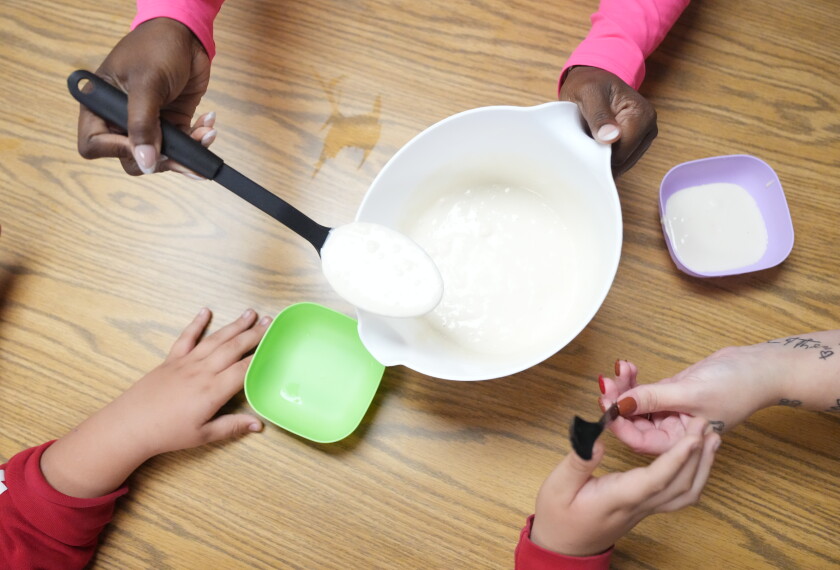
Students get waffle mix for a chicken and Waffles cooking day in the classroom of Gabrielle Carpenter at the Daniel Webster School in Indianapolis, Friday, Oct. 2, 2026.
Students prepare waffle mix in Gabrielle Carpenter's special education classroom on Oct. 2, 2026, at Daniel Webster School 46 in Indianapolis. Carpenter uses the biweekly cooking lessons to teach the students independence, along with skills like counting and measuring.
AJ Mast for Education Week
Special Education Cameras in Special Ed. Classrooms: Safety Measure or Privacy Invasion?
Cameras don't address insufficient teacher training, inadequate staffing, and poor behavior policies.
7 min read
A photo showing a CCTV security eye style camera monitoring students in a classroom. The classroom is blurred in the background while the camera is in focus.
iStock/Getty
Special Education Spotlight Beyond the Diagnosis: Helping Students With Dyslexia Thrive
Explore what educators need to know about dyslexia—and how the right support can help students build confidence and thrive.
Special Education New Federal Guidance Could Roll Back Special Ed. Transition Services
New DOJ guidance threatens high school transition programs meant to help disabled students live independently.
3 min read
Lois Curtis, left, addresses a group at the state Capitol in Hartford, Conn., to observe the 10th anniversary of a U.S. Supreme Court ruling that qualified patients have the right to receive community-based care rather than to be institutionalized. Curtis was one of the to plaintiffs in the suit, Olmstead v. L.C. and E.W.
Lois Curtis, left, addresses a group at the Connecticut state Capitol in 2009 to mark the 10th anniversary of <i>Olmstead</i> v. <i>L.C.</i>, a U.S. Supreme Court ruling stemming from a lawsuit in which she was a lead plaintiff that established qualified patients' right to community-based care over institutionalization. In June, the U.S. Department of Justice stated it “will not rely upon the <i>Olmstead</i> Guidance in its enforcement” of the Americans with Disabilities Act, a move that advocates fear could upend transition planning for K-12 students who have disabilities.
Bob Child/AP
