Recent findings of the Trends in International Mathematics and Science Study, or TIMSS, show that although U.S. 4th and 8th graders scored above the international average on both mathematics and science assessments, its relative position compared to other countries did not change much over time, with the U.S. still lagging far behind top-performing countries. With these results, federal and state education officials may be concerned with the quality of teaching in these subjects.
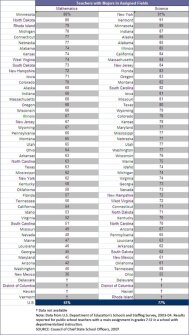
Technology Counts 2008, which examined Science, Technology, Engineering, and Mathematics, or STEM, reports that in the 2003-04 school year, 61 percent of mathematics teachers (grades 7-12) had majored in mathematics, while 77 percent of science teachers (grades 7-12) had majored in their subject area. For mathematics, Minnesota is ranked top with 86 percent, while New Mexico had the lowest rate of 36 percent. For science, New York had the most teachers with majors in-subject with 91 percent, and Ohio had the lowest rate of 55 percent.
For more state-by-state data on STEM education and other topics, search the EPE Research Center’s Education Counts database.