Special Report
Classroom Technology

Google Docs Fuels Shift to Collaborative Classroom Writing

By Michelle R. Davis — June 12, 2017 3 min read
  • Save to favorites
  • Print

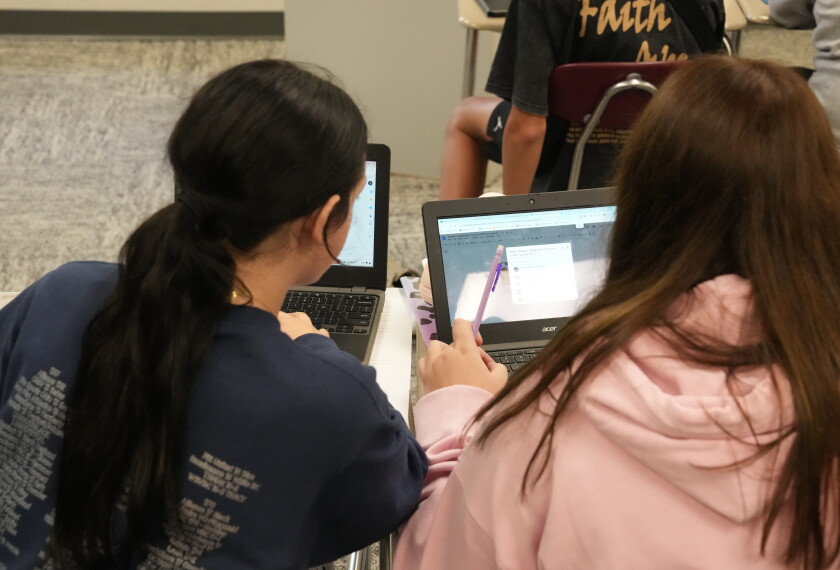
Collaborative tools, and Google Docs in particular, have shifted the way students write, collaborate, and get feedback and editing from teachers. It’s the first thing nearly all teachers interviewed for this story mentioned when asked about the use of educational technology in literature and writing instruction.

“Google Docs and the whole G Suite system for English classrooms is revolutionizing the way we interact with each other and create,” said Bill Bass, the innovation coordinator for instructional technology, information, and library media for the Parkway school district in Chesterfield, Mo., and a former English teacher. “That collaboration is key to helping kids make authentic connections with text and information.”

Allowing teachers to provide electronic feedback within text—instead of “red-lining” papers—paves the way for more transparent revisions and more targeted comments, said Kristen Hawley Turner, the director of teacher education at Drew University in New Jersey and the co-author of several books about ed tech and reading, including Connected Reading: Teaching Adolescent Readers in a Digital World.

Turner added that the ability for students to work with each other is just as important.

Group work extends to social-annotation tools, too, said Troy Hicks, a professor of English and education at Central Michigan University and the co-author of Connected Reading. Digital resources like NowComment allow teachers to upload texts and have students highlight, add questions, and create discussion threads with other students.

In a related vein, peer-review tools are also playing an important role. Sites like Eli Review and Writable—Hicks has consulted for both—support the peer-review process, provide step-by-step supports, and encourage effective feedback strategies, Hicks said.

Technology has also enabled personalization in english/language arts. Students have new ways of communicating knowledge, through presentations that might incorporate text, infographics, photos, and video.

Students now have “multiple mediums and modes of creation and consumption that have changed the landscape,” Bass said. Creating movie trailers as book reviews is one example.

However, many English teachers still have concerns that overuse of multimedia can have the effect of dumbing down students’ writing.

The use of personalized digital products is also expanding. Commercial products, like Renaissance Accelerated Reader 360 and LightSail, make it easy for teachers to deliver the same texts but at different reading levels or to customize reading and writing assignments based on those levels. Web-based Newsela, for example, offers daily news articles adapted to reading levels in English and Spanish. Adaptive products like READ 180, which assesses students then provides customized exercises and lessons, are also gaining in popularity.

But teachers need to ensure that adaptive and customized resources push students to read “outside their comfort zones,” Hicks said. “We still want to introduce students to challenging texts.”

One of the biggest struggles for teachers these days is the unreliability of digital tools and infrastructure, Turner said. “Technology fails. If your entire lesson is about students peer-reviewing and writing in Google Docs and the Wi-Fi goes down, you’re up a creek.”

Bass said he sees a future that allows students many more options for reading, writing, and collaborating, and a structure that permits them to choose how to approach the subject. That may mean augmented-reality and video-reality tools with 360 video for telling stories and the ability to communicate and collaborate in “multiple modes.” There’s likely to be more reliance on digital content—from e-books to streaming video. “We’re going to ask kids to interact with the content in many different venues,” he said.

Related Tags:

Coverage of learning through integrated designs for school innovation is supported in part by a grant from the Carnegie Corporation of New York at www.carnegie.org. Education Week retains sole editorial control over the content of this coverage.
A version of this article appeared in the June 14, 2017 edition of Education Week as English Language Arts: Google is opening the doors for interactive writing lessons

Events

This content is provided by our sponsor. It is not written by and does not necessarily reflect the views of Education Week's editorial staff.
Sponsor
School Climate & Safety Webinar
Building Your School Safety Roadmap: Key Priorities for the Upcoming Year
What should be on your school's safety roadmap this year? Join experts to discuss priorities, preparedness, and best practices.
Content provided by Evolv Technology & IdentiSys
English Learners K-12 Essentials Forum Rethinking Instruction for English Learners
Join this free event to explore teacher preparedness, family communication, and strategies to ensure equity and opportunity for students.
This content is provided by our sponsor. It is not written by and does not necessarily reflect the views of Education Week's editorial staff.
Sponsor
Artificial Intelligence Webinar
From Passive to Active Reading: Student Engagement in the Age of AI
What the research tells us about active reading and student engagement—and what it means for teaching in an AI-enabled world.
Content provided by Pearson

EdWeek Top School Jobs

Teacher Jobs
Search over ten thousand teaching jobs nationwide — elementary, middle, high school and more.
View Jobs
Principal Jobs
Find hundreds of jobs for principals, assistant principals, and other school leadership roles.
View Jobs
Administrator Jobs
Over a thousand district-level jobs: superintendents, directors, more.
View Jobs
Support Staff Jobs
Search thousands of jobs, from paraprofessionals to counselors and more.
View Jobs

Read Next

Classroom Technology Are Teens Starting to Accept Cellphone Bans? A New Survey Has Answers
Researchers surveyed teens and adults on how well school cellphone policies were enforced over the course of a school year.
5 min read
Students use their cellphones as they leave for the day the Ramon C. Cortines School of Visual and Performing Arts High School in downtown Los Angeles, Aug. 13, 2024.
Students use their cellphones as they leave the Ramon C. Cortines School of Visual and Performing Arts High School in downtown Los Angeles on Aug. 13, 2024. A new set of surveys of teen attitudes toward school cellphone restrictions shows growing acceptance of the policies by those most directly affected.
Damian Dovarganes/AP
This content is provided by our sponsor. It is not written by and does not necessarily reflect the views of Education Week's editorial staff.
Sponsor
Classroom Technology Sponsor
Closing the Vision-to-Execution Gap: What the Archdiocese of New York Learned About Classroom Technology
Reliable classroom technology helps teachers teach without disruption, students explore ideas, and schools turn learning goals into action.
Content provided by ASUS
A student stands at the front of a classroom presenting with a laptop, while a digital whiteboard displays text behind her. Other students are seated and working on laptops.
Photo provided by ASUS.
Classroom Technology Opinion The Big Flaw With Ed-Tech Tutoring Isn't Technological
Before focusing on the technology, we need to redesign the learning model, Michael Horn argues.
•
4 min read
The United States Capitol building as a bookcase filled with red, white, and blue policy books in a Washington DC landscape.
Luca D'Urbino for Education Week
Classroom Technology Q&A Students’ Tech Engagement Doesn’t Equal Learning, Psychologists Warn
A panel of psychologists shares recommendations for ensuring technology promotes meaningful learning.
6 min read
DSC03088
Students at a high school in Plymouth, Ohio work on how to properly prompt the Gemini AI app on Aug. 28, 2026. A new report of the American Psychological Association warns that student engagement with tech apps should not be conflated with benefits for learning.
Ruddy Roye for Education Week