Look beyond the astonishingly high class sizes and troubled rollout, say Rocketship Education officials, and you’ll see that “flexible classrooms” are a blended learning upgrade featuring more differentiated instruction, increased teacher collaboration, and better-integrated technology.
Here’s how the charter operator’s new instructional model looked in action at Rocketship Mateo Sheedy Elementary in San Jose, Calif. on a recent chilly morning:
On one side of the large, rectangular 4th grade classroom, teacher Juan Mateos leads a lesson on identifying figurative language. He projects a poem about California earthquakes on to a screen: “Palm trees begin to sway all by themselves / Here, the earth likes to dance, cha-cha-cha.”
Twenty-two students—grouped together based on their similar academic abilities, which put them in the middle of the classroom pack—are gathered on a carpet, reading along. At Mr. Mateos’ instruction, they turn to classmates and debate whether the poem is a metaphor or an example of personification.
Twenty yards away, teacher Jason Colon works with 22 of the school’s most-advanced 4th graders, also grouped according to ability. The children sit in pairs, facing each other across their desks, binders upright between them. To keep this ambitious lot engaged in his math lesson about graphing coordinates, Mr. Colon has the children create their own x- and y-axes, plot “battleships,” and attempt to sink each other’s fleets—a creative twist on the classic board game.
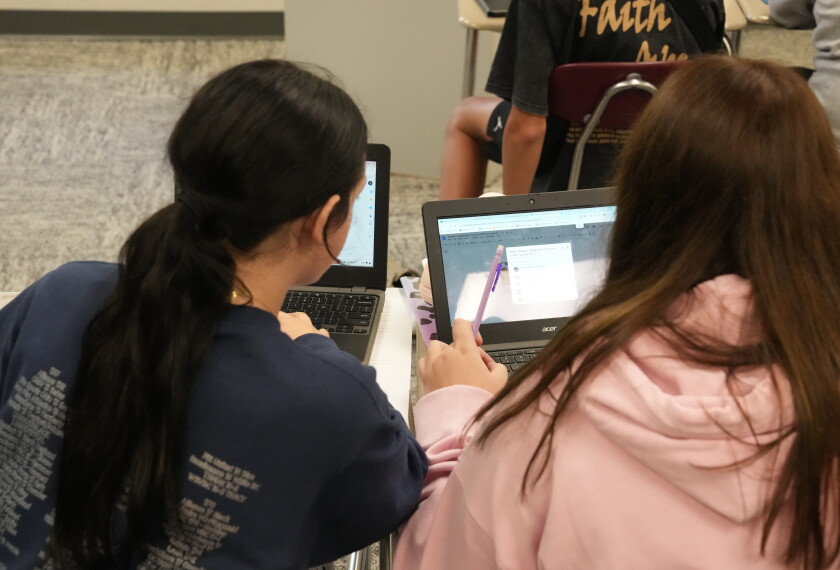
And in the middle of the room, Mateo Sheedy’s lowest-performing 4th grade students are split among several learning stations. Twenty-five children sit in front of laptops, while 17 others work independently at small tables.
Michael Yeung, a 25-year-old “individualized learning specialist,” who makes roughly $15 an hour, attempts to oversee it all—while also working from a scripted curriculum to help four students learn letter sounds.
When the children rotate stations, Mr. Mateos adapts his lesson to push the more-advanced students to write their own figurative language, while Mr. Colon shelves the Battleship activity in favor of reteaching struggling students an earlier lesson on converting fractions to decimals. The middle performers now work on computers.
“The biggest difference,” said Mr. Mateos, a 27-year old Teach For America alum, “is how targeted our instruction is.”
Under Rocketship’s old “station rotation” blended learning model, still used in early grades, class sizes are more traditional, and students of mixed abilities rotate from regular classrooms to stand-alone “learning labs,” where they receive computer-assisted instruction. Rocketship officials say that under that model, it’s difficult to address the needs of top- and bottom-performing students—a challenge many schools face.
With the new flexible classrooms, the goal is to do a better job of providing personalized instruction to students at all levels. As a result, teachers’ duties have changed dramatically.
Mr. Mateos is now a specialist, focused on teaching each reading and language arts lesson in three different ways.
He’s also become a salesman, helping persuade worried parents to embrace the idea of a single class with 92 students.
And as the grade-level lead in the school’s flexible 4th grade classroom, Mr. Mateos has become a quasi-administrator, helping support the two colleagues with whom he now shares his workday.
“It’s intense,” he said.
Read a related story: Growing Pains for Rocketship’s Blended-Learning Juggernaut
Challenges remain: It’s been difficult to regroup the students more frequently than every six weeks, limiting the personalization that can take place. During the recent morning at Mateo Sheedy, one child working in the online learning station neglected to log in to his computer, sitting for 15 minutes before anyone noticed, while another pulled his arms inside his shirt and drifted off.
“Keeping track of what’s happening and classroom monitoring has been a struggle,” said Mr. Yeung, the classroom aide.
Still, the organization is bullish about its new blended learning model, said Lynn Liao, Rocketship’s chief programs officer.
“We think this is a path for thinking more openly about technology, teaching, and instructional time, and the fundamental structure of schooling,” Ms. Liao said.