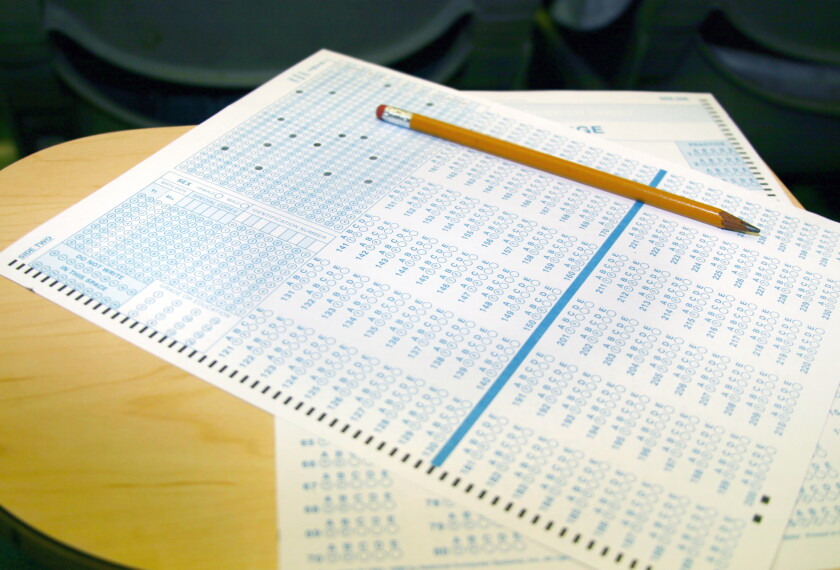
The release of New York state test scores showing steep plunges in mathematics and English/language arts proficiency from last year has state officials and educators grappling with the growing influence of the common core on standardized-test performance.
Education officials in the Empire State say this year’s scores, released Aug. 7, on tests aligned for the first time to the Common Core State Standards, give schools a more accurate and honest picture of whether students are being adequately prepared for both postsecondary studies and the labor market.
But others in the K-12 community believe that as common-core-aligned tests roll out over the next several years, such scores will be used to attack educators, and ultimately hamper students’ development. The process, they say, shows that there is a focus on standardized testing that is hollow and pernicious.
Two other states, California and Wyoming, that released their state assessment results the same week as New York attributed declining scores in part to the common core, even though the degree to which the standards were integrated into their tests varied.
Big Drops, Persistent Gaps
Infographic: Explore changes in New York’s 3-8 proficiency rates.
The proportion of New York students in grades 3-8 deemed “proficient” in English/language arts fell from 55.1 percent in 2012 to 31.1 percent for the 2012-13 school year. In math, the drop was even steeper, with the proficiency rate falling from 64.8 percent to 31 percent.
Among subgroups, only 20.6 percent of economically disadvantaged students scored at the proficient level in math, compared with 53.3 percent a year ago. Significant achievement gaps also persisted on the new tests, although in English, the gaps actually shrank somewhat: The performance lag between black students (16.1 percent proficient) and white students (39.9 percent) was actually smaller than in 2012, when the gap was 29.2 percentage points. Gaps between Hispanics and whites in both English and math also declined.
Only 23.1 percent of charter school students were proficient in English in grades 3-8, compared with 31.1 percent of all public school students. In math, however, charter and regular public school students posted almost identical proficiency rates of around 31 percent.
In a news conference to release the scores, New York state education Commissioner John B. King said the numbers should serve as a wake-up call, but not a reason to panic.
“We wouldn’t be better off if we tried to persuade ourselves that students are ready when they’re not,” he said.
Despite the low scores, there will actually be less emphasis on test preparation in New York in the future, and more on curriculum and instruction, New York state board of regents Chancellor Merryl H. Tisch told reporters.
“We knew this would be hard. This is not a small change in what we’re expecting of kids. But it’s the right thing,” said Chris Minnich, the executive director of the Council of Chief State School Officers, which oversaw the development of the common core along with the National Governors Association.
But United Federation of Teachers President Michael Mulgrew said that New York City’s teachers lacked the proper curriculum for the common core and that students struggled to deal with the six-day test administration.
Morna McDermott, an administrator with United Opt Out National, which opposes high-stakes testing, said the exams are part of what makes the common core a “Trojan horse” for education policy changes, such as teacher evaluations pegged to student test scores and holding students back based on reading-exam results.
“I’ve never seen children pull themselves out of poverty because they had better tests,” Ms. McDermott said.
States in Transition
Links between the new standards and test scores are being cited by other states as well, although the connections are not always clear.
On Aug. 8, California reported slight declines for grades 2-11 on its Standardized Testing and Reporting, or star, exams in English and math.
In a statement, schools Superintendent Tom Torlakson said the declines—the first time in several years that scores did not rise on both tests—were in part the result of schools’ “transition to the Common Core State Standards.” However, the star assessments weren’t altered to reflect the standards this year.
Wyoming also reported declines on its state assessments in English and math.
Richard Crandall, the state’s education director, said that the test items for the 2012-13 academic year were “more closely aligned” with the common core than the previous year’s tests, and that next year, all test questions will be related directly to the common core.