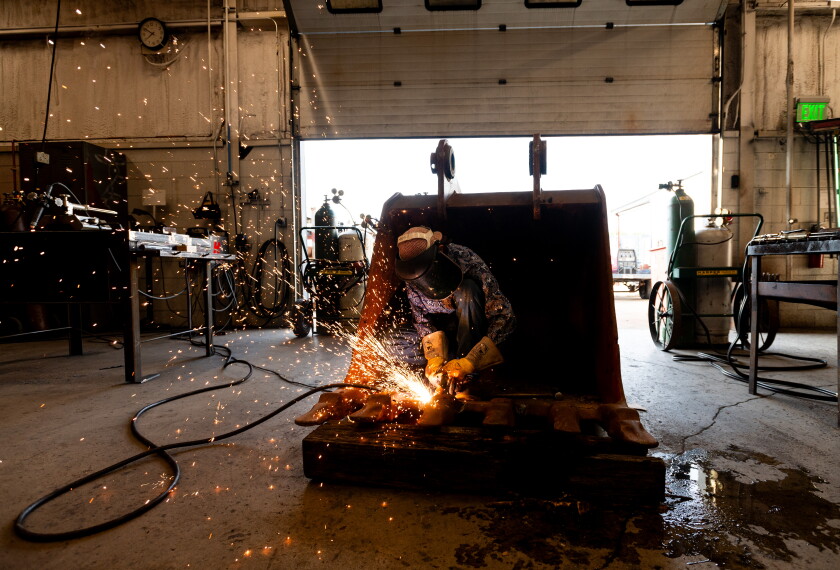
Every student at Wheeling High School takes a full academic courseload. But many of the graduates of this 2,000-student school in Wheeling, Ill., also emerge with significant experience in a career field.
Those interested in health careers, for example, can work with student-athletes in the school’s athletic-training facility, earn a Certified Nursing Assistant credential, and intern at a nursing-care facility. They have the option of taking electives in Advanced Placement Psychology or sports medicine.
But in the mind of the school’s principal, it’s the career exposure that matters most, whether a student ends up a doctor or physical therapist. “There’s no dead end. There’s a significant experience to help kids figure out if this is really what they want to do,” Principal Lazaro Lopez said.
The Wheeling model represents one of the options that Illinois and a number of other states are taking steps to replicate.
For a related story, see “Swiss Academic and Career Paths Designed to Cross,” (April 24, 2013).
The arrangement is a highly complex undertaking: Mr. Lopez manages more than 50 industry partners for an advanced-manufacturing pathway alone. (It’s in the process of creating 12 paths in all). The best examples hinge on substantive relationships between industry officials and educators, always tricky.
Drawing in part on the practices of other countries, states want such pathways to make high school more relevant; inform students of the options that await after they remove their caps and gowns; and, most importantly, engage youths in challenging courses that don’t close the door to higher education.
Fresh Catalyst
The renewed emphasis on job preparation in Illinois appears to be catching on nationally, too.

In his State of the Union address, President Barack Obama pointed to the German system of work apprenticeships. His fiscal 2014 budget request seeks some $300 million in grants to tighten the links between high school and careers.
While most of the state action has been in development for some time, an influential 2011 report issued by the Harvard Graduate School of Education also helped catalyze some of the new activity. It contended the “college for all” push has not served some students, and since its appearance, eight states have committed to setting up high-quality pathways, in partnerships with Harvard and Jobs For the Future, a Boston-based nonprofit group.
States are in different stages of their work. Officials in Tennessee, for example, are working to begin career education as early as 7th grade and have begun to finance some regional projects to knit together courses of study.
In New York, Gov. Andrew Cuomo recently announced plans to designate 10 more schools to follow the example of the Pathways in Technology Early College High School, formed through a partnership between public education and IBM.
Georgia’s state board of education this month approved standards for “foundational” courses across 17 broad career clusters, such as energy and information technology. All freshmen will be required to take at least one and encouraged to continue a sequence as they progress through high school.
Georgia, Illinois, New York, and Tennessee are all participants in the Jobs For the Future network, as are California, Massachusetts, Missouri, North Carolina, and Ohio.
While the idea of building career-related pathways in high schools is an old one, participating states highlight several new areas of focus, many of them rooted in lessons drawn from European systems of work-based learning.
For one, proponents of the approach say, pathways should be tightly linked to labor demands and careers that are likely to be in demand, as pathways are abroad.
“The majority of jobs in this area are in advanced manufacturing and health care—that’s the bottom line. And the shortages exist in those areas,” said Lillian Hartgrove, a vice president for the Highlands Initiative, a four-county economic-development project in the Upper Cumberland region of Tennessee. The project is crafting pathways in those two fields and planning a third in information technology.
Second, advocates say all students should have the flexibility to change paths without forgoing the academic credits needed for entry to two- or four-year institutions.
At Wheeling High, Principal Lopez recounts that the health pathway encouraged one young woman to enroll in AP Biology, while another realized that she didn’t want to deal with blood and chose another direction. “And both are successes. It doesn’t cost them anything at this stage to switch between pathways,” he said. “It’s always based on their interest.”
Finally, states are grappling with how to provide students with intensive work-based learning experiences. Of all the challenges facing states, that may be the toughest.
In the words of Mr. Lopez: “How do you get not one or two, but hundreds of kids a real experience in a field they’re interested in? In fine arts, I want kids to be curating in museums or working with studio musicians. Those are the pieces that are harder to fit.”
A Role for Business?
Business engagement is one area in which many of the state partners have looked to the Swiss model. In that country, professional associations play a quasi-governmental role in helping to outline the competencies students need to master in each occupation, helping keep training consistent and uniform.

In the United States, by contrast, “we tend to involve business and industry mainly monetarily,” said John D. Barge, Georgia’s schools superintendent. “We need to do more than ask them for money, such as involving them in the development of curriculum, problem-based learning, and the evaluation of student skills.”
And industry certifications in the United States often are proprietary, not shared across an occupation.
“We have folks on these [advisory] boards everywhere, but there is no standardization or uniformity to our approach,” said Jason A. Tyszko, the deputy chief of staff for the Illinois commerce and economic-opportunity department, a partner in the Illinois STEM Pathways project, a public-private venture to engage more secondary students in jobs in the high-growth fields of science, technology, engineering, and mathematics. “Everyone is talking about different standards, different skills, different credentials.”
That’s partly why one major part of the project is the creation of eight “learning exchanges,” one for each broad area such as agriculture and the IT fields, that will serve a role similar to that of the Swiss professional associations. The exchanges will act as intermediaries with companies to develop curricula, expand access to lab space and equipment, train educators, and provide feedback on current course sequences and structures, Mr. Tyszko said.
Illinois is supporting the exchanges with part of its $43 million grant from the federal Race to the Top competition, but funding is an issue for most of the states.
State policymakers acknowledge it probably isn’t feasible for most U.S. high school students to experience an extended, Swiss-style apprenticeship, but they do believe that efforts could be better than the typical “career day.”
In Tennessee, the public and private partners in the Upper Cumberland project are discussing whether it’s feasible, for instance, to use online learning so students can see an interactive knee surgery, Ms. Hartgrove said.
Mr. Tyszko said businesses could also facilitate more relevant experiences by sponsoring competitions in which students are asked to solve a real-world problem of interest.
Under an Illinois pilot project, for example, Abbott Laboratories, a health-technology firm, sponsored a design contest for high school students in which they analyzed different forms of HIV testing and conceived new ideas to improve dissemination of testing and treatment in rural areas of the world.
Tracking Specter
State officials are also having to be creative with sources of money.
Danielle Mezera, the assistant commissioner for career and technical education for Tennessee, has repurposed a state reserve fund under the federal Carl D. Perkins Career and Technical Education Act into a competitive-grant program. The state offers extra money to regions, among them Upper Cumberland, that meet specific criteria related to the pathways work.
Among other steps, the state is pressing regions to consider closing old career and technical programs that no longer lead to in-demand jobs. That’s difficult, in part because much of the information districts report as part of the Perkins Act, which supports both high school and community college programs, is incomplete, leading to a degree of unreliability, Ms. Mezera said.
“If you are very diffuse in how you approach your program, if you’re scattering the opportunities, you’re essentially providing pathways that will lead to nothing,” she said. “If you are more focused in what you are going to offer, you’re able to shift your resources accordingly to actually grow that intentional focus.”
For all the excitement over the new initiatives, the work raises the specter of old wounds, too. State officials scrupulously avoid the word “tracks” to describe work-based learning opportunities because of its associations with old-school shop and welding classes reserved for less academically capable students.
The debate still seethes, most recently in Texas, where lawmakers are considering rolling back some graduation requirements in the name of giving students more career options.
For critics like the Washington-based Education Trust, an advocacy group for disadvantaged students, the focus on pathways risks re-creating a system in which students of color are disproportionately led toward less rigorous curricula and weaker instruction.
So far, that hasn’t been the case at Wheeling High. Graduation figures show that roughly 90 percent of students go immediately on to postsecondary education, with about 55 percent of that figure going to a two-year college and the remainder to four-year schools.
“I never tell my kids what their future needs to look like,” Mr. Lopez said. “My job is to help give them options. When you cross the stage and shake my hand on the day of graduation, I want you to have a number of doors open, so you say, ‘Which do I want to go through first?’ ”