The Rev. Martin Luther King Jr. once famously said, “Change does not roll in on the wheels of inevitability, but comes through continuous struggle.” Though he was speaking about the road to true equality for all people, I have often applied this quote to the role of education in America, particularly public education for K-12 students. Despite the quickness with which our society has become accustomed to having everything, all at once, education reform is still a slow-turning gear in the great machine of time.
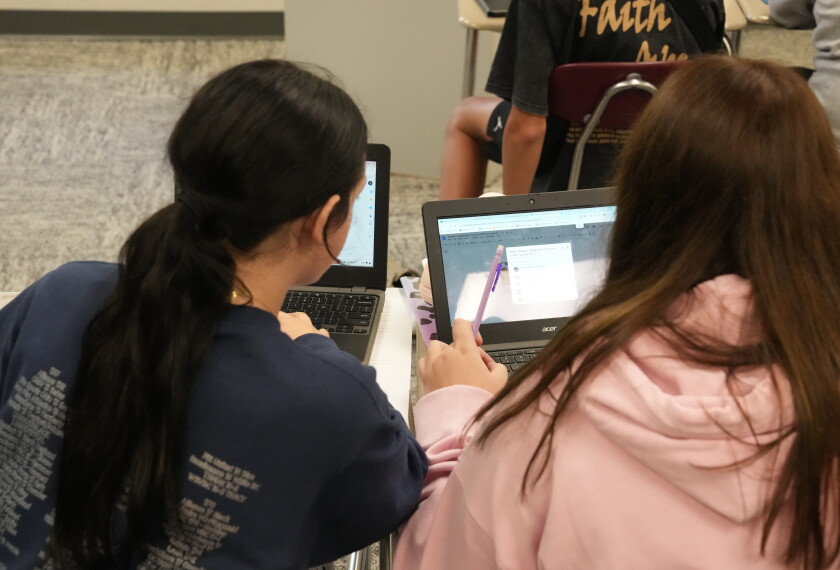
The truth is that the face of K-12 education is in a constant state of change. Educators who have been in the field for several decades may notice that the pace at which changes in methodology and student demographics occur today is much faster than in the past. Many factors play into this phenomenon, but none as strongly as technological advancements. The Internet, wireless devices, and improvements in communication all heighten the immediacy for information both within and outside the classroom.
This is both a blessing and a curse, of course. It is really too soon to tell if the first Internet-raised generations will fare better or worse in life and succeed on a global scale. The assumption is that technology equals improvement, and I would argue, overall, that is true. More access to information and a shrinking world can only benefit students. The children graduating from high school in the next decade will have a broader view of the world than ever before, thanks to traditional geographic boundaries losing their hold in the areas of communication, employment, and learning. I take no issue with the actual technology. It is great. Where I see existing and potential problems is in the indirect effects of technology on the comprehension habits of our youngest learners.
You have to look at the overall influence of rapidly advancing technology to realize how it is also an obstacle to K-12 classrooms.”
You have to look at the overall influence of rapidly advancing technology to realize how it is also an obstacle to K-12 classrooms. In its broadest sense, technology has totally transformed the way our children view life. A recent study by Common Sense Media found that 72 percent of children age 8 and younger have computer access at home. Television use is almost universal, with 98 percent of children in this age group having at least one TV at home and 10 percent reporting that theirs is kept on all the time.
While television consumption by children is nothing new, programs targeted toward toddlers and even infants are on the rise. Consider the cable and satellite television venture BabyFirstTV. The channel plays continuous programming aimed at the very young. I bring this up not to spark a debate about whether this type of television viewing is helpful or hurtful to developing youngsters; I mention it as an example of just how ingrained screen culture has become in the lives of our kids.
The journal Pediatrics found that between birth and age 6, kids watch an hour and 20 minutes of television per day. These measurements do not even address indirect exposure, which puts the amount of time a television plays in the background at nearly four hours per day for kids ages 8 months to 8 years. Love it or hate it, screen culture is a foundational element of the contemporary American childhood.
As a result, our kids arrive at kindergarten with an advanced idea of instant gratification. They know that any game, program, or form of communication is available at the touch of a button. This easy access to everything translates to the way these children are programmed for learning, especially when moments of frustration arise. There is not a quick fix for everything, but most children have limited firsthand experience with waiting. It has always been difficult to keep the attention of students, particularly in the elementary set, but advancements like smartphones, electronic tablets, and websites directed at young learners have complicated this truth even more. Teachers and administrators today must find ways to keep students interested, but not completely abandon tried-and-true methodology. Thus, technology takes its toll on K-12 classrooms across the nation.
Phrases like “hitting the books” may soon be nonexistent as budgets for e-readers chip away at the book budgets for school libraries. An electronic book has a lot of appeal: It is cheaper to manufacture, lighter to carry, and even manages to reduce a student’s carbon footprint. Since students are so comfortable with touchscreen methods, it stands to reason that reading may actually come more easily when learned through an electronic device. The problem again is not that the technology harms the actual learning mechanics, but that it raises new issues about how one learns.
When we read for pleasure, most of us are seeking a form of transportation. We feel a special interest in a particular subject matter. Excitement. A chance to escape reality.
People who love to read have an interactive relationship with the material. Cracking open a fresh book is an experience unlike any other. Kids who are introduced to literature in the same way that they learn math problems, or have video calls with grandparents, or play noneducational games do not have the same reverence for reading, because it is nothing special.
I’ve heard the argument that it is not the delivery method but the content that matters in getting kids excited about reading, but I’m not sure I’m biting. Again, this is an issue that is still too young to judge definitively. It is just one instance of the indirect impact of rapidly advancing technology that keeps me up at night.
So what, then, is the answer? If technology is embraced by some and rejected by others, how can elementary and secondary school students be expected to know the right way to learn? It seems that the answers are about as clear as mud. I believe that technology has provided the swift kick that K-12 education has needed for decades to make the sweeping adjustments required to reach contemporary students and inspire education. I am just not sure yet which traditional teaching elements deserve to be clung to and which ones are meant for the curb.
The debate of how best to prepare our children for a lifetime of achievement is one I believe deserves constant attention in order to give young students the best shot at academic and life.