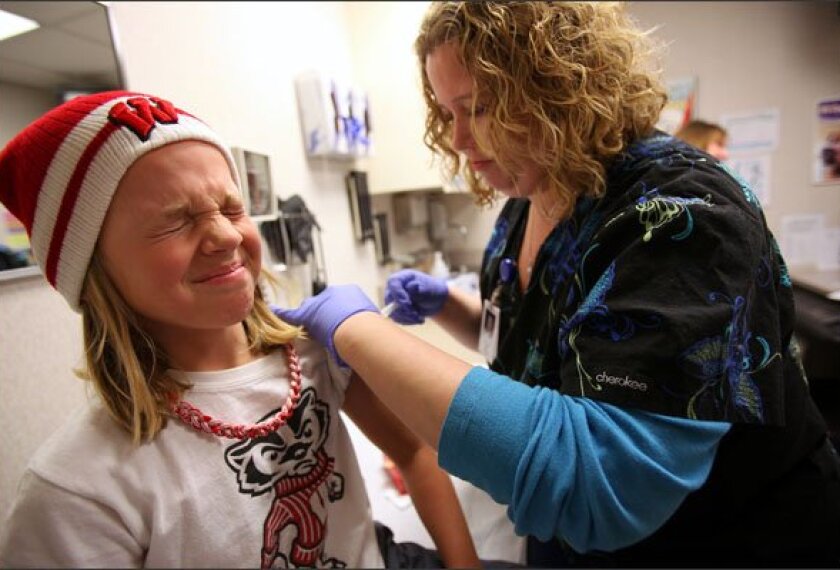
A rough flu season is prompting schools around the country to shut down briefly because dozens of students, in some cases, have the illness or something like it.
While no one tracks how many schools close because of the flu—or, in public-health parlance, “influenza-like illness"—stories of closures are cropping up nationwide. And flu season is only at about its midpoint.
“The bottom line is that the flu season continues. And it’s shaping up to be a worse-than-average season,” Dr. Tom Frieden, the director of the federal Centers for Disease Control and Prevention, said in a press call with reporters Jan. 18. “There’s still time to vaccinate, and ... early treatment is critically important.”
As of Jan. 18, 29 children in the United States had died because of the flu this season, the CDC said. While the virus is particularly deadly for children and adults with underlying medical conditions, some of the deaths were of healthy youths.
The strain of the virus making rounds now is the one that led to the deaths of 153 children during the 2003-04 flu season, Dr. Frieden said. “We’re only in the middle of our season, and even a single death in a child is one too many.”
At least three deaths this season were of teenagers and an infant in New Jersey. And a Maine 1st grader who had not been vaccinated died in early December.
Maine’s education and health departments issued an alert this month about outbreaks of influenza-like illness across the state, which have affected at least 17 schools and resulted in “substantial absenteeism.” The agencies encouraged schools to review policies on illness with staff members and schedule school vaccination clinics.
Closing a school is a local decision made by a school or district in connection with the local health department, said Curtis Allen, a spokesman for the Atlanta-based CDC. Schools must balance the risk of keeping children in school with the social and economic disruption caused by a closure, he said.
Vaccine Complications
In the 1,145-student Westville, Okla., school district, the tipping point was reached in mid-January, Superintendent Terry Heustis said. Two weeks before the winter break, Mr. Heustis said, his monitoring of student absences went into overdrive. After the holiday ended, the rate just kept rising.
By Jan. 16, 110 elementary students were absent, and another 20 went home sick during the school day. In addition, 12 staff members were absent and three more went home sick—including the school nurse. By 1 p.m. that day, Mr. Heustis said, 200 of his district’s students, or nearly 20 percent, were out because of some kind of illness.
“It wasn’t hitting us hard in the junior high and high school, but we all share one campus, one cafeteria, one library,” he said. “It was just a matter of time.”
Mr. Heustis consulted with the state and made the decision to shut the district down that Thursday and Friday. With a teacher work day scheduled for the following Monday, the closings would give students five straight days out of school—enough recovery time to allow absentee rates to return to normal.
Since the closure, the district scrapped an informal policy that kept children in school if they felt sick but weren’t running a fever.
“That policy probably didn’t help us out any,” Mr. Heustis said, because the flu can set in so quickly, sick people may feel fine in the morning and awful later, even if they have no fever at first. Now, “if you have flu-like symptoms,” he said, “we’re sending you home.”
Nearly every state already has reported widespread influenza activity to the CDC, triggering pleas from that and other agencies that people get vaccinated.
Part of the challenge is the nature of flu vaccine, which must be given yearly to be effective. That condition can make it seem like a chore for those who can’t be vaccinated at school or work. While the vaccine is free for many, cost may be another obstacle, said Mr. Allen of the CDC.
Vaccines also worry some people, and there’s a lingering myth about the flu vaccine.
“Some people feel that the influenza vaccine would give them the illness, and it does not,” Mr. Allen said, although it may trigger soreness and a slight fever that pales in comparison to the flu.
That minor discomfort is worth it, he said. “Influenza is much worse than a bad, bad cold,” he said. “You’re typically in bed sick for seven to 10 days.” And aside from feeling rotten, the illness has a sinister side. “Influenza can evolve into something much more serious,” Mr. Allen said. It leads to the hospitalization of 200,000 people and 3,000 to 49,000 deaths annually.
Another complication of the vaccine, which protects only against some strains of the virus, is that it takes about two weeks to become effective. Some people are exposed in that time and get sick anyway.
“Although the flu vaccine is far from perfect, it’s by far the best tool we have to prevent influenza,” Dr. Frieden said.
Health Centers’ Role
One way schools are trying to ensure more children and school employees are vaccinated is through school-based health centers. During the 2007-08 school year, the most recent for which data are available, 79 percent of those facilities across the country provided flu vaccinations to children and adolescents, according to the National Association of School-Based Health Centers, in Washington.
Ever since such a center opened four years ago at Perspectives Middle Academy in Chicago, the school has led flu-shot campaigns and offered students and employees free flu shots, said Tenisha Jones, who until recently directed the center.
Ms. Jones said offering the vaccine is a no-brainer.
“We want our kids at school,” Ms. Jones said. “We want our teachers well.”
![Teachers talk during lunch in the teacher’s lounge at Annunciation Catholic School in Minneapolis, Minnesota on Tuesday, May 5, 2026. ] LEILA NAVIDI • leila.navidi@startribune.com](https://epe.brightspotcdn.com/dims4/default/adfdcac/2147483647/strip/true/crop/3537x2400+32+0/resize/840x570!/quality/90/?url=https%3A%2F%2Fepe-brightspot.s3.us-east-1.amazonaws.com%2F4a%2F27%2Fa71ae6c64cbe887f40d2c3e1a063%2Fus-news-minn-annunciation-teachers-year-filepic-5-ms.jpg)


