Opinion
Reading & Literacy Letter to the Editor

Early Reading Intervention Makes Crucial Difference

August 08, 2011 2 min read
  • Save to favorites
  • Print

To the Editor:

There has indeed been an uptick in policy and advocacy toward the goal of getting more children reading on grade level by the end of 3rd grade, as described in “P-2 Years Targeted to Achieve Grade 3 Reading Proficiency” (Education Week, July 13, 2011).

Researchers and educators have known for years that 3rd grade reading proficiency is a critical milestone as children move to more-challenging learning tasks and must be able to comprehend, and apply, what they are reading across subject areas. More attention is rightly being paid to the importance of high-quality preschool programs, like one in Bremerton, Wash., that put children on the path to reading.

Early-education advocates are also aware that learning begins at birth, and that learning can be advanced by the healthy physical and social-emotional development of a child. In addition to formal early-education interventions, we must ensure that children reach all of the essential developmental milestones, beginning at birth, to get them ready for school and future academic success.

Those early-years experiences—which start with parents talking with their children and reading with them every day—lay the foundations children need to become skilled and avid readers later on. We need an approach that values and integrates the role of family, schools, and community providers.

In Connecticut, a number of communities are working to better align programs and services to ensure healthy social, physical, and cognitive development for all of our children along the continuum from birth through 3rd grade. The New Britain Early Childhood Collaborative, for example, launched a Campaign for Grade-Level Reading last fall, in partnership with the local school district, to bring together parents, child-care providers, and social service agencies to dramatically improve literacy. With two-thirds of New Britain’s 4th graders unable to read on grade level, this issue is essential to the very future of this community, and equally important to many other communities across the country.

It is important to make 3rd grade reading proficiency a priority in K-12 education policy, while also taking steps to attend to the early developmental issues that are critical predictors of a child’s success in school.

David Nee

Executive Director

William Caspar Graustein Memorial Fund

Hamden, Conn.

The William Caspar Graustein Memorial Fund provides support to the New Britain Campaign for Grade-Level Reading. The project also receives support from the Children’s Fund of Connecticut, the Annie E. Casey Foundation, and the Connecticut Department of Education.
Related Tags:

A version of this article appeared in the August 10, 2011 edition of Education Week as Early Reading Intervention Makes Crucial Difference

Events

This content is provided by our sponsor. It is not written by and does not necessarily reflect the views of Education Week's editorial staff.
Sponsor
Reading & Literacy Webinar
Unlocking Success for Struggling Adolescent Readers
The Science of Reading transformed K-3 literacy. Now it's time to extend that focus to students in grades 6 through 12.
Content provided by STARI
Jobs Regional K-12 Virtual Career Fair: DMV
Find teaching jobs and K-12 education jubs at the EdWeek Top School Jobs virtual career fair.
This content is provided by our sponsor. It is not written by and does not necessarily reflect the views of Education Week's editorial staff.
Sponsor
College & Workforce Readiness Webinar
CTE for All: How One School Board Builds Future-Ready Students
Discover how CPSB uses partnerships and high-quality digital resources to build equitable, future-ready CTE pathways for every student.
Content provided by Cengage School

EdWeek Top School Jobs

Teacher Jobs
Search over ten thousand teaching jobs nationwide — elementary, middle, high school and more.
View Jobs
Principal Jobs
Find hundreds of jobs for principals, assistant principals, and other school leadership roles.
View Jobs
Administrator Jobs
Over a thousand district-level jobs: superintendents, directors, more.
View Jobs
Support Staff Jobs
Search thousands of jobs, from paraprofessionals to counselors and more.
View Jobs

Read Next

Reading & Literacy How a School's Language Lab Teaches Non-Phonics Reading Skills
In 'language lab,' teachers work on vocabulary and syntax to help students understand complex text.
5 min read
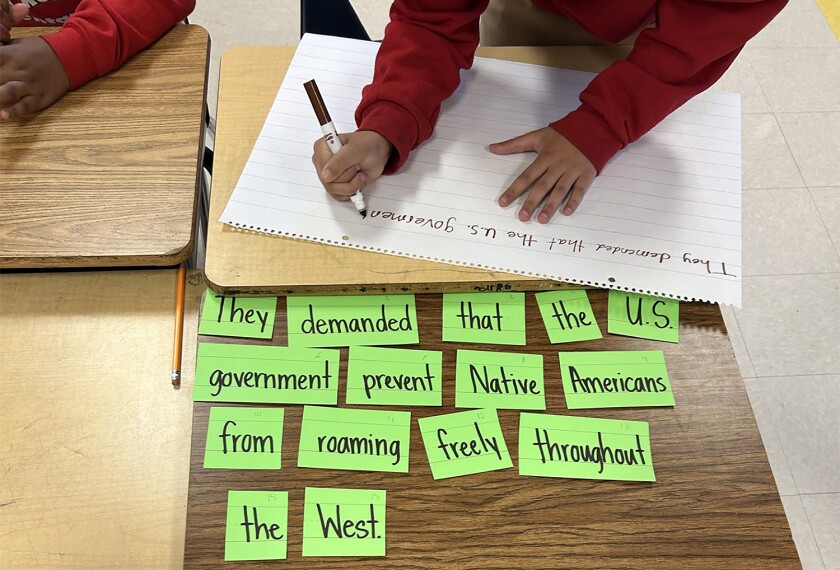
5th grade classroom in February. A morpheme word sort, sentence combining practice, and syntax surgery.
In a 5th grade classroom at Rock Rest Elementary, near Charlotte, N.C., students practice combining sentences and participate in "syntax surgery" to order the parts of complex sentence.<br/>
Madison Hart, Rock Rest Elementary
Reading & Literacy Quiz Risk vs. Reward: How Defensible Is Your Literacy Strategy?
Build a stronger case for your literacy approach. Test your knowledge of research-driven strategies that support reading success with this quick quiz.
Reading & Literacy Opinion What the 'Science of Reading' Movement Has Meant for English Learners
We should think of reading instruction for multilingual learners as a bridge, not a checklist.
8 min read
Conceptual illustration of classroom conversations and fragmented education elements coming together to form a cohesive picture of a book of classroom knowledge.
Sonia Pulido for Education Week
Reading & Literacy Quiz Quiz Yourself: Best Practices for Supporting Older Struggling Readers
Older students who struggle with reading face challenges that go beyond comprehension. Do you know what they are and how to best help them?
