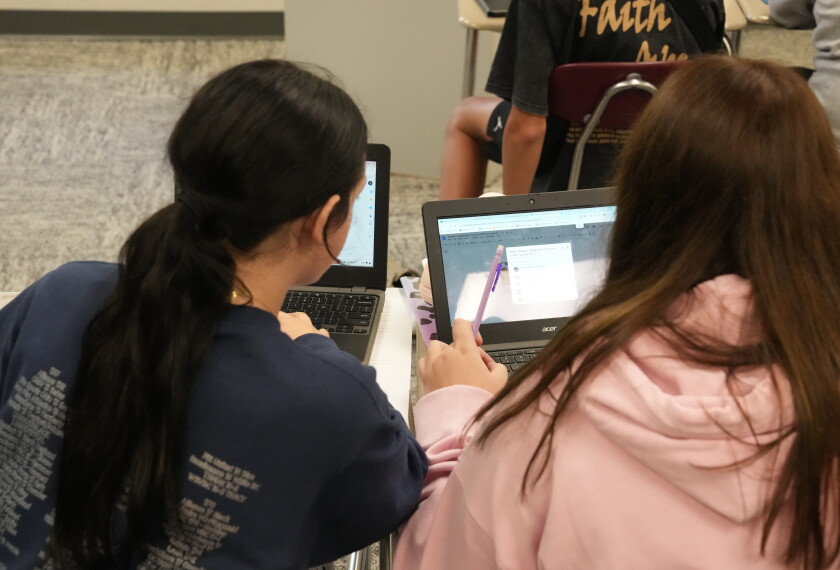
Already, many educators are utilizing mobile devices for learning.
In brick-and-mortar school districts across the country, a flurry of policy changes last summer allowed teachers to more fully integrate cellphones and other portable devices into their instruction. And recent research by the Joan Ganz Cooney Center at the Sesame Workshop, in New York City, suggests even preschoolers are getting their tiny hands on Mom’s or Dad’s iPhone or Droid and learning from it.
Yet, even though the Vienna, Va.-based International Association for K-12 Online Learning has identified mobile learning as an emerging trend, there is one giant step K-12 virtual education has yet to take: the creation of online courses that can be completed entirely with a mobile device.
Educators have been heartened by results of programs in which mobile devices play a key supplemental role by, for example, delivering review or enrichment exercises in a blended online and face-to-face environment, or enabling texted directions and even oral exams in an online class. But, while online-learning advocates say constructing courses that can be completed entirely on a smartphone or tablet device could greatly expand access to online courses, the structure behind them may look a bit unfamiliar.
“How you design the course, I think, will be fundamentally different,” said Elliot Soloway, a professor of computer science and education at the University of Michigan, in Ann Arbor, and a leading proponent of mobile learning. “These people are going to be doing this in five- to 10-minute chunks, as opposed to 30-minute chunks. That’s what I think will happen, but I don’t know that that’s the way most course designers are going to think about it.”
To complicate matters, mobile devices themselves vary in capability. The screen size of an iPad or other tablet computer, for example, is larger than that of a smartphone, while the smartphone’s mini-keyboard might make word processing easier than on a tablet device. That affects the very basic orientation between a user and the Internet, said Cathleen A. Norris, a regents professor of technologies at the University of North Texas, in Denton.
“The screen real estate is different,” said Ms. Norris. “You don’t have 15 inches. Search is more difficult. Therefore, instead of doing the search at all, let’s do a special-purpose account that does this thing. So you’ve got lots and lots of apps instead of the Web per se.”
Making It Happen
Concerns such as uneven cellphone reception and power supply mean that improvements to infrastructure and services may also be needed before a fully mobile course can be a reality.
“No single group can make it happen by themselves,” said Christopher Dede, a professor of educational technology at the Harvard Graduate School of Education. “Every group has to believe it’s worth them taking the risk, because everyone else is coming into the water to take a risk with them.”
Instilling that belief was the focus, he said, at a conference on wireless education Mr. Dede hosted in Washington in October, with support from Qualcomm, a San Diego-based telecommunications-development company. And attendee Albert J. Browne, the national program director and vice president of education and technology for the Verizon Foundation, said his organization will explore just how to test those waters.
The foundation, a nonprofit outreach arm of the New York City-based telecommunications provider Verizon, has gained attention among online education advocates for its Thinkfinity Web platform, which provides teachers with thousands of free lesson plans. Now, Mr. Browne said, content experts from Thinkfinity will dive into a pilot project at four or five schools—reaching about 120 students in all—to try transferring an entire curriculum from a subject at one grade level into something that can be delivered exclusively via a mobile device, most likely a cellphone, whether in a classroom or at home.
“We don’t want to provide you with an app of Thinkfinity,” Mr. Browne said. “What we want to do is take your curriculum, understand it, work with Thinkfinity’s content experts, and mobilize it.”
Just what that curriculum will look like is unclear. Mr. Browne said he expects something of a blend between what Mr. Solloway suggested would be a new way of structuring a course, and what teachers and students have been used to for generations.
“Some of the teachers have said they would much rather teach in themes, as opposed to by chapter. That means pulling from Chapter 1, Chapter 9, Chapter 7, and weaving them together using the capability of the technology,” Mr. Browne said. “The others are saying we can’t jump too quickly from the modalities of how textbooks are structured, and that the teaching profession is not ready for that 180-degree turn.”
Perhaps effective mobile courses of the future will allow teachers and students to choose their own paths. That’s already a model that appears to have worked in programs that have used mobile devices as supplementary tools.
For example, Stephen Weimar, the director of the Math Forum at Drexel University, in Philadelphia, said that when the Internet math resource began designing content for a program to use smartphones to help high school math students illustrate, communicate, and solve problems, it emphasized variability of features.
“We weren’t too invested in having to have their kids do something a particular way,” Mr. Weimar said of designing content for Project K-Nect, which began in pilot form in one district’s Algebra 1 course in 2007 before soon expanding to three more North Carolina districts.
“We were providing them a backbone of experience and resources that could carry them a long way,” he said, “and we did not have day-to-day contact with the teachers where we could see what they were doing to support and enhance it.”
Some students used the phones to post blogs about problems, others viewed online textbooks or surfed a premade list of “best math sites,” and some even reached out to teachers and program administrators after hours. Students involved in the first year of the program were found to score better on a state end-of-course math exam than others taught by the same brick-and-mortar teachers, program officials said.
How to structure that malleability into an environment where smartphones and tablets are utilized exclusively remains an obstacle. And, while mobile-learning advocates believe fully mobile online courses could provide access for students who were otherwise unable to enroll in an online course, they debate whether students who have more choices would be best served in a fully mobile course.
Harvard’s Mr. Dede suggests it’s possible, even after the fully mobile course is created, that mobile learning may be better deployed as a tool in a wider arsenal.
“When people look for information in their lives, they don’t say newspapers have to be a self-sufficient source of information, TV has to be a self-sufficient source of information, [or] the Web page has to be a self-sufficient source of information,” he said.“They kind of navigate between them, and they don’t think twice about it.”