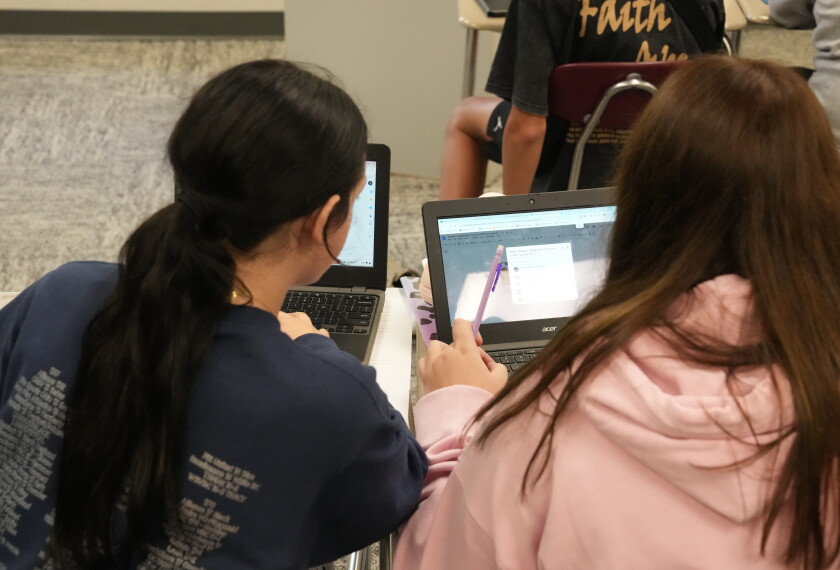
It’s one thing to put school-issued laptops into the hands of students who live in remote villages or on vast ranches.
Getting those students online at home is quite another.
That’s why Matt Federoff, the chief information officer of the 10,000-student Vail district in rural southern Arizona, is attempting to equip all 20 of the district’s high school buses with WiFi routers at a cost of approximately $1,000 per vehicle. With more than 1,000 students at two of the schools using school-issued laptops—and many of them living beyond the reach of traditional broadband Internet providers—it’s the most practical way to provide them with time and means to hop on the Web.
Currently, many students can spend more than two hours a day on a school bus.
“Qwest and Cox and other providers aren’t going to be going out there anytime soon,” said Mr. Federoff, whose district covers more than 400 square miles.
Vail is now piloting one WiFi bus, and, with the help of recent national television and radio attention, Mr. Federoff says he’s seeking $15,000 of private funding to help expand the project. “This doesn’t give [students] Internet in their home, but it gives them 2½ hours of access there and back.”
While such use of the technology is not quite the subject of a national dialogue yet, Vail and other districts have helped launch a discussion among experts about the benefits and drawbacks of merging Internet access with school transit. As with every new technology idea, concerns arise about cost, online content filtering and safety, and even the durability of a technology that is much more common in private and commercial vehicles. But there’s also excitement about the potential benefit for rural students, special education students, and athletes and musicians, all of whom are likely to spend substantial portions of their day in school transport.
“We think it’s just a fabulous extension of the learning possibilities for young people,” said Leslie Wilson, the president of the Lansing, Mich.-based One-to-One Institute. “That being said, … there needs to be those safety elements.”
Just how to provide those safeguards isn’t always obvious.
Before last year, San Francisco-based Autonet Mobile had never before worried about filtering online content for vehicles because it had never worked with a K-12 client. So when Autonet joined with Vail to wire its pilot bus, the for-profit company had to create a filtering system that would block the same content that would be restricted on the on-campus network, said founder and Chief Executive Officer Sterling Pratz.
Since then, Autonet has gained 30 K-12 clients and begun advertising school bus wiring on its website. Mr. Pratz says the equipment is of the same industrial grade used on tractor trailers and therefore equipped to withstand the jarring vibrations—as well as heat and cold—of school bus travel.
Who’s Monitoring?
Charles Cutsforth, the owner of Palatine, Ill.-based Comprehensive Communications, provides a similar service. His company was hired by the Aspirnaut Initiative—a program that links Tennessee’s Vanderbilt University with underserved science and math students in rural Arkansas—to wire a school bus in 2008 so the program’s students could complete online lessons on long commutes.
His Internet in Motion service, however, has no router making roving connections with available cellphone towers—the kind being piloted in Vail. Instead, his product allows students to work online while still being monitored through the schools’ servers.
Mr. Cutsforth believes his method presents less of a security risk. “There are a lot of issues in maintaining decent coverage and decent service,” he said. “If this is just an open WiFi connection that it is connecting to, who is monitoring what they are looking at? What kind of Web trafficking is being handled?”
Mr. Federoff said he understands the concern, but believes that for students learning in one-to-one environments, monitoring online use may not even be desired. As it is, he said, both teachers and bus drivers have found students who need the time have used it productively.
Julie Hudson, a co-founder of the Aspirnaut program and the assistant vice chancellor for health affairs at Vanderbilt, says while there may be disagreements about the best way to provide Internet access on long rural bus routes, opponents of WiFi buses in any form should put themselves in the students’ shoes.
“Who would ask an adult to get on a bus for at least 45 minutes each way with nothing to do?” said Dr. Hudson, who believes the single easiest way to help underserved rural students connect with the larger world is to expose them to technology.
Targeting Special Education
Other experts see similar potential for special education students who often spend hours of their day traveling across a district to receive support.
“Many of the [special education] students go these long distances. If they have personal portable technologies … that adapt to these special needs,” they would gain great benefits, said Ms. Wilson of the One-to-One Institute. She cited online reading devices for troubled readers and other assistive communications technology.
Special education experts agree there is greater opportunity to extend the school day by giving students access to WiFi on their buses. But the diverse needs of those students would mean that implementing such a program would involve a more elaborate plan, and likely a much higher price tag.
“If a child is in a wheelchair, how will this child use a laptop?” asked George Giuliani, the executive director of the National Association of Special Education Teachers. “If a child has been visually impaired, what will be done there? … There are more assistive-technology-type questions.”
Others wonder if outfitting special education buses with WiFi would contradict efforts to put more students with special needs into mainstream classrooms.
“The whole idea right now in special education is inclusion, which means students by federal law should be educated in the least restrictive environment,” said Diane Painter, an assistant professor of education at Shenandoah University in Winchester, Va., and the newsletter editor for the Council for Exceptional Children’s Technology and Media division. She acknowledges, though, that it is still far more difficult for rural districts to gain access to technology than urban ones. At her current rural residence, there is no cable service, something that would have been unthinkable during three decades teaching special education and technology in the suburbs of Washington.
“I think a better use of [technology] resources would be to make access more equitable within the schools,” she said.
So far, districts that are following the Vail model to equip school buses with WiFi don’t appear to be targeting special education. But they do look to be giving careful thought to how best to prioritize which buses to transform into mobile Internet hotspots.
At the 30,000-student Keller Independent School District in the Dallas-Fort Worth region, the plan is to unveil eight WiFi buses next fall. Dana Chandler, the director of Durham School Services, the contractor that provides bus services to the Keller district, said bus rides can still average about 45 minutes each way even though the district is relatively urban.
The 20,500-student Rowan-Salisbury district, in North Carolina, purchased four WiFi routers from Autonet and unveiled five WiFi-equipped “activity buses” this month. They are used for field trips and athletic and musical events by North Rowan High School, which operates a one-to-one learning program with 600 school-issued iPod Touch portable media players.
Phil Hardin, the district’s executive director of technology, said a couple longer daily routes that serve rural areas would get WiFi service next if the program expands.
Increasing Ridership
The private 700-student Wildwood School in Los Angeles also is considering installing WiFi routers on three routes in hopes of increasing ridership among secondary students. In addition to providing students with extra time to access online course materials, officials say there may be another advantage: decreasing the number of students who drive to the urban campus.
“If we can lure more students to ride the bus with computer time,” said Tanya Raymo, the transportation director, “that’s a big draw.”
But rural students are still the ones who stand to benefit most, experts say.
Ms. Wilson of the One-to-One Institute says providing those students with Internet access could encourage providers to stretch their cable and broadband services. And in Arkansas, where enrollment in the Aspirnaut program has gained notice, co-founder Ms. Hudson says students now have more options for home service than they did two years ago.
“Would that not push the envelope for quicker, faster, further Internet building?” Ms. Wilson said. “I think that’s how this would grow and foster that to happen.”