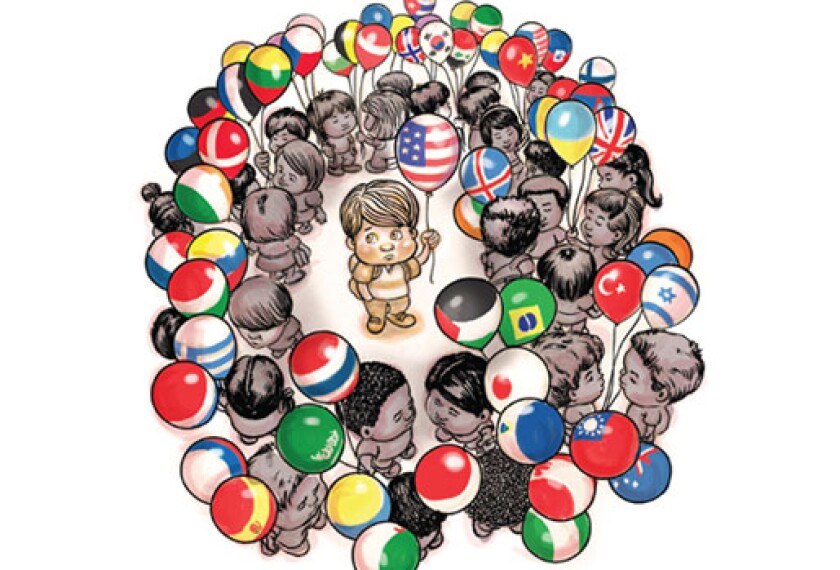
Eight years into the No Child Left Behind Act, educators, researchers, and advocates remain locked in heated debate over the effects of the law’s testing and accountability mandates on students, many from immigrant homes where a language other than English is spoken. Remarkably lost in the crossfire are the equally serious implications for the nation and its competitive position internationally.
Two recently reported developments related to language instruction, set against rising multilingualism abroad, lend truth to that proposition. Together, they reveal that NCLB is an impediment to fostering bilingual skills and bicultural understandings, especially among the nation’s 12 million students from immigrant families, including the 5.1 million identified as English-language learners, as well as millions of English-dominant students who are economically disadvantaged.
The first of these developments has surfaced in the Obama administration’s proposed English Learning Education Program, with an $800 million commitment tucked into the president’s budget plan for fiscal 2011. The proposal, as laid out by Assistant U.S. Secretary of Education Thelma Melendez in a speech before bilingual educators in February, is a disheartening mix of more of the same peppered with hopeful hints of a changed vision. And yet, though threaded through with continued talk of testing and “rigorous” standards, it nonetheless conveys a long-overdue message that the bilingual potential of English-language learners, or ELLs, is a national asset, rather than a deficit as conventionally considered.
Reversing four decades of federal wavering on the question of home-language instruction, the assistant secretary openly affirmed the cognitive benefits of bilingualism, the need for “nuanced instructional approaches” that recognize the diversity within the ELL population, and the administration’s desire “in particular … to encourage dual-language programs” that would help prepare students, both English- and non-English-dominant, for a “globally competitive world.”
Relying solely on English as the language of global communication, we risk the world's talking over our heads as we become more culturally trapped."
Tying such programs to the global economy is not new to Washington. More than 40 years ago, then-U.S. Sen. Joseph Montoya of New Mexico, a co-sponsor of the original 1968 Bilingual Education Act, warned that “in a world that grows smaller every day, America should no longer ignore the language ability and cultural variety of its people and its heritage.” The act’s 1994 amendments echoed those sentiments, noting that as the world was becoming “increasingly interdependent” and “international communication becomes a daily occurrence,” multilingual skills were an “important national resource” promoting the nation’s “competitiveness in the global economy.”
That was before the No Child Left Behind Act took a definitive turn otherwise. Though the law neither prescribes nor precludes any particular teaching approach, and even permits dual-language programs that include English-dominant students (a nod to mainstream parents), it still presents strong deterrents against using federal funds for that purpose. The fact that schools are judged by the percentage of students reclassified as fluent in English each year creates a built-in incentive to set aside non-English-language instruction in the interest of moving ELLs swiftly and exclusively toward English proficiency.
In effect, No Child Left Behind and its implementing regulations establish national policy that gives perfunctory recognition to bilingualism while overlooking biculturalism, inevitably moving the instructional landscape toward some variant of English immersion while miring the nation in a time warp of monolingualism.
But that is only part of the story. The law intersects with language programs and national interests in other insidious, though less obvious, ways. The assistant secretary’s speech came on the heels of a national survey report contrasting the dramatic decline over the previous decade of public elementary and middle school classes in French and German with the equally dramatic rise in Arabic and Chinese classes, funded in part under the federal government’s National Security Language Initiative. Chinese-sponsored “guest teachers” have provided further inducement.
The media attention given to the report focused on China’s emergence as a major political and economic player and the belief that fluency in Chinese opens doors to career opportunities. Only briefly noted was the survey’s suggestion that the drop in instruction in other languages was in some measure the result of NCLB.
The law’s emphasis on reading and math has drawn resources away from language programs, which accountability measures do not cover. And while the number of elementary schools offering Spanish has risen, most of that increase has occurred within private, and not public, schools. Among public schools, higher socioeconomic status went hand in hand with more programs overall.
The potential problems implicit in both the shift in languages and the equity disparities were largely absent from news reports. The paradox in offering such opportunities, admittedly narrow, to mainstream students, while denying language-appropriate ones to less-privileged ELLs with stronger bilingual potential, similarly escaped notice.
What makes these crosscurrents both troubling and confounding is that other parts of the world are moving toward multilingualism, and not merely bilingualism. Within the European Union, for example, there is a concerted push for every student to develop proficiency in at least two languages in addition to the mother tongue by the completion of secondary school. The European Commission is now conducting a major survey on the success of this strategy, with a report due in 2012.
Undoubtedly, there is a compelling need for cross-border communication to integrate member states into a united Europe. There also is an underlying fear that other languages are losing status to English. Nonetheless, in almost all EU countries, compulsory learning of a foreign language now begins in primary education—in Spain, as early as the age of 3. In the United States, by contrast, as of 2008, a meager 15 percent of public elementary school students were enrolled in foreign-language classes. Yet we know that languages are learned most effectively at an early age.
To be sure, in 13 EU countries, English is the mandatory first foreign language. This trend, along with the spread of English as the global lingua franca and the universally rapid absorption of American culture, has reinforced a false security among many Americans that it suffices to be monolingual in English or, at most, to learn the rudiments of Chinese or Arabic for a leg-up in the job market.
That is not to deny that there is a severe shortage of Americans proficient in non-Western languages now deemed critical on an international scale. Nor does it suggest that dual-language immersion programs are appropriate for all students. But dismissing the national or professional importance of French and Spanish, with their vast numbers of postcolonial speakers, ignores the important role that language plays in intercultural understanding. You cannot deeply “know” the values of a people or a nation’s politics unless you can directly access its art, literature, news media, government documents, and policy reports. Relying solely on English as the language of global communication, we risk the world’s talking over our heads as we become more culturally trapped.
As lawmakers now examine No Child Left Behind, the current version of the Elementary and Secondary Education Act, in light of the coming ESEA reauthorization, they would be wise to consider that the law’s rigid testing and accountability standards are squandering valuable linguistic and cultural resources, and that the negative impact on language learning for all students, including the least advantaged, can progressively set the nation behind in the global arena.
More specifically, they should recognize the untapped potential in students from immigrant homes to mediate across linguistic and cultural bounds, especially in regions like Latin America, East Asia, Africa, and the Middle East, where the United States holds important economic and geopolitical interests.
Meanwhile, educators should encourage students to learn “critical” languages like Arabic and Chinese in addition to, and not in lieu of, French, German, and other European languages. Above all, like our transatlantic neighbors, we Americans must shed the misguided notion that monolingualism promotes economic growth, while multilingualism threatens national security and identity.


