
Corrected: An earlier version of this story incorrectly identified the location of one of the school districts studied in A User’s Guide to Peer Assistance and Review. The district studied is in San Juan, California.
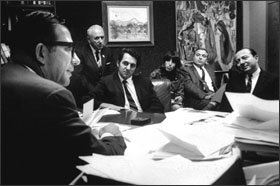
Around a conference table, six people finger binders stuffed with teaching standards, sheets on which to record teachers’ practices, and handbooks outlining when materials need to be submitted. For good reason: They are now immersed in the intensive period of documenting in writing whether the teachers they counsel have improved over the course of the year. Ultimately, their findings will help determine whether their teacher “clients” remain employed.
The job’s downside—lots of paperwork—contrasts with its high point: helping teachers reach their potential.
“The best part is when you get thankful e-mails and phone calls, when they are just so happy that they’ve tried something new out and seen that it works,” said Greg Barnes, one of the educators gathered here.

But Mr. Barnes is not a young principal learning how to evaluate his teaching force for the first time. Instead, like the others assembled here at the headquarters of the Montgomery County Education Association, he is a top instructor who now works full time as a “consulting teacher.” In that role, he provides intensive professional development to teachers who have not met evaluation standards. After a year of providing assistance, consulting teachers serve as key witnesses before a joint union-management board that recommends whether the district should renew the contract of each novice, or in the case of veterans, begin dismissal procedures.
Established in the 142,000-student Montgomery County, Md., district in 1999, peer assistance and review—or “peer review,” as it is occasionally called—is actually an old idea. In 1981, the then-president of the Toledo Federation of Teachers, Dal Lawrence, helped create the first PAR program. Almost 30 years later, only a handful of districts have followed the schools in that Ohio city with their own variations.
But spurred on by new assistance primarily from the American Federation of Teachers, more districts are coming on board, even as the state of the nation’s long-ignored, but much-criticized teacher-evaluation instruments rockets to the top of the national education agenda.
Teacher experts are of two minds about the program’s continuing expansion. Supporters believe that the stars have finally aligned to boost support for peer assistance and review.
I don’t see any unresolvable conflict between this program and the responsibility of the union to protect people from unfair treatment or unfair dismissals.”
“The fact that PAR is getting another look is a silver lining in this whole focus on evaluation,” the president of the AFT, Randi Weingarten, said. “It is suggesting to the world that we’re really trying to figure out how to better support, nurture, and evaluate teachers.”
But other observers say that the program, which is intended for select subpopulations—novices and struggling veterans—should be more closely linked to an overall teacher-quality strategy for all teachers, including compensation reform.
“Peer review is an incomplete approach. It’s a more collaborative way of doing what districts have been trying to do for decades—to detect incompetence,” said Timothy Daly, the president of the New Teacher Project. The New York City-based group, which trains and places new teachers, released an influential report recently on teacher evaluations. “We would argue that doesn’t even come close to achieving the goals a good evaluation system should attempt to reach,” he said.
Rocky Road
In what amounts to a bit of historical irony, the 1981 “Toledo Plan” presaged the current conversation about teacher effectiveness. It was among the first efforts to set forth teaching standards, predating both the certification process of the National Board for Professional Teaching Standards and the development, in 1996, of consultant Charlotte Danielson’s widely replicated Framework for Teaching.
But in spite of the flexibility that districts have to design PAR programs, the concept of teachers’ participation in the performance reviews of other teachers has never been an easy sell. The late AFT President Albert Shanker quickly embraced the concept, but it was viewed with suspicion by union affiliates and, until the late 1990s, by the National Education Association.
Defining the number of PAR programs today is difficult. Some use a system of assistance, but don’t have an evaluative component. Others consist of just an intervention program for struggling tenured teachers or a program for novices. In general, researchers and unions agree that true programs contain a strong professional-development component and factor the results into employment decisions. Beyond that, the details—including how “consulting teachers” are selected, the length of their terms, and the composition of the PAR panel—differ greatly.

SOURCE: A User’s Guide to Peer Assistance and Review, Harvard Graduate School of Education, Project on the Next Generation of Teachers.
Now, with such concerns seemingly on the wane, PAR appears to be experiencing a small renaissance. In 2008, the AFT passed a resolution at its biennial convention calling on each district to explore peer review.
Just this year, affiliates in Anderson, Ind., and St. Louis have signed on to institute PAR. Detroit and New Haven, Conn., are now considering the idea. And in October, the AFT dedicated a chunk of its $3.3 million Innovation Fund to support new programs in New York state and Rhode Island.
Since assuming the AFT presidency in July 2008, Ms. Weingarten has been a vocal advocate.
“Randi put peer review on the front burner,” said Francine Lawrence, the president of the Toledo Federation of Teachers and the wife of Dal Lawrence. “She dedicated resources at AFT national to it.”
Susan Moore Johnson, a professor at the Harvard Graduate School of Education and the primary researcher of an extensive, Web-based study of seven districts’ PAR systems, also attributes the renewed interest in peer review to teachers’ concerns about “value added” growth measures based on student test scores.
“Unions are legitimately concerned that a teacher doesn’t get information back from a value-added score that tells him or her about what to do to improve his or her teaching practice,” she said.
Meanwhile, Kate Walsh, the president of the National Council on Teacher Quality, a Washington-based policy organization, views the uptick in programs through a political lens.
“I’m assuming [the AFT] doesn’t want to be portrayed as a union that says no to everything,” Ms. Walsh said. “This is one of their positive solutions.”
Scrutinizing PAR
As the number of programs grows, the scrutiny about what they accomplish also seems likely to become more intensive. The debate over the merits of PAR programs is a complex one.
Marcia Reback, the president of the Rhode Island Federation of Teachers and Health Professionals and the chairwoman of an AFT task force on PAR, points to the long-standing nature of the programs as a sign of district officials’ esteem.
“When you think about the fact that budgets are as tight as they are and that superintendents are willing to invest in the personnel to do this work, it’s compelling,” she said.
According to Ms. Moore Johnson, union stewardship was a central element of the seven PAR programs her team studied, as was a clear articulation of teaching standards and the consulting teachers’ responsibilities. Those factors have kept the evaluation process consistent in PAR districts over time, she said.
“PAR assures evaluation will not be overlooked, at least with the groups of teachers who were included in the process,” she said.
Here in Montgomery County, the consulting teachers underscore PAR’s focus on teacher improvement. Britt Waterfield describes PAR as a process that helps teachers become more reflective about their own teaching and that produces stronger learning gains. Most teachers, adds Theresa N. Robinson, ultimately come to see visits from their PAR teacher not as a punishment or a burden to be endured, but a valued resource.
“They’ll start to call you up and say, ‘I really could use some feedback on my fifth period,’ ” Ms. Robinson said.
Expedient Dismissal?
Union officials also are proud of what they say is PAR’s rigorous process for counseling out of the profession teachers who can’t or won’t improve.
But whether those rates are sufficient is a more difficult question. No national data state definitively what percentage of teachers in a given year should be dismissed for poor performance. A widely cited 1997 study by Pamela D. Tucker, now a professor at the University of Virginia, found that principals in Virginia estimated that 5 percent of the teachers in their schools were incompetent. A handful of other surveys have come to similar conclusions, but the question remains open.
The most recent data obtained by Ms. Moore Johnson and her team—although drawn from fragmented union and district sources in some cases—suggest that annual nonrenewal rates for novices in the cities studied range from no nonrenewals in Cincinnati to a 9.7 percent rate in Syracuse, N.Y. For veteran teachers, intervention programs’ rates are typically much lower.
To calculate dismissal rates in PAR, Harvard professor Susan Moore Johnson and her team of researchers collected statistics from district and union data sources—not an easy task because of poor recordkeeping and definitions that don’t always line up. (A district may deem the disposition of a teacher who left the district rather than face dismissal after a poor PAR review a “resignation,” rather than a “dismissal.”)
Outcomes for Teachers in the Novice Program
CINCINNATI
Year: 2007-08
Total novices: 40
Nonrenewed: 0 (0.0%)
Granted 2nd year of PAR: N/A
MINNEAPOLIS
Years: 2005 to 2008
Total novices: 85 to 194 per year
MONTGOMERY COUNTY, MD.
Year: 2007-08
Total novices: 446
Nonrenewed: 16 (3.6%)
Granted 2nd year of PAR: 32 (7.2%)
Resigned: N/A
ROCHESTER, N.Y.
Year: 2006-07
Total novices: 426
Left district: 30 (7.0%)
SYRACUSE, N.Y.
Year: 2007-08
Total novices: 62
Nonrenewed: 6 (9.7%)
TOLEDO, OHIO
Year: 2007-08
Total novices: 98
Left district (nonrenewed or resigned): 9 (9.2%)
Note: The data represent results after one year.
Outcomes for Teachers in the Intervention Program
CINCINNATI
(teachers on staff: 2,357)
Year: 2007-08
Teachers referred to intervention: N/A
Teachers in intervention: 5
Dismissed: 0
Resigned/retired: 1
Extra year of intervention: 0
Successful return to classroom: 0
MINNEAPOLIS
(teachers on staff: 2,250)
Years: 2004 to 2008
Teachers referred to intervention:183
Teachers in intervention: N/A
Left district: 68
Extra year of intervention: 45
Successful return to classroom: 70
MONTGOMERY COUNTY, MD.
(teachers on staff: 9,371)
Year: 2007-08
Teachers in intervention: 9
Dismissed: 7
Resigned/retired: 0
Extra year of intervention: 2
Successful return to classroom: 0
ROCHESTER, N.Y.
(teachers on staff: 2,861)
Years: 2001 to present
Teachers referred to intervention:13
Teachers in intervention: 4
Dismissed: 1
Resigned/retired: 1
Successful return to classroom: 2
SAN JUAN, CA.
(teachers on staff: 2,267)
Years 2005 to 2008
Teachers referred to intervention:12
Teachers in intervention:10
Dismissed:1
Resigned/retired: 3
Successful return to classroom: 4
TOLEDO, OHIO
(teachers on staff: 1,852)
Year 2007-08
Teachers referred to intervention: N/A
Teachers in intervention: 7
Dismissed or resigned: 1
Extra year of intervention: 6
Successful return to classroom: 0
Note: The data represent results after the intervention ended.
SOURCE: A User’s Guide to Peer Assistance and Review, Harvard Graduate School of Education, Project on the Next Generation of Teachers.
The numbers can’t be directly compared with overall district dismissal rates—usually less than 1 percent of the teaching force—because a majority of PAR programs cover only a small, specific population of teachers, not the total in the district.
Julie Sanders, a 7th grade teacher in Montgomery County, is a strong believer in the idea behind PAR, which she calls a “get-well plan” for teachers, but she isn’t convinced that it adequately captures everyone who needs help.
“It would overwhelm the system,” Ms. Sanders said. “I think [the PAR panelists] probably need to get rid of a lot more people than they actually do.”
And because of rigorously enforced timelines and the extensive documentation required to refer a teacher to peer assistance and review, some principals continue to use the “excessing” process to rid their buildings of poor-quality instructors, Ms. Sanders said. (Teachers who are removed from schools as a result of program changes, but still are employed by the district, are deemed “excessed.”)
That is a place where administrators need to be held accountable on making better use of the system, said Ms. Lawrence, the Toledo union president.
“It isn’t an easy thing to say to a teacher, ‘You have performance problems and you need to be referred to assistance,’ ” she said. “But that’s part of what being a manager means.”
Phillip Gainous, the vice president of the Montgomery County Association of Administrators and Supervisory Personnel and the co-chairman of the Montgomery County district’s PAR panel, thinks that the referral process is gradually improving. Principals are gradually coming to view PAR not as a hammer, he said, but as a genuine route to improvement.
“We are not at 100 percent, but we are well on our way there,” he said.
Consulting teachers agree that striking the right balance between being, in Ms. Weingarten’s words, “good for kids and fair to teachers,” is not easy.
For instance, although the PAR panel in Montgomery County almost always takes its lead from the reports of consulting teachers, Mr. Barnes said he had witnessed a few cases in which the panel granted a second year of intervention to a teacher he believed was not meeting standards. The phenomenon appears to be rare, but it nonetheless worries those who believe PAR sometimes extends an already lengthy dismissal process.
“It does not take a full year to decide whether someone is struggling in their job, let alone two,” said Ms. Walsh of the nctq. “I think the cost is too great to children’s learning to always be giving the teacher the benefit of the doubt.”
But Doug Prouty, the president of the Montgomery County Education Association, an NEA affiliate, and the co-chairman of the district’s PAR panel, noted that the program—unlike those in other districts—sets limits on how long a teacher can receive intervention support.
“We don’t give people forever,” said Mr. Prouty. “It lessens the impact of PAR because the message you send is that it isn’t about improvement, it’s about maintenance.”
Both Mr. Prouty and the consulting teachers point out that the district’s other in-school support networks have been improving, so that teachers who are not covered by PAR or are not scheduled for an evaluation that year receive help that aligns with PAR. Although the quality of such support still varies depending on the school building, the district has won kudos from national experts for instituting those measures.
Moving Forward
As the national conversation about teacher effectiveness continues, it is an open question how well peer review will fit into newly emerging systems.
This notion of limited peer selection and review represents a very unusual, nontraditional role for teachers. … But if we are truly talking about professionalism —not having someone stand over us making rules, telling us what to do, of gaining some control of our own activity—then we had better look very closely at the Toledo program and others like it.”
Federal officials, for their part, seem open to peer evaluation as one component of a teacher-evaluation system. “I’m a big fan of peer evaluation,” U.S. Secretary of Education Arne Duncan said at a recent Washington forum. “Great teachers helping great teachers, colleague to colleague and peer to peer, is what it’s all about.”
But Mr. Daly of the New Teacher Project questions whether PAR programs meet the standards for evaluation outlined in the Obama administration’s $4 billion competitive-grant program for states under the Race to the Top Fund. The program would reward states that evaluate teachers annually in part on student test scores, establish at least four different performance ratings, and link results to compensation and career-ladder initiatives. Most PAR programs are not set up to connect those functions, Mr. Daly said.
“The next thing you’d have to do is use the information for more than just dismissals,” he said. “I think absolutely PAR could be used as part of a larger [teacher-quality] system, but there are a lot of things that have to be filled in here.”
To Ms. Lawrence, PAR serves as the groundwork for other such initiatives. “It is the fundamental collaborative initiative between union and management,” she said. “All of our other collaborative ventures stem from that.”
The core features of the PAR model could be expanded beyond its current population of teachers, she and researchers like Ms. Moore Johnson argue.
Such a proposal would raise challenges of both finances and capacity. Though PAR can replace other support initiatives, it requires release time for consulting teachers and the hiring of replacement teachers.
For some proponents, the benefits outweigh the costs. “Meaningful evaluation systems are expensive,” said Ms. Weingarten of the AFT. “[PAR] means basically taking the entire notion of mentoring, induction, observation, support, and end-of-the-year evaluations and putting them all together.”
Ms. Reback of Rhode Island says affiliates in her state will use their AFT Innovation Fund dollars to embed PAR into a much more comprehensive evaluation system for teachers at all levels. A lot rides on what they manage to come up with, she acknowledges.
“We are under a microscope; we have to succeed,” she said. “We don’t have any choice.”
But here in Montgomery County, teachers and administrators remain convinced that peer assistance and review is on the right track. There is less suspicion about PAR among teachers about the system and a better system of referrals, the consulting teachers say. Most of all, says consulting teacher James L. Berry, they want PAR to continue to evolve.
“The philosophy of peer review,” Mr. Berry said, “is the only thing here that’s etched in stone.”


