Corrected: An earlier version of this story mislabeled a chart as showing trends in 8th grade test scores, rather than at the 4th grade, due to incorrect information provided by the chart’s author. That earlier version of the story also incorrectly suggested that test-score trends discussed by researcher Daniel J. Losen referred to both 4th and 8th grades, rather than for 4th grade alone. The chart and story have now been updated.
Includes updates and/or revisions.
Preliminary findings from new research suggest that in three states where voters decided to replace bilingual education with structured English immersion as the default method for teaching English-language learners, the new approach may be producing less-than-stellar results.
The studies were commissioned by the Civil Rights Project at the University of California, Los Angeles, and the Linguistic Minority Research Institute at UC-Santa Barbara, as well as the University of California’s All Campus Consortium on Research for Diversity, or UC ACCORD. The findings were presented here in California’s capital city during the institute’s annual conference on May 2-3, which focused on “restrictive language policies.”
In 1998, California voters approved Proposition 227, which aimed to curtail bilingual education in the state. Arizona voters approved a similar initiative, Proposition 203, in 2000; two years later, Massachusetts voters passed Question 2, which aimed to reduce bilingual education in that state.
‘Unz Initiatives’
All three initiatives were approved by voters following campaigns financed by Ron Unz, a Silicon Valley businessman, and have been nicknamed the “Unz initiatives.”
The wording of the three initiatives varied slightly, and they have been implemented in different ways.
In California, for example, parents use a provision for waivers in the law so their children can be excused from English-only classes and still participate in bilingual education.
But the Arizona law contains more-stringent criteria for parent waivers than the California law, so few school districts there provide bilingual education. Still, the percentage of California’s ELLs who are in bilingual education has dropped from about one-third to 5 percent since the initiative was approved.
As in California, the initiatives in Arizona and Massachusetts significantly reduced the number of English-language learners receiving instruction in their native languages.
Russell W. Rumberger, the director of the Linguistic Minority Research Institute, summed up the research findings in an interview by saying that they show structured English immersion “clearly is not any panacea” for ELLs.
“There’s no visual evidence that these three states are doing better than the national average or other states” in educating ELLs, he said.
A new study by Mr. Rumberger compares student achievement of English-learners in Arizona, California, and Massachusetts, with that of such students in other states. Loan Tran, a graduate student in education at UC-Santa Barbara, is a co-author of the study, which is being funded by the U.S. Department of Education’s Institute of Education Sciences.
Preliminary findings suggest that the achievement gap on the National Assessment of Educational Progress in both reading and mathematics is wider between English-learners and non-English-learners in the 4th grade in the three states with Unz initiatives than in Texas and New Mexico, which require schools to provide bilingual education.
The researchers found that student and family factors—such as whether families have books—have a greater impact on ELLs’ achievement than do school and state policies, such as whether students’ native languages are used in instruction or whether students receive specialized instruction at all.
Impact of Policies
Nevertheless, they found that state policies can have an impact. For example, the NAEP data show that rigorous academic standards reduced the achievement gap in reading between ELLs and non-ELLs in the 4th grade. In addition, students with the lowest levels of English proficiency benefited the most from specialized instruction to learn the language.
When Arizona Superintendent of Instruction Tom Horne was asked to comment on why states with bilingual education have smaller achievement gaps than states with the Unz initiatives, he said in an e-mail that ELLs do better on tests in states with bilingual education because those states assess such students in Spanish, while states with Unz initiatives assess students only in English.
Arnold A. Goldstein, the director of reporting for the assessment division of the National Center for Education Statistics, noted that the NAEP reading test is given only in English. However, some ELLs are tested in math in Spanish on NAEP, Mr. Goldstein said.
Daniel J. Losen, a senior education law and policy associate with the Civil Rights Project, presented a study that examined English-learners’ scores on NAEP in Arizona, California, and Massachusetts after implementation of the Unz initiatives.
A study compares trends in the average scores of 4th graders who are English-language learners on the National Assessment of Educational Progress in reading in states that passed ballot measures to curtail instruction in such students’ native languages.
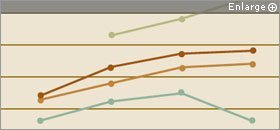
Source: Daniel J. Losen, Civil Rights Project at UCLA
He found that after 2002, when Question 2 was enacted in Massachusetts, such students’ NAEP scores—which in 2002 were well above the national average for ELLs—rose in 4th grade reading.
But the story was different in Arizona and California, and Mr. Losen surmised that the difference might stem from variations in how the Unz initiatives were carried out in those states.
In Arizona, 4th grade reading scores started at a point well below the national average. They increased steadily until 2005, as did the national average for English-learners on NAEP. But then they fell sharply as the national average continued to increase.
In California, English-learners’ reading scores on NAEP in 4th grade started slightly below the national average in 1998 and continued to rise until 2007, the most recent year for which data are available. But the average for ELLs nationally climbed faster than for those in California.
Legal Action Discussed
Mr. Losen speculated that it might be possible for lawyers to make a case in federal court that the Unz initiatives in Arizona and California are a violation of the federal Equal Educational Opportunities Act. “The defense could argue that implementation has failed,” he said.
He said, though, that the same case could not be made for Massachusetts. Mr. Losen also noted that it is hard to separate the influence of the Unz initiatives on ELLs from that of the federal No Child Left Behind Act.
Mr. Horne of Arizona said he believed that national-assessment scores for Arizona’s ELLs had declined recently because the state began to require school districts to reclassify such students as fluent in English when they reached proficiency in the language; previously, districts kept those students in the pool of ELLs.
“If reclassification is honest, the remaining students are the ones who really don’t know English, and their average on the test would be much lower than if you include students who have been classified ELL for many years, and should have been reclassified but weren’t,” Mr. Horne explained.
Some research findings presented at the conference focused on individual school districts or states.
Rosann Tuny, the research director of the Center for Collaborative Education in Boston, for example, presented data for the 10,000 ELLs in the 58,000-student Boston public schools on state math and reading tests during the three school years after implementation of Question 2.
Performance in reading for ELLs stayed about the same. In 2003, for instance, 45.2 percent of such students passed the state’s 10th grade reading test. In 2006, the percentage of ELLs passing had dropped only to 43.2 percent.
But in math, ELLs did increasingly worse on the state’s 10th grade math test after implementation of Question 2, Ms. Tuny said. The percentage of students passing that test dropped from 69.1 percent to 45.4 percent from 2003 to 2006.
Ms. Tuny also noted that the dropout rate for Latinos who are ELLs increased from 4.4 percent to 10.3 percent during that same time period. In addition, she said, “after Question 2, the dropout rate started increasing among students much earlier—in middle school.” Researchers at the conference were generally skeptical that the Unz initiatives have worked well for English-learners, though they presented their findings more as descriptive than conclusive.
Different Perspective
But Russell M. Gersten, the executive director of the Instructional Research Group, an educational research institute in Long Beach, Calif., who didn’t attend the conference, has a different perspective. He believes that at least in California, the Unz initiative has had a more positive than negative effect on ELLs.
He noted that a large study on the impact of Proposition 227 commissioned by the California Department of Education highlighted some positive aspects of the initiative. That 2006 study, conducted by the American Institutes for Research and WestEd, concluded that “there is no clear eidence to support an argument of the superiority of one [ELL] instructional approach over another.”
Ideally, Mr. Gersten said, Proposition 227 would give the flexibility to school districts to provide, say, an hour of Spanish instruction each day to ELLs in kindergarten and 1st grade. The proposition permits bilingual education only for students whose parents have signed waivers of English-only instruction.
Mr. Gersten said many ELLs were being shortchanged with bilingual education before passage of Proposition 227. “There really were problems, such as the issue of low expectations in many of the native-language classrooms,” he said. “A huge number of teachers were on waivers, which means they spoke Spanish but weren’t necessarily certified.”
Because of Proposition 227, Mr. Gersten contended, ELLs now are taught the same curriculum as other students: “It used to be that kids had a different curriculum, and it’s not at all clear it was as challenging.”


