For decades, a highly qualified workforce has helped fuel economic prosperity in the United States. But now other countries are catching up with and even surpassing America’s performance.
On a variety of measures, “the U.S. has been joined by a number of other countries,” says Alan P. Wagner, a professor of educational administration at the State University of New York at Albany, “and particularly in the younger age groups, there is evidence of higher levels of performance elsewhere.”
For example:
- Although the achievement gap opens before children even reach school, U.S. support for early-childhood education lags well behind that of other developed nations.
- While U.S. children in elementary school perform relatively well on international tests of achievement, particularly in reading, American 15-year-olds perform in the middle of the pack on tests of science and mathematics, with one-quarter performing at the lowest achievement levels.
- At a time when a high school diploma is typically the minimum requirement for a decent job, the United States has slipped to 11th among 30 Organization for Economic Cooperation and Development countries in the proportion of 25- to 34-year-olds with that credential.
| Data Download | |||
|---|---|---|---|
|
- Long a leader in higher education, the United States has dropped to seventh in the proportion of 25- to 34-year-olds with a college degree.
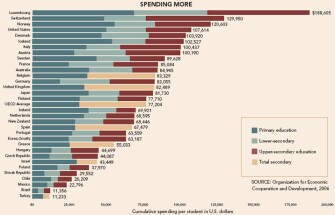
“These results cannot simply be tied to money,” says Barbara Ischinger, who heads the education directorate for the OECD. “ Only Luxembourg, Switzerland, and Norway spend more per student in the primary through secondary grades than the United States does, according to OECD data.
- Mathematically Lagging On international tests of performance, 15-year-olds in the United States, on average, trail behind their peers in many other developed nations. Out of the 30 countries taking part in the 2003 Program for International Student Assessment, or PISA, the average mathematics achievement of U.S. students was higher than that of students in only five countries.

- Spending More Spending levels in the United States are some of the highest among those countries belonging to the Organization for Economic Cooperation and Development. Only Luxembourg, Switzerland, and Norway spend more per student in the primary through secondary grades than the United States does.
The United States, however, devotes only half of its expenditures to teacher compensation, a share that is below those of all but five OECD countries.
Perhaps most troubling, America’s older adults, ages 35 to 64, have higher rates of college completion than its younger generation—a trend opposite the direction in other industrialized nations.
“Are we going to react in a way that’s too little, too late?” asks Thomas J. Tierney, the president of the Bridgespan Group, a nonprofit management-consulting organization based in Boston. “I think the choice is ours.”


