In his 2006 book Building Blocks: Making Children Successful in the Early Years of School, the author and education observer Gene I. Maeroff argues, “Unprecedented attention to schooling from preschool through 3rd grade offers greater promise for improving outcomes than almost any other step that educators might take.”
“Doing it right in the first place,” he explains, “is the most obvious way to give students what they will need to prosper in the classroom.”
Striking disparities in what children know and can do are evident well before they enter kindergarten. While the average 4-year-old in a family receiving welfare has heard some 13 million spoken words, for example, a child from a working-class family has heard about 26 million, and a child from a professional family almost 45 million, according to a study by Betty Hart and Todd R. Risley, summarized in their 1995 book Meaningful Differences.
Research has found that participation in intensive, high-quality early-childhood education can improve school readiness. Children who attend such programs are less likely to drop out of school, repeat grades, or need special education than children who have not had such experiences. As adults, they are less likely to commit crimes, more likely to be employed, and likely to have higher earnings.
Studies also suggest that poor and minority children stand to benefit the most academically from attending high-quality early-childhood programs.
- School Readiness Policymakers could help make the transition from preschool to elementary school smoother by specifying the knowledge and skills young children need to be ready for school. But to date, few states have both defined school readiness and required districts to assess the school readiness of entering students.
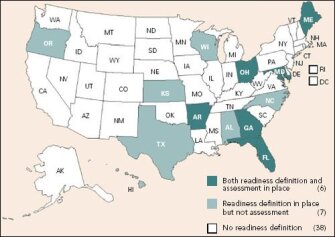
- Preschool Enrollment Patterns Thirty-eight states now have state-financed preschool programs, enrolling some 10 percent of children, ages 3 and 4, according to the National Institute for Early Education, based at Rutgers University in New Brunswick, N.J. Only a handful of states have more than 20 percent of 3- and 4-year-olds attending state-financed preschools.
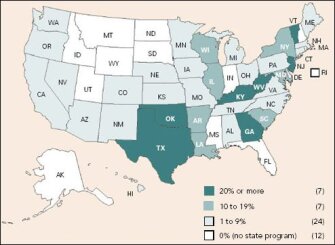
- Preschool Split The likelihood that a child will attend preschool is strongly tied to family income. While research suggests that low-income children benefit most from high-quality early-childhood education programs, they are far less likely to attend center-based preschool of any kind than their more advantaged peers.
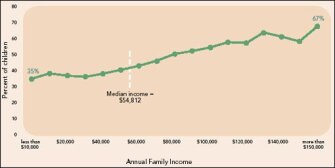
Access to such programs remains sharply divided by race and class, however. While 67 percent of 3- and 4-year-olds in families with annual incomes exceeding $150,000 attend preschool, that’s true for only 35 percent of children in families earning less than $10,000 a year, according to data from the U.S. Census Bureau.
States are increasingly recognizing the benefits of early-childhood education. According to the National Institute for Early Education based at Rutgers University in New Brunswick, N.J., 38 states now have state-financed preschool programs, enrolling some 10 percent of children ages 3 and 4. In total, 45percent of children ages 3 and 4 take part in some form of early-childhood education, according to the Census Bureau.
Policymakers could help make the transition from preschool to elementary education smoother by specifying the knowledge and skills young children need to be ready for school and by more closely aligning standards and curricula from preschool through the primary grades.
“Coordination should be the watchword of this effort,” writes Maeroff, “with standards, curriculum, instruction, and assessment aligned across the PK-3 continuum like the moving parts of a finely designed mechanical clock.”
| Data Download | |||
|---|---|---|---|
|
According to a survey of the 50 states and the District of Columbia conducted for Quality Counts, 41 states and the District currently have early-learning standards aligned with state academic standards for the elementary grades. Thirteen states have defined what young children need to know and be able to do to be ready for school. Sixteen states require districts to assess the school readiness of entering students. And 18 states provide programs to help young children who do not meet school-readiness expectations.