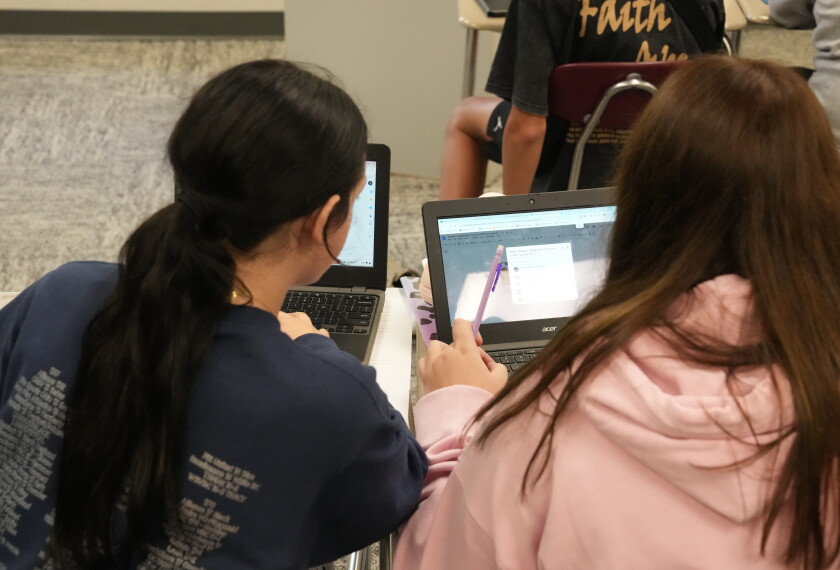
Almost one-quarter of school districts nationwide and nine states have invested millions of dollars in “one-to-one” laptop programs, hoping the availability of a computer for every student will improve achievement and other skills.
They made those investments despite the fact that research on the impact of such technology on student achievement is largely mixed and preliminary.
But a new wave of studies may help districts get a better sense of whether spending money on laptop initiatives is worthwhile. Those studies seek in part to establish a link—or a lack thereof—between one-to-one computing initiatives and academic achievement.
One report presented at an educational research conference last month, “One-to-One Computing: What Does It Bring to Schools?,” examines a Midwestern middle school over the 2003-04 school year. Students’ grade point averages rose during that school year, researchers found, but since GPA “was measured by traditional methods of assessment,” the students’ GPAs “might not be an accurate assessment of student learning with and without technology.”
“Overall, this is a complicated issue,” said Jing Lei, a co-author of the report and an assistant education professor of instructional design, development, and evaluation at Syracuse University in New York state.
It’s difficult to tease out the effect of providing each student with a computer from other factors, such as teacher involvement and student study habits, said Yong Zhao, the report’s other co-author. He is the director of educational psychology and educational technology at Michigan State University’s Center for Teaching, in Lansing.
As a result of that difficulty, much of the research on one-to-one technology initiatives, so far, looks at teacher, student, and parent perceptions and attitudes, not necessarily at how the tools affect academic indicators such as grade point averages and test scores, Mr. Zhao said. The research that has been done, he said, also tends to focus on just a year of implementation in a district or school, not several years, which would better gauge the impact of technology on achievement.
‘Many Variables’
Now, an increasing number of researchers are attempting to examine the effects one-to-one computing initiatives are having on student achievement. And they are looking at more than just one year.
Two education professors at Boston College, for instance, are evaluating a one-to-one laptop project at four middle schools in Berkshire County, Mass. In the three-year study, the researchers—Michael K. Russell and Damian J. Bebell—are using teacher and student surveys and interviews, as well as classroom observations, and they plan to analyze school records and student test performance.
“There’s a lot of research going into these [one-to-one laptop] programs, but not research on the outcomes,” Mr. Russell said. “The Berkshire study is on actual outcomes.”
Meanwhile, the 47,000-student Henrico County, Va., school district in suburban Richmond began a three-year study this school year on its one-to-one laptop project for secondary school students. All 25,000 middle and high school students and 2,000 teachers are issued laptops to use for their schoolwork. They are also allowed to take the laptops home.
Started in fall 2001, the $34 million laptop initiative has been well-received by students and teachers, though it has weathered some problems, ranging from connectivity difficulties to isolated cases of students’ use of the computers to cheat, change grades, or download pornography.
Interactive Inc., a Huntington, N.Y.-based education research firm, is conducting the Henrico County study. It is scheduled to release preliminary results this fall that will examine a number of factors, including productivity outcomes such as achievement, integration of technology into classroom instruction, student-assessment practices, and the limits of the laptop computers to improve teaching and learning. The study will also document how and whether students are learning problem-solving, online-communication, and other workplace skills.
While the study’s results are still months away, some Henrico County educators are confident that laptop computers have helped both students and teachers.
“It’s too early to tie academic improvement to technology—it would be very inappropriate to make that generalization because there are so many variables,” said Albert M. Ciarochi, the principal of the district’s Highland Springs High School. “But the greatest thing that we can readily see is that [laptops] allow the teachers and students to work smarter, not harder.”
The 11,000-student Daviess County schools in Owensboro, Ky., started a four-year, $1.6 million one-to-one laptop initiative this school year by giving laptop computers to all 900 of its high school freshmen. District officials plan to evaluate that effort before expanding the program to other grades.
Although the district has already invested the money in the program because school leaders are confident it will have a positive impact, they may also approve research on the effects of the program, said Susan Smith, the technology coordinator for the Daviess County district.
The district already has high rates of achievement and daily attendance, Ms. Smith said, so the laptop project was more about jump-starting student engagement than raising test scores.
“If engagement is there, achievement will follow,” she said.
‘Time and Money’
Some researchers and educators say the public tends to view laptop computers as a way in and of itself to boost teaching and learning. But the machines can’t simply be dropped into classrooms and work magic.
The experts say districts employing such initiatives must train teachers on how best to use the computers in their classrooms. And students must learn how to amplify the academic applications of the computing devices—not just use them to pass electronic notes to each other or play video games.
What’s more, educators can have a shortsighted view of laptops and other technology tools, Mr. Zhao of Michigan State University suggests. For instance, some schools bar students from using Web tools such as blogs because they fear students will use them inappropriately.
Yet Mr. Zhao argues that students must learn 21st-century skills, such as how to be responsible leaders in online communities, and how to construct effective digital portfolios. He says that schools would be better served if they used laptops primarily to teach those skills, instead of seeing the machines as tools for raising test scores.
“Lots of time and money have [been spent] to retrofit technology to teach traditional subjects,” he said. “Let’s not ask the question whether laptops are effective, but how can they be effective?”
Margaret Honey, the director of the New York City-based Center for Children and Technology, echoes Mr. Zhao. She emphasizes that laptops should be used to help develop workplace skills such as problem-solving and effective communication.
She argues that the metrics aren’t in place to gauge the efficacy of one-to-one school laptop projects, and that the United States has fallen short in measuring the skills in information-communication technology that students must acquire to be competitive with their counterparts in other fast-evolving countries.
“Just because you speak English doesn’t make you an effective communicator,” she pointed out. “So just because you use technology doesn’t make you an effective communicator with technology. That’s why we need effective assessments to judge how students are developing 21st-century [information-communication-technology] skills.”
Maine, which has spent $37 million to place laptops in the hands of every public school 7th and 8th grader and one-third of all high school students, is doing just that, said Bette J. Manchester, the director of special projects for the Maine education department.
The state is working with the Educational Testing Service, based in Princeton, N.J., to develop information-communication-technology assessments, and it plans to pilot technology resources developed by the ETS.
“These technology tools are part of an educational process,” said Ms. Manchester. “Just like a hospital, you don’t gauge it on its technology, but on what doctors and nurses do.
“We need those same expectations for schools,” she continued. “[Technology tools] can help [students] become independent learners and thinkers and problem solvers.”