Curriculum

Public Supports Higher Wages, Better Training for Teachers

By Linda Jacobson — June 07, 2005 1 min read
  • Save to favorites
  • Print

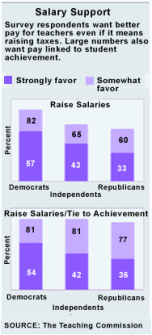
The poll results are posted by the Teaching Commission.

A majority of Americans, regardless of their political affiliation, say they would be willing to pay more taxes to give teachers higher salaries. And even higher percentages of people surveyed—77 percent of Republicans and 81 percent of Independents and Democrats—think higher raises should go to teachers who improve student achievement, according to recent polling results from the Teaching Commission.
BRIC ARCHIVE

A New York City-based nonprofit organization working to improve teacher quality, the commission conducted two polls late last year: one of 807 adults, including an oversampling of public school parents, and one of 533 public school teachers.

The poll results for members of the public also show that 62 percent of respondents believe teacher education programs should be more rigorous, and that 82 percent favor requiring every new teacher to have a mentor.

“The message is getting through: Now is the time to transform the teaching profession to upgrade the skills of all our students and close achievement gaps,” Louis V. Gerstner Jr., the chairman of the commission and a former chairman and chief executive officer of IBM Corp., said in a statement. “And it’s not only the general public that’s ready for reform. Many teachers know better training, more mentoring, modern incentives, and meaningful rewards for excellence are long overdue.”

The poll, released in April, also shows significant support—more than three-quarters of both sample groups—for paying teachers higher salaries if they are willing to work in low-income schools.

The margin of error is 3.5 percentage points for the public survey and 4.3 percentage points for the teacher survey.

Events

This content is provided by our sponsor. It is not written by and does not necessarily reflect the views of Education Week's editorial staff.
Sponsor
Artificial Intelligence Webinar
Managing AI in Schools: Practical Strategies for Districts
How should districts govern AI in schools? Learn practical strategies for policies, safety, transparency, as well as responsible adoption.
Content provided by Lightspeed Systems
This content is provided by our sponsor. It is not written by and does not necessarily reflect the views of Education Week's editorial staff.
Sponsor
Reading & Literacy Webinar
Unlocking Success for Struggling Adolescent Readers
The Science of Reading transformed K-3 literacy. Now it's time to extend that focus to students in grades 6 through 12.
Content provided by STARI
Jobs Virtual Career Fair for Teachers and K-12 Staff
Find teaching jobs and K-12 education jubs at the EdWeek Top School Jobs virtual career fair.

EdWeek Top School Jobs

Teacher Jobs
Search over ten thousand teaching jobs nationwide — elementary, middle, high school and more.
View Jobs
Principal Jobs
Find hundreds of jobs for principals, assistant principals, and other school leadership roles.
View Jobs
Administrator Jobs
Over a thousand district-level jobs: superintendents, directors, more.
View Jobs
Support Staff Jobs
Search thousands of jobs, from paraprofessionals to counselors and more.
View Jobs

Read Next

Curriculum Opinion What Policymakers Get Wrong About 'High-Quality' Curriculum
Schools can't fix instruction without fixing curriculum, Doug Lemov warns.
10 min read
The United States Capitol building as a bookcase filled with red, white, and blue policy books in a Washington DC landscape.
Luca D'Urbino for Education Week
Curriculum Cursive is Making a Comeback. It Won’t Be Without Challenges
A growing number of states are requiring schools to return to cursive writing instruction.
5 min read
A third-grader practices his cursive handwriting at a school in the Queens borough of New York.
A third-grader practices his cursive handwriting at a school in the Queens borough of New York. At least half of the nation’s states have adopted cursive writing instruction in recent years, reversing a sharp decline in teaching of that skill after the Common Core, launched in 2010, omitted it from its standards.
Mary Altaffer/AP
Curriculum Why Media Literacy Efforts Are Failing to Keep Up With Misinformation
Classroom educators need support from district and school leaders in addressing flashpoint topics.
5 min read
Ballard High School students work together to solve an exercise at MisinfoDay, an event hosted by the University of Washington to help high school students identify and avoid misinformation, Tuesday, March 14, 2023, in Seattle. Educators around the country are pushing for greater digital media literacy education.
Students at Ballard High School in Washington state work to solve an exercise at MisinfoDay, a March 2023 event hosted by the University of Washington to help high school students identify and avoid misinformation.
Manuel Valdes/AP
Curriculum Opinion Kim Kardashian Says the Moon Landing Was Fake. There's a Lesson Here for Schools
Teachers can use popular conspiracies to help students scrutinize what they see online.
Sam Wineburg & Nadav Ziv
5 min read
Halftone collage banner with two smartphones and mouth speaks into ear and strip with text - fake news. Halftone collage poster. Concept of fake news, disinformation or propaganda.
iStock/Getty + Education Week
