

The letter sat for days in a stack of tabletop mail, a plain envelope with an Albuquerque return address, as easy to ignore as a credit card offer or cut-rate vacation deal. He figures it was almost a week before anybody noticed it.
“Congratulations,” Russell Sandoval remembers reading, after peeling it open. “You have been admitted to the University of New Mexico as a beginning freshman for the fall 2005 semester.” The institution even sweetened the deal with a scholarship that could save him thousands of dollars in tuition.
His mother hugged him. His father, who was working in the front yard, smiled and congratulated him. Amid all that elation, the son, who was at home on the San Felipe Pueblo for the Christmas holiday, reminded his parents that this was only a first step.
“One down,” Sandoval said. “Let’s see how many more I get in to.”
Like many of his senior classmates here at Santa Fe Indian School, Sandoval harbors an ambition that no single bit of recognition, however appealing, can fully satisfy. His view is long-term. Next fall, he envisions himself on a college campus, in New Mexico, Arizona, or Colorado, away from home, but not too far away. He hopes to be working toward a degree in the computer field, and meeting students from places he’s never seen.
And after graduation, he sees himself returning to San Felipe, or a nearby pueblo, using his college skills to help improve the community. It is a longing shared by many of the seniors at Santa Fe Indian School, which, in recent years, has defied long-standing trends among Native American students by sending an unusually strong percentage of its graduates to college, including some of the country’s most prestigious institutions.
While reliable estimates of American Indian students’ college participation are scarce (in part because their numbers are so low), the U.S. Bureau of Indian Affairs boarding school in Santa Fe has taken steps to make postsecondary education the norm, rather than the exception, even while serving many disadvantaged youths. Overall, the academic proficiency of the 700-student school’s students also ranks well above the recorded averages of other BIA facilities, which serve some of the nation’s most disadvantaged students.
In large measure, the Santa Fe school is accomplishing what many schools serving academically at risk children long to do: encourage their students early on to consider college and then give them the support to get there.
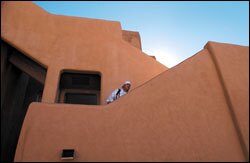
For many of the school’s students, who arrive from Indian communities across New Mexico, and occasionally outside the state, the first leg of that journey is often the toughest. It begins in 7th grade, when they move into dormitories on the campus, a tan chessboard of adobe-style buildings along a churning roadway south of the city’s chic downtown plaza. The new arrivals follow a program that blends New Mexico’s state curriculum with lessons about native culture and with potent doses of career and college counseling.
And over time, many of those students develop a conviction, pressed upon them by their parents and elders, that college is not only a ticket to the world outside the pueblo, but also a promise to return.
“Your heart is there,” says Sandoval, 17. “You grew up in there, in that atmosphere. You know that you have to have a responsibility to go out and get an education, and then come back and help your people.”
On the day they made the half-hour drive north to the Santa Fe Indian School six years ago, Russell Sandoval and his parents, Michael and Sandra, carried a mental picture with them. A school for Native Americans. Operated by New Mexico’s Pueblo tribes. A place where Indian youths lived and studied together, like a family.
But after his parents dropped him off, the boy found little that was familiar to him. At a student orientation, his classmates described themselves as Navajo, Apache, even Plains Indians. “I thought this was a Pueblo school,” Sandoval recalls thinking upon meeting students from other tribes. Even among the other Pueblos he met, he heard Indian languages that were completely different from the Keresan dialect he knew from San Felipe, a community of 3,200 people that straddles the Rio Grande River.
Sandoval was right about the school’s Pueblo status, though it would take years for it to secure that standing. Santa Fe Indian School opened in 1890, with nine Pueblo students and a mission that paralleled those of the other federal schools serving American Indians at the time: to educate and “civilize” Indian youths, by removing them from their family culture and making them conform with white society. That pattern of forced assimilation, which was occurring around the country, persisted for decades. It swept up many of the families and staff members who are connected with Santa Fe Indian School today, including Gil Peña, the school’s dean of students.

Peña, a 58-year-old with orderly gray hair and wire-rimmed glasses, acts as both the school’s czar of student discipline and an adviser to longtime Superintendent Joseph Abeyta. A former Pueblo governor with a nutcracker-strength handshake and a tone that shifts smoothly between lighthearted and serious, he seems well suited for the sometimes difficult meetings with parents and students that accompany his job. A school should nurture students as it educates them, he says. Santa Fe Indian School’s parents and tribal communities help accomplish that goal.
His own experience was much different. Peña’s first school was a BIA facility on his native Nambñ Pueblo, about 15 miles north of Santa Fe. He arrived there not knowing a word of English, and when he tried speaking to his classmates in his Pueblo language of Tewa, his teacher, an Anglo woman from Texas, cracked him on the head or the hand with a ruler. He remembers running off into the nearby hills, and school officials catching him and bringing him back.
“It was a scary time for me,” Peña says. “You leave your culture, your tradition, your language, when you walk in that door.”
Each fall, Peña is charged with delivering a pointed message to incoming 7th graders at Santa Fe Indian School: Some of you won’t last here. Some will leave for disciplinary reasons; others won’t cut it academically.
In discipline, student life, and academics, the school today encourages tribal influence, and in some cases relies on it. On this December morning, Peña is preparing to meet with the parents of a Navajo girl who’s been misbehaving. When he sees the incident report, he recognizes the family name right away.
In similar cases, Peña will ask to meet with both the parents and the family’s tribal governor, in the home community. He will present the situation to the native leader and ask for help. That approach pays off, Peña believes. Students come away with a strong message from their families and tribal leaders: Disrespect the school, and you disrespect us.
Members of the Pueblo community have a strong incentive to immerse themselves in the Sante Fe Indian School: They operate it, under an arrangement with the BIA, an arm of the U.S. Department of the Interior.
In the 1950s, the original campus was closed, a move that outraged many parents. According to author Sally Hyer’s history of the school, One House, One Voice, One Heart, the BIA later told students that their best option would be to attend Albuquerque Indian School, 60 miles to the south, an aging, decrepit facility in the memories of many Santa Fe staff members.
In 1977, frustrated leaders on the All-Indian Pueblo Council, a coalition of native governments, voted to take over administration of the Albuquerque school, and later relocated it to the Santa Fe campus. Today, the school is operated by the 19 Pueblo tribes of New Mexico—separate, federally recognized sovereign nations—and it receives federal funding from the BIA. About 60 percent of roughly 180 BIA schools today operate under similar grants or contracts.
While Santa Fe Indian School offers only one Advanced Placement subject, English, it allows students to enroll jointly in local community colleges. The school’s classes are also modified to include “community based” education—student-led projects on relevant issues affecting Indian tribes. Each year, Pueblo leaders advise school staff members on those topics, which have recently included air and water quality and animal migration. The goal for students is not only to gain knowledge about social issues, says Glenda Moffitt, the school’s director of planning and evaluation, but also an understanding of what it takes to run tribal governments.
Santa Fe Indian School has established policies aimed at promoting student discipline—and independence. Students follow a tight routine: a 6 a.m. wakeup call, breakfast at 7, classes till about 3 p.m., followed by after-school activities, such as sports.
Dorm life brings its own responsibilities. Sandoval’s uncluttered room, on one of the residential hall’s upper stories, is about three quick strides wide, with identical beds and bookshelves occupying both sides. A chrome-tinted stereo sits on a central desk, above a pair of gym shoes belonging to his roommate, fellow senior (and state cross-country champion) Jerome Tafoya. A short hallway leads to a bathroom, almost as big as the bedroom itself.
School officials believe the residential component can prepare students for college dorm life. Sandoval plays a role in that training: The tall, lanky teenager with dark, short-cropped hair is a dorm proctor, responsible for overseeing cleaning duties and dorm checks.
For Sandoval, the possibilities after high school became clearer his sophomore year, when he took a required seven-week career unit led by school counselor Pat Schubauer. He began researching colleges, some of which he applied to this year, such as the University of New Mexico. His top choice, Arizona State University, was also on that list.
Each year, Schubauer reviews college applications with students, advises them on the accompanying essays and recommendations, and tries to encourage them to think about the postsecondary setting that will best suit them.
She often introduces the concept of going to college with a question: Think about the job you want someday—what training will you need to get there?
The counselor agrees with other faculty members that her students’ desire to improve their pueblos—through better social services, new businesses, and other means—often outweighs financial and career motivations. The pressure to help the pueblos “is not like something that’s put on them from the outside,” she says. “It’s something that’s lived in their community.”
It seems to be paying off. The school estimates that at least 90 percent of seniors, on average, go on to two- or four-year colleges, including technical schools, a rate that eclipses the adult percentage of Native Americans with a bachelor’s degree or higher.
Not that the school doesn’t face hurdles. While its students far exceed the test-proficiency levels of the overall BIA population, Santa Fe Indian School was placed on “alert” status under the federal No Child Left Behind Act this academic year, joining about two-thirds of all BIA schools that didn’t make adequate yearly progress, bureau records show. That designation was triggered by special education students not making AYP, according to BIA data.
Some critics say the school’s location, in a tourist mecca famed for its resorts and art galleries, gives it unparalleled advantages. Other BIA facilities, in far more remote, impoverished areas, face a much harder task in recruiting staff members, they say. Still others suspect that Santa Fe Indian School, in requiring prospective students to complete an application process, ends up serving more academically gifted students than other BIA facilities.
Moffitt calls that criticism baseless. She maintains that the application is meant to provide basic information, not to screen students. The average 7th grader, Moffitt points out, arrives with academic achievement at a 3rd or 4th grade level, and more than 100 of the school’s 700 charges qualify as special education students. The school meets those needs through extensive after-school tutoring and remediation, she says.
Despite its ability to help students reach college, only 40 percent are graduating in a two- or four-year period, Moffitt estimates. Some who drop out return later, says Moffitt, who believes about 60 percent eventually secure a college degree. (That number surpasses some college-persistence estimates for Indian students nationwide.)

Keith Candelaria is a 1999 graduate who went on to Dartmouth College. After receiving a degree in environmental earth science from the Ivy League institution, he returned to New Mexico to work as a water-protection specialist. Today, the 23-year-old educates Indian communities about water contamination—an issue he worried about as a boy, on the Jñmez Pueblo.
“Growing up, it’s instilled in you,” he says. “You see what the reservation lacks.”
Yet those bonds are also part of what makes college so difficult for Indian students, adds Candelaria, who remembers some native undergraduates quitting college for that reason.
Russell Sandoval expects to grapple with those transitions, too. He knows he will miss the customs like his pueblo’s corn dances, a centuries-old tribal ceremony. His expectations come across in an essay on his application to the University of New Mexico. The paper is historical, touching on the Catholic Church’s influence on pueblo society. It is biographical, detailing his record as a National Honor Society member and senior class president. And it speaks to why he’s applying to college in the first place, drawing upon a conversation he had with his grandmother.
“She is the link to the past, and to the future, for she is wise,” Sandoval writes. “It pains her to see that most teenagers aren’t too eager to move on to a higher education. She always tells me constantly to make something out of the opportunity I have been given. … [I] want to be that person that brings change and a sense of direction to the community.”


