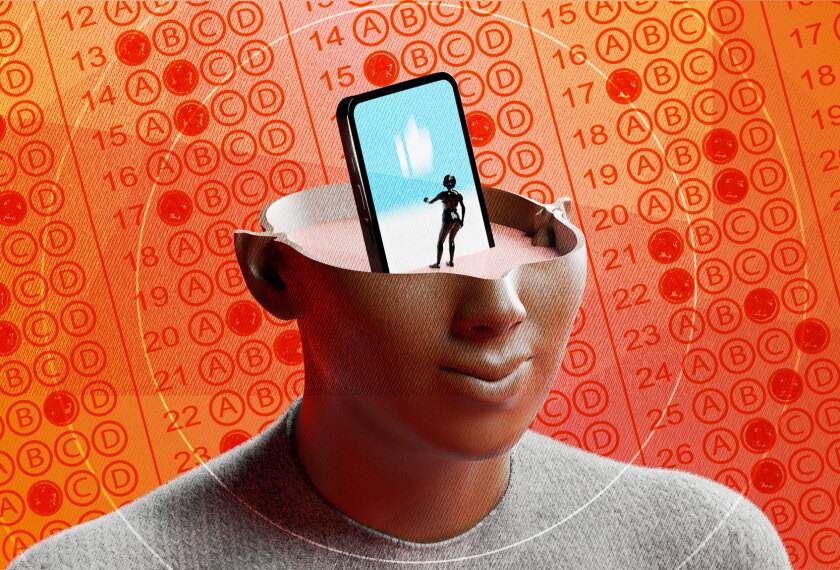
The rising controversy over “high stakes” testing masks an underlying consensus about accountability that is, for schools, even more debilitating than the test fad itself. Despite their strong differences, conservative and liberal reformers alike have come to embrace the Great Accountability Fallacy, the notion that the school, alone, should be held responsible for student achievement. They differ sharply about how to improve outcomes, but they are certain that improvement is uniquely up to the school.
To testing proponents, mostly conservatives who see public schools as inadequate and irresponsible, accountability is a straightforward proposition: A school, like a factory, turns out a product; if the product is subpar, the factory must be at fault. Schools’ products are manifestly subpar. Testing is key to promoting higher standards because it will dramatize schools’ weaknesses and motivate improved results by teachers and pupils--provided it is accompanied by tough consequences (low-scoring schools placed on “watch” lists or threatened with state takeover, students who fail denied promotion and graduation, and so on).
Liberal reformers agree readily that there are performance problems in schools, but attribute these to the very kinds of instruction and assessment conservatives want to reinforce. For them, the whole standards-and-testing enterprise is misguided, unfair, and cynical. It rests on a primitive, punitive notion of motivation, assuming that teachers and students are lazy (“raising the bar” can’t make people jump higher unless they haven’t been trying hard enough). It targets the wrong goals in the wrong ways, aiming at the recall of facts, figures, and formulas instead of the ability to apply knowledge in real-life settings. Often, the exams themselves are full of design defects. (Massachusetts’ recent statewide exam is a classic case: It lasted an exhausting 15 hours; covered much material students hadn’t studied; required 8th grade reading skills on its 4th grade test; and did not begin with the easiest problems and move gradually to the hardest.) Such tests don’t raise the bar, they punish the victims--especially poor, minority, and non-English-speaking students. Indeed, punishment, not assessment, often seems precisely the point: The tests are intended to magnify public schools’ shortcomings and bolster the conservative case for vouchers, choice, and privatization.
The differences in this dispute are profound and go to basic beliefs about the nature of learning and the essence of teaching. But they are differences about goals and methods. Underneath, the adversaries share similar assumptions about the extent of the school’s responsibility. Most liberals, like conservatives, feel that schools aren’t doing an adequate job, especially schools in poor communities. And most concentrate on changes in schooling alone as the critical factors in improving student performance.
This simplicity lends each separate reform effort purity and urgency, but it assigns the school a responsibility far beyond its reach and ignores the reality visible in any school any day: The chief determinant of student performance is not the school; it is (pardon the mouthful) the psycho-social-cultural-economic world in which a student grows up--the complex of influences that shape community norms, family life, and child development.

As researchers have been noting for years, the strongest predictors of achievement have always been nonschool factors, such as the student’s own personal characteristics, the level of parents’ education and income, the size and stability of the family, the wealth and stability of the community. Together, these have a far greater influence on performance than the school’s instructional program. James J. Gallagher captured this truth in these pages when he suggested that education is, by itself, “a weak treatment"; that it contributes less than 25 percent of a student’s total outcome in academic achievement and social behavior. (Commentary: “Education, Alone, Is a Weak Treatment,” July 8, 1998.) Even that proportion may have been too generous. On the National Assessment of Educational Progress, researchers have accounted for 89 percent of the state-level difference among students’ math scores by knowing only four factors: the number of parents in the home, the level of their education, the type of community in which they live, and the state’s poverty rate.
Sadly, the trends in key nonschool determinants over the past 30 years have been, with some exceptions, negative. The breakup of the family, the decline of shared social values, the decrease in livable-wage jobs in urban areas, the rise of television with its blizzard of sex and violence--these and other influences have hugely complicated the school’s task.
The effects are pervasive. Across the country, kindergarten teachers report that more and more students begin school less ready to learn; that is, less able to form a line, listen to others, share materials, persevere at tasks. (Remember Goals 2000’s first commitment, that all children in America will start school ready to learn? Consider how much test scores would improve if this condition alone were met--and how helpless schools are to guarantee it.)
More and more students are sent to school ill because working parents can’t stay at home with them--visits to the nurse are rising 20 percent per year in some states. Adolescent behavior is becoming more and more provocative. Parents spend less time with their children and assert less authority over them, and are themselves less respectful of the school’s authority and much more likely to challenge its decisions. These and other negative trends--trends that occur among families from all socioeconomic levels--make students harder to reach and teach. They make it more difficult to raise scores even when schools adopt new standards and improve instruction.
Many school reformers would object that they are fully aware of these dilemmas and have been seeking to help schools address them through new programs and better funding. Their concern is genuine, but it repeats the great accountability fallacy: It seeks yet more ways for schools to fill gaps left by others. Most schools now have improvement agendas that are vastly overloaded as they try not only to cope with less-ready students but also to implement all the initiatives that have been pressed upon them in curriculum, instruction, assessment, technology, governance, and inclusion. (Special education itself epitomizes the fallacy: A well-intentioned innovation ends up making the school responsible for remediating virtually any disabling condition regardless of origin, nature, or cost.)
To argue this case does not trivialize the work of dedicated teachers or let bad ones off the hook. It doesn’t mean that school doesn’t matter; school matters hugely. Even if its margin of influence is, on average, “only” 25 percent, this can be decisive in the shaping of lives and careers. And there are many students for whom the schools’ impact is greater--many whose lives are literally transformed by teachers. And it emphatically doesn’t mean we shouldn’t hold schools accountable. We should never excuse bad teaching or not trying. Indeed, the harsher students’ lives, the more they need dedicated teachers. We have every right to expect educators to do the very best job possible with the resources we give them.
But we don’t have the right to expect them to solve societal problems they didn’t create and can’t control. School reformers of all stripes must begin to reconcile the intensity of their commitments with the modesty of the school’s clout. This means moving the accountability debate beyond an obsession with the ranking--and blaming--of schools and extending its scope to include family and community, the media, and civic and political institutions. Within education, this would ideally mean developing some kind of “value-added standards"--ways to specify and assess the expectable contribution of a teacher and a school, given the realities in which they work.
Consensus about such standards would be elusive and would by no means solve all our differences. But it would avoid the accountability fallacy, and it would help us reconsider what constitutes meaningful progress in education. It would remind us that schools reflect society far more than they shape it, and that test scores tell us much more about what schools are facing than how they’re failing. Surely, we must challenge teachers and administrators to do their utmost, but not to work miracles. And not by themselves.
Robert Evans is a consultant to schools and the executive director of the Human Relations Service in Wellesley Mass. He is the author of The Human Side of School Change (Jossey-Bass, 1996).