| Vocational education should challenge the divide between manual and mental work. |
When I went to high school, students were placed, upon entrance, into one of three or four curricular “tracks.” Most readers beyond their 30s will remember them. There were, typically, an academic or college preparatory track (and, in some schools, honors or advanced placement courses); one or two variations of a general education track; and a vocational track. Like many children of the working class, I began my high school career in the vocational track. What makes my story unusual, particularly for the time, is that I was moved out of it and into college prep. I got to see both worlds. Though I had little sense at 16 as to what this move would mean for my future, I could certainly tell that the courses were different and that, well, it somehow felt different to be in school.
We as a society have developed a popular occupational vocabulary that leads us to make substantial distinctions between work of body and brain, of white collar and blue—these days expressed as the new knowledge work versus old-style industry and service work. Neck-up and neck-down. One of the most influential of these dichotomies, particularly in the lives of young people, has been the distinction between the academic and the vocational, which characterized the high school curriculum for much of the past century.
Although the official policy of placing students into an exclusively vocational track has been largely abandoned, there remain patterns of inequality in the courses students take. I certainly see these patterns in the schools I visit as part of my work on the faculty of the UCLA Graduate School of Education & Information Studies. Vocational courses still tend to be the domain of working-class students and students of color, and some of the courses exhibit the same limiting characteristics that I experienced in my day.
A dimension of this inequality is summed up by the authors of a recent historical analysis from the National Center for Research in Vocational Education: “Vocational teachers emphasized job-specific skills to the almost complete exclusion of theoretical content. One result was that the intellectual development of vocational students tended to be limited at a relatively early age.” This, I think, is a remarkable statement. We charge the school with cognitive development, yet in the very curriculum that places work at its core, we have historically found a restriction of intellectual growth. The report captures the fundamental paradox of vocational education as it has been practiced in the United States: its diminishment of common work and of the people who do it. This state of affairs provides an extended illustration of the degree to which the hand-brain division runs deep and wide in our social and institutional life.
John Dewey, the eminent 20th century educational thinker, was among the first of many to raise concerns about vocational education’s narrow focus on job training and its separation of young people essentially by social class. “Social predestination,” he called it.
A further issue involved gender stereotyping and racial segregation. Girls were channeled into clerical courses (which were successful in leading to employment) and into courses like home economics, which did little to prepare them for work outside the domestic sphere—or beyond domestic labor. Black Americans, especially in the South but not only there, were virtually excluded from many forms of mechanical and technical training. Critics wondered if vocational education was creating employment opportunity or was reinforcing the prevailing social order and opportunity structure.
And there is another, not unrelated, matter of inequality. A long line of sociological studies demonstrates systematic bias at play in the way students got placed in various curricular tracks. (And in a post-tracking environment, these biases continue to affect course placement and selection.) For all the administrative rationality and meritocratic logic of the differentiated curriculum, academic counseling can be irregular and inconsistent and can be affected by, among other things, parental power and teachers’ and counselors’ beliefs about race and social class.
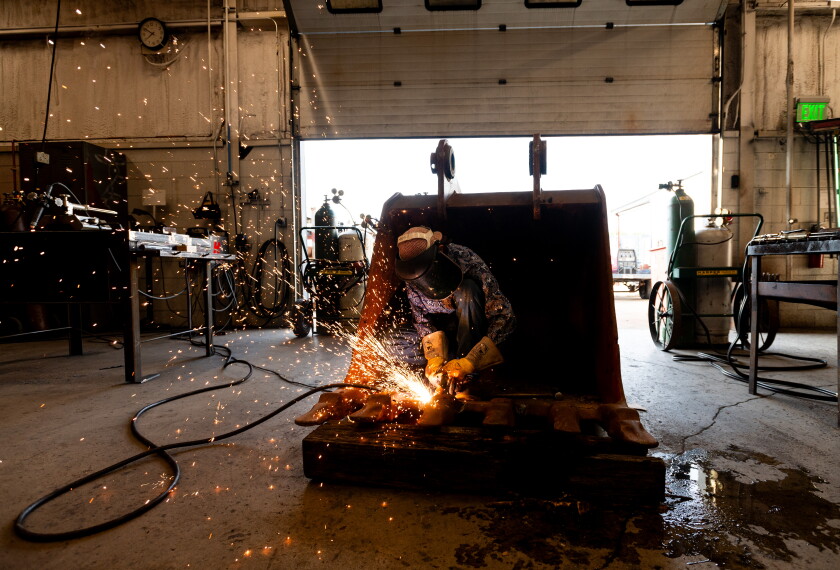
Finally, there are the intellectual limitations of vocational education. Criticism has frequently come from those schooled in the humanities or the life and physical sciences. While their critiques have merit, they also have an unfortunate quality, typically framed in the very terms that the vocational education community rejects: a comparison with the college prep course of study. What intrigues me, though, is that within the vocational education enterprise—on its own terms, not comparatively—there has been scant attention paid to the intellectual dimension of common work, to the cognitive possibilities of the hair salon, the welding shop, the construction site.
This is not to deny that many a vocational instructor has taught well and has made a difference in young people’s lives. My stepfather, a very handy guy, locates the origins of his skill some 60 years ago with a Mr. Foster, his high school wood-shop teacher. When you get close to good vocational instruction—just as when you get close to work done well—the intellectual content of the practice is clear, though it may not be expressed in typical academic terms.
It is also important to note that during the past two decades, there have been a number of attempts to reform vocational education, to add academic work into its course of study, or, more ambitiously, to create programs or entire schools that integrate the two approaches. As with any reform effort, the results have been varied, with many attempts minimally to moderately successful, and a few proving truly innovative. There are a number of reasons why reform is difficult district bureaucracy, turf battles, teacher development but surely one is the history of the academic-vocational divide itself.
Popular theories of intelligence once defined entire social groups as “hand-minded” and “abstract-minded.” Combined with these theories was the belief that the task of an efficient school system was to guide people into their likely places in the social order. So the hand-minded—primarily working-class—children would be trained for manual work. These beliefs were woven through the organizational development of vocational education and cemented in cultural biases about physical versus mental ability. Furthermore, there were no bridging mechanisms built between the vocational and academic realms to enable creative interaction, to foster cross-disciplinary discussion that could expand and enlighten, for example, the use of tools or the development of literacy.
Theories of intelligence once defined entire social groups; these beliefs were cemented in biases about physical versus mental ability. |
I think here of something I saw at a Habitat for Humanity site that crystallized this issue for me. I was watching Scott Butler, a teacher and skilled carpenter, as he guided two of his students inserting windows into a house frame. They had just placed an assembled window into its space in the frame. They were looking it over, eyeballing the edges, checking it with a level. They were following procedure, and everything seemed OK; they were ready to fasten the window in place. Mr. Butler took a few steps toward them and asked them to come along, to walk with him around to the other side of the window, inside the house. “Take a look from here,” he said. The boys inspected the edge of the frame, and saw the problem. The plywood that forms the frame on this side of the window assembly had been cut unevenly, and at several places there was not enough wood to receive the nails that the boys were about to drive from the other side. They were visibly struck by this, said they wouldn’t have thought of this. But, geez, now that they see it...
In many ways, this is a small thing, but it also could be thought of as a metaphor for the vocational-academic divide. Though a routine move, and though utterly functional—you have to see if your window assembly will be secure—this strategic shifting of physical location represented for me the shifting in perspective that is such a key element of intellectual development. It contributes to the solving of problems in many domains, to a more complex understanding of human behavior, to adopting point of view in literature and the arts. A lot could emerge from this moment. The day-to-day at the Habitat job site was full of such episodes, and their cross-disciplinary potential is, for the most part, lost to the English teacher or the psychology teacher, sealed off by the physical and conceptual barriers of the curriculum.
Debates about vocational education, though politically weighty, tend to take place at the margins of school reform efforts. But I’ve come to believe that the vocational-academic divide could become the site of a broadly significant conversation, one that would not only affect vocational education but also extend far beyond it. There is the issue of intelligence itself: its definition, the limits of our standard measures of it, and our lack of appreciation of its manifestation in the everyday. There is the set of cultural assumptions that attribute low intelligence to entire categories of work and the people who do the work—often poor people, people of color, and immigrants. There is our impoverished sense of what work itself, any kind of work, requires and an arrogant denial of the intricate human dimension of technology.
Without such a discussion, we will never truly transform vocational education or bridge the academic-vocational divide. We will continue to take good ideas and squander them, dumb them down, trivialize them, for the beliefs about intelligence and the social order that underlie a curriculum are as important as the content of the curriculum itself. We need to challenge our assumptions about hand and brain and the rigid system of educational theory and method that emerged from them, making the schoolhouse truly more democratic by honoring the fundamental intelligence of a broad range of human activity.