

A cutting-edge technology like artificial intelligence might seem out of place in an elementary classroom. But educators are experimenting with ways for their young students to use AI in an effort to engage them, reinforce what they’re learning, and teach them about the technology’s inner workings.
While there is concern among parents, policymakers, and medical experts that AI-powered platforms are not safe for young children and that students are spending too much time with technology at school, some educators argue these concerns don’t mean students should wait until high school to start learning how to use the technology—so long as it’s in the classroom with proper oversight and guardrails.
The younger students start, the more agency they’ll have when using AI, said Dustin Nadler, an associate professor of psychology and the associate director of the Center for Access and Achievement at Maryville University in St. Louis. Nadler presented on his research into incorporating AI and machine learning into elementary classrooms recently at the ISTELive 26 + ASCD annual conference in Orlando, Fla.
“We can better prepare students to be more critical consumers and to become creators, not just passive users” of AI, he said.
Nadler also said students are more likely to see themselves as future AI engineers and researchers if they are exposed to these concepts when they are in elementary school.
“How do we develop this sense of identity, the sense of, ‘this is something that I can aspire to be,’ where we remove some of the stereotypes and barriers that exist?” he said in an interview.
So how are educators who work with elementary students introducing AI to their students? Education Week attended several presentations at the Orlando conference to find out.
Teachers use AI to engage students and give feedback
In the 2nd grade classes at A.D. Henderson University School in Boca Raton, Fla., K-5 STEAM teacher Jenny O’Sullivan has students use AI in a project for their English/language arts class on insect habitats. They take what they’ve learned through their research on an insect of their choice to create a realistic AI-generated image of the insect in its habitat. She then records each student against a green screen discussing their research and superimposes that video on the AI-generated image.
[T]each them good habits now, so that the middle school and high school teachers don’t’ have to teach them to break their habits.
The final project might look like a 2nd grade student waving from atop their praying mantis while reciting facts about the insect. The videos are played in a loop in a hallway at the school. The exercise helps students cement what they’ve learned, O’Sullivan said.
“It’s really nice to be able to have them show what they learned, what they did in the classroom, in a meaningful way,” she said. “They have complete ownership because it’s their insect in their setting. They’re giving these facts. They are the researchers.”
The point of research is to share information, and this is a fun and creative way of doing it, she added.
Teachers are also creating tailored AI chatbots for their elementary classrooms.

Holly Clark, an education technology consultant, trainer, and author, has worked with teachers using SchoolAI to create customized chatbots focused on a particular subject and grade level, such as 1st grade astronomy. Because kids are in the driver’s seat and get to ask the chatbot what they want on the topic, the chatbot becomes an engaging tool for reinforcing their knowledge and teaching them new things. Students can ask their questions verbally, and the chatbot can provide audio answers.
“This is what 1st graders do, this is how they learn,” Clark said. “Because they got to ask the questions, every kid had a mental hook about where to go for deeper comprehension.”
Other education companies, such as MagicSchool, also have customizable chatbot features built into their products and services.
Teachers are also using AI to create chatbots based on characters in books students are reading, Clark said.
I tell the kids beforehand, chatbots are like strangers. You don't talk to strangers at the grocery store without your parents.
Other AI-powered tools, such as Snorkl, can provide students with instant feedback on their work and how they’re solving a problem or writing an essay, said Clark.
“Instead of having to come up to the teacher and ask if they did it right, or wait for the teacher to grade it, they get feedback right away while their working memory is intact,” said Clark.
Learning the nuances of effective AI prompt writing
Elementary students can—and should—learn how AI works and how to use it properly.
Cara Pavek, a 1st grade teacher at A.D. Henderson University School, has her students use an AI image generator for projects. It’s a useful exercise in learning the nuances of productive prompt writing. Pavek has her students first draw what they want the AI image generator to create. She only has them prompt the tool to create the image once they’ve visualized their goal. Students quickly learn how detailed a prompt must be to get what they need.
“I have kids who go, ‘wait, I didn’t want it like that.’ And I say, ‘so how does your prompt have to change?’” Pavek explained. “Because prompt literacy is something that’s important.”

Allowing students to experiment with AI gives teachers meaningful opportunities to teach students how to use AI responsibly and safely.
Pavek doesn’t let her students use AI chatbots unsupervised. For example, for a project that has students creating their own characters for a story, she sits with each student and helps them enter their prompts into Google Gemini.
“I tell the kids beforehand, chatbots are like strangers. You don’t talk to strangers at the grocery store without your parents,” she said.
These conversations are an important foundation for making sure students use AI responsibly, she said. “We also [make] sure that they understand that AI is a helper. We need to make sure that we’re thinking first.”
Some important AI lessons take place without the technology itself
Students can learn about how AI works and to use it responsibly without using the technology itself. So-called “unplugged” AI activities use paper and other analog tools to teach students about important concepts, such as AI bias and algorithms.
Roberta Frietas, an education technology specialist and Google Trainer, presented on the concept at the conference.
For example, teachers can give students a deck of cards with pictures of, say, surgeons and nurses (and other professions) on them. These images represent the dataset the AI is trained on.
The students don’t know it, but the surgeon pictures are disproportionately male and the nurse pictures disproportionately female, reflecting both the demographics of those professions and how they are often portrayed in media. As students draw and tally the cards, they see that the surgeon image “generated” by AI is more likely to be male, and the nurse image is more likely to be female.
“It’s very important for students and teachers to understand what’s behind [AI], why they get the answers they’re getting,” Freitas said. “This is why it’s very important to get the fundamentals before you actually interact with AI.”
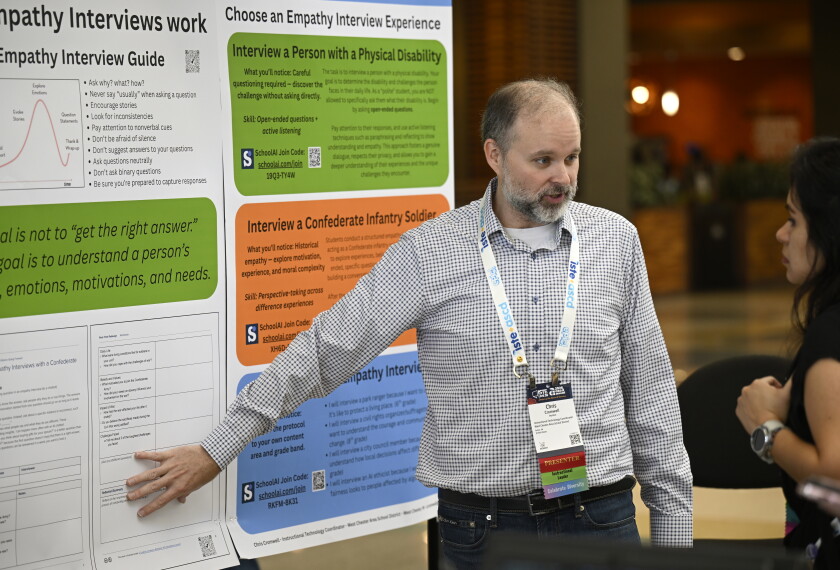
Because of their age, students are not allowed to use AI at Morris Elementary School in Lenox, Mass., said Kate Shaw Olender, the school’s technology integration specialist. Presenting in Orlando, she said that doesn’t stop her from teaching her students AI literacy—how the technology works, how it can be biased, and how students can protect their data. Olender also said she is intentional about modeling effective and responsible AI use.
This is important, Olender said, because her elementary students are using AI outside of school, either intentionally by playing around with an AI chatbot or unintentionally through online games and social media. Elementary students need to know that AI is not magic or all-knowing, she said.
“A lot of times they’ll say, ‘oh, it can answer anything,’” she said. “They need to be aware of the good and the bad, they need to be aware of the ethics, and question, question, question whether they should be using it, what they’re using it for, and, is it a tool for what they’re looking for?”
As a former university librarian, Olender remembers college students coming to her unable to do an effective internet search because they were used to having so many filters from their school-issued devices on their browsers.
“I’m a huge believer in, teach them good habits now, so that the middle school and high school teachers don’t have to teach them to break their habits, and then how to form good habits,” she said.


