Reading & Literacy

Will Reading First Survive?

June 23, 2008 1 min read
  • Save to favorites
  • Print

Looks like a House appropriations subcommittee isn’t interested in revising or strengthening Reading First, as many advocates and experts have advised. As my colleague Alyson Klein reports here, the panel, led by David Obey, one of the harshest critics of was a $1 billion-a-year program, would zero out funding in fiscal 2009.

After the 61 percent cut to RF in the fiscal ’08 budget, the strength of the program is certainly compromised. Many districts will be forced to eliminate positions, particularly the reading coaches that became a standard resource in participating schools.

But many observers believe the RF principles—the use of sound, proven instructional strategies, teaching essential skills in an organized way, and regularly gauging what students can and can’t do—are likely to endure, especially in those places where principals and veteran teachers internalized them. Certainly the number of teachers who think they can just wing it or rely on instinct to teach kids to read is dwindling. Many RF schools, however, have high turnover of both staff and students, requiring repeated and ongoing training (of teachers) and intervention (of struggling readers), both costly endeavors.

Ed. Sec. Margaret Spellings and Ed. Dept. staffers have been explaining the options for tapping other sources of federal funding for RF programs. Some states and districts are formulating plans for sustaining RF, such as Colorado, described here, and a Louisiana district that has promised to commit some $1.6 million in local funding to continue RF, according to this story in the Shreveport Times.

What other efforts are under way, on the state or local levels, to keep the program going?
A version of this news article first appeared in the Curriculum Matters blog.

Events

Jobs Regional K-12 Virtual Career Fair: DMV
Find teaching jobs and K-12 education jubs at the EdWeek Top School Jobs virtual career fair.
This content is provided by our sponsor. It is not written by and does not necessarily reflect the views of Education Week's editorial staff.
Sponsor
Artificial Intelligence Webinar
Making AI Work in Schools: From Experimentation to Purposeful Practice
AI use is expanding in schools. Learn how district leaders can move from experimentation to coordinated, systemwide impact.
Content provided by Frontline Education
This content is provided by our sponsor. It is not written by and does not necessarily reflect the views of Education Week's editorial staff.
Sponsor
Student Well-Being & Movement Webinar
Building Resilient Students: Leadership Beyond the Classroom
How can schools build resilient, confident students? Join education leaders to explore new strategies for leadership and well-being.
Content provided by IMG Academy

EdWeek Top School Jobs

Teacher Jobs
Search over ten thousand teaching jobs nationwide — elementary, middle, high school and more.
View Jobs
Principal Jobs
Find hundreds of jobs for principals, assistant principals, and other school leadership roles.
View Jobs
Administrator Jobs
Over a thousand district-level jobs: superintendents, directors, more.
View Jobs
Support Staff Jobs
Search thousands of jobs, from paraprofessionals to counselors and more.
View Jobs

Read Next

Reading & Literacy Quiz Quiz Yourself: How Much Do You Know About Helping Struggling Students Get Back on Track?
Too many students struggle with reading. Test your knowledge of what works—and discover strategies to help them get back on track.
Reading & Literacy How a School's Language Lab Teaches Non-Phonics Reading Skills
In 'language lab,' teachers work on vocabulary and syntax to help students understand complex text.
5 min read
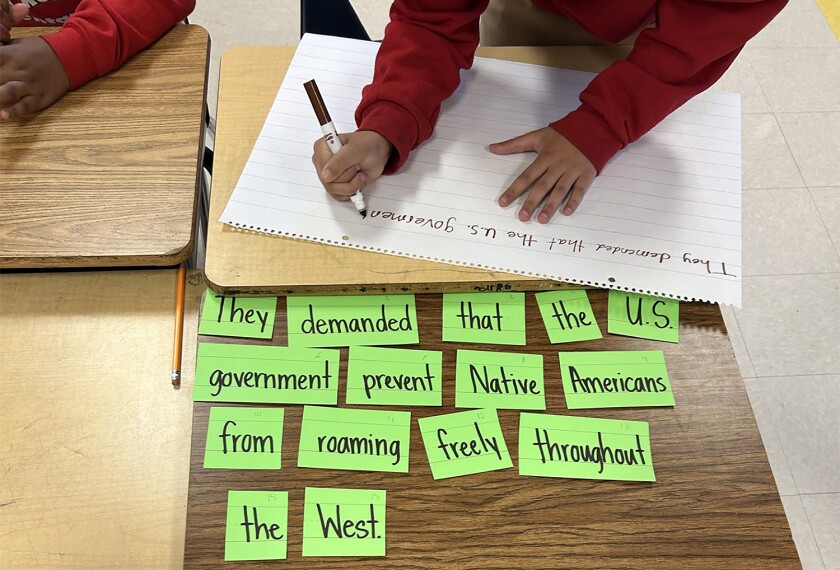
5th grade classroom in February. A morpheme word sort, sentence combining practice, and syntax surgery.
In a 5th grade classroom at Rock Rest Elementary, near Charlotte, N.C., students practice combining sentences and participate in "syntax surgery" to order the parts of complex sentence.<br/>
Madison Hart, Rock Rest Elementary
Reading & Literacy Quiz Risk vs. Reward: How Defensible Is Your Literacy Strategy?
Build a stronger case for your literacy approach. Test your knowledge of research-driven strategies that support reading success with this quick quiz.
Reading & Literacy Opinion What the 'Science of Reading' Movement Has Meant for English Learners
We should think of reading instruction for multilingual learners as a bridge, not a checklist.
8 min read
Conceptual illustration of classroom conversations and fragmented education elements coming together to form a cohesive picture of a book of classroom knowledge.
Sonia Pulido for Education Week
