Curriculum

Two-Handed Challenge

October 01, 2004 1 min read
  • Save to favorites
  • Print

Schools Use Cup Stacking to Teach Coordination

Americans will compete at just about anything, including eating hot dogs and rolling logs. Now, cup stacking joins that list.

Robert W. Fox, 46, a former physical education teacher, promotes cup stacking as a sport that can be taught in schools. About 7,000 schools incorporate the activity into their PE classes, he said, and students compete in annual world cup-stacking tournaments.

The challenge involves stacking and unstacking 12 specially designed plastic cups in specific sequences.
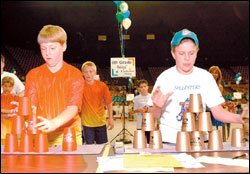
Students compete in cup-stacking.

“It is pretty easy to catch the pattern of how to do it,” Mr. Fox said. The real challenge is to do it faster and faster each time.

“I first saw cup stacking in 1990 on ‘The Tonight Show with Johnny Carson,’ ” Mr. Fox said. In 1995, when he became a PE teacher at the 650-student Coyote Creek Elementary School in Highlands Ranch, Colo., he decided to teach it to students.

Mr. Fox realized immediately that the youngsters loved the activity. “I offered after-school programs for cup stacking, and hoped for 25 students,” he said, “but ended up with 200.”

Although it doesn’t involve exercise, cup stacking benefits students’ hand-eye coordination, Mr. Fox said. Athletic coaches say it helps players learn to use both hands with equal ease, he noted.

Mr. Fox and his wife, Jill, founded the World Cup Stacking Association to promote the sport.

Rhonda Holt, the National Association for Sport and Physical Education’s teacher of the year for 2000, was skeptical when she heard the cup-stacking “noise” in the halls at the conference where she met Mr. Fox.

Still, the 28-year PE teacher at the 460-pupil Peterson Elementary School in Wichita, Kan., said she tried cup stacking and liked it because it’s not restricted to the gym.

“We’re always looking for new things to add to the curriculum,” she said. “And this activity has a great value, because the students use both hands.”

Events

This content is provided by our sponsor. It is not written by and does not necessarily reflect the views of Education Week's editorial staff.
Sponsor
Artificial Intelligence Webinar
Managing AI in Schools: Practical Strategies for Districts
How should districts govern AI in schools? Learn practical strategies for policies, safety, transparency, as well as responsible adoption.
Content provided by Lightspeed Systems
This content is provided by our sponsor. It is not written by and does not necessarily reflect the views of Education Week's editorial staff.
Sponsor
Reading & Literacy Webinar
Unlocking Success for Struggling Adolescent Readers
The Science of Reading transformed K-3 literacy. Now it's time to extend that focus to students in grades 6 through 12.
Content provided by STARI
Jobs Virtual Career Fair for Teachers and K-12 Staff
Find teaching jobs and K-12 education jubs at the EdWeek Top School Jobs virtual career fair.

EdWeek Top School Jobs

Teacher Jobs
Search over ten thousand teaching jobs nationwide — elementary, middle, high school and more.
View Jobs
Principal Jobs
Find hundreds of jobs for principals, assistant principals, and other school leadership roles.
View Jobs
Administrator Jobs
Over a thousand district-level jobs: superintendents, directors, more.
View Jobs
Support Staff Jobs
Search thousands of jobs, from paraprofessionals to counselors and more.
View Jobs

Read Next

Curriculum The Many Reasons Teachers Supplement Their Core Curricula—and Why it Matters
Some experts warn against supplementing core programs with other resources. But educators say there can be good reasons to do so.
7 min read
First grade students listen as their teacher Megan Goes helps them craft alternate endings for stories they wrote together at Moorsbridge Elementary School in Portage, Mich., on Nov. 29, 2023.
First grade students listen as their teacher Megan Goes helps them craft alternate endings for stories they wrote together at Moorsbridge Elementary School in Portage, Mich., on Nov. 29, 2023. In reading classrooms nationwide, teachers tend to mix core and supplemental materials—whether out of necessity or by design.
Emily Elconin for Education Week
Curriculum Shakespeare, Other Classics Still Dominate High School English
Despite efforts to diversify curricula, teachers still regularly assign many of the same classic works, a new survey finds.
6 min read
Illustration of bust of Shakespeare surrounded by books.
Chris Whetzel for Education Week
Curriculum Why Most Teachers Mix and Match Curricula—Even When They Have a 'High-Quality' Option
Teachers who supplement "may be signaling about inadequacies in the materials that are provided to them,” write the authors of a new report.
6 min read
An elementary school teacher helps a student with a writing activity.
Allison Shelley for All4Ed
Curriculum How Digital Games Can Help Young Kids Separate Fact From Fiction
Even elementary students need to learn how to spot misinformation.
3 min read
Aerial view of an diverse elementary school classroom using digital  devices with a digitized design of lines connecting each device to symbolize AI and connectivity of data and Information.
iStock/Getty
