

The number of students with disabilities who spend a substantial portion of their school day in general education classes is on the rise, according to a new report from a government watchdog agency.
But the increases in general education classroom time for students with disabilities vary by state, and school districts say limited funding to hire staff such as paraeducators and establish inclusive programs limit their ability to drive up students’ time in standard classes with their peers who don’t have disabilities.
The report from the U.S. Government Accountability Office, Congress’ nonpartisan watchdog, measures U.S. schools’ progress toward educating more students with disabilities in the least restrictive environment possible, a requirement in the federal Individuals with Disabilities Education Act.
Researchers have also found that students with disabilities perform better when they spend significant amounts of time in mainstream classrooms and that they’re exposed to more rigorous coursework in those settings.
Overall, the number of students who have disabilities and spend at least 40% of their school day in general education classes rose about 25% between the 2012-13 and 2023-24 school years, according to the GAO report.
“If your goal is to have as many kids in gen. ed. who can appropriately be placed there, yes, I think it’s moving in a positive direction,” said the report’s author, Jacqueline Nowicki, director of K-12 education research at GAO.
“But it’s important also to not forget that being able to do that means you need to have the resources in place to make those kids successful in those environments. It’s one thing to say we’re putting kids in gen. ed., and it’s another to ensure they have the supports to be successful.”
The GAO report found that districts that do not have schools specifically designed for students in special education, those with lower per-pupil revenues, and districts with high and low levels of poverty—rather than those with average poverty rates—were more likely to have a higher percentage of students with disabilities spending at least 40% of their time in general education classrooms.
Districts where 20% or less of students are eligible for free or reduced-price lunches and those where more than about 80% of students are eligible had higher rates of students with disabilities in general education classes for larger shares of their days.
It is not clear from this study, Nowicki said, why schools on both ends of the spectrum had higher rates than those in the middle of the pack.
The growth in the number of students with disabilities in general education for at least 40% of their day was driven by an increase in the share of students with disabilities in mainstream classes for at least 80% of their day, meaning the growth was largely driven by those who are in mainstream classes for the majority of the day.
The report also detailed the share of students with disabilities in general education classes for at least 40% of their day by race and ethnicity, disability type, gender, and English learner status.
Students with specific learning disabilities, speech or language impairments, and “other health impairments” were the most likely to reach the 40% threshold, according to the report.
Meanwhile, the share of students with orthopedic, hearing, and visual disabilities spending at least 40% of their day in general education decreased in most states.

There were also increases in nearly every state among English learners with disabilities, and Hispanic and multiracial students with disabilities spending large portions of their time in mainstream classes. In every state, girls were more likely to be in general education settings than boys.
The GAO report found that schools’ student-teacher ratios and the ratio of students to support staff such as nurses and social workers generally did not affect the rates of students with disabilities spending at least 40% of their day in general education.
General education placements varied significantly by state
Forty-two states and the District of Columbia increased the percentage of students who spend at least 40% of class time in general education settings. The rate of increase, however, varied widely between states.
Schools in the nation’s capital, for example, had the largest increase (7.7 percentage points), while in North Dakota, the share of students with disabilities in general education classrooms for 40% of their day decreased by more than 3 percentage points in the decade-plus covered by the report.
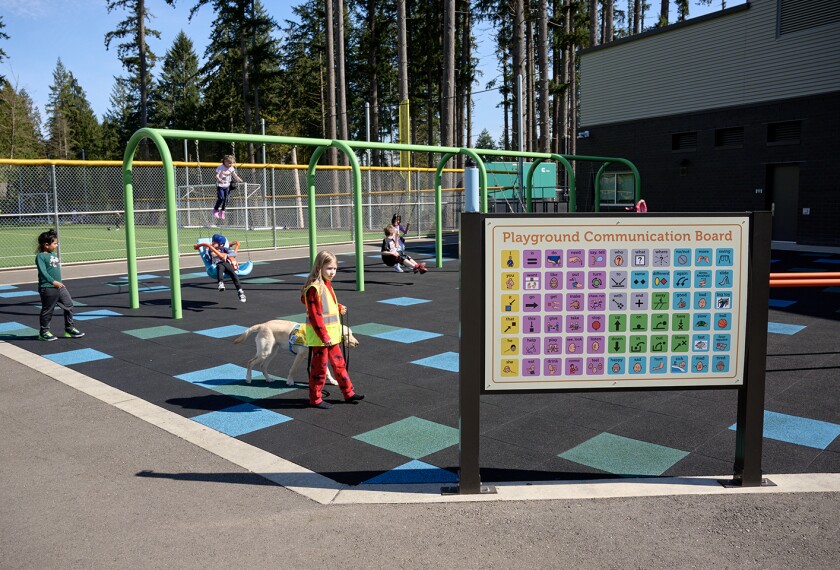
In interviews with educators and district leaders in Connecticut, Illinois, and Washington state (chosen because their districts have a diverse range of enrollment sizes and demographics), officials cited a lack of paraeducators who can help students with disabilities spend more time in gen. ed. and a lack of appropriate spaces to meet the needs of students with disabilities—such as accessible playgrounds—as barriers to increasing students’ time in gen ed.
Teacher contract limitations can also be a barrier. Some collective bargaining agreements allow teachers to opt out of co-teaching, in which a general education teacher and a special education teacher work together in a gen. ed. classroom.
“I did not find it surprising that the lack of resources was considered a main driver in terms of determining a student’s educational setting, but it’s not supposed to be that way,” Nowicki said. “Kids are supposed to be in the least restrictive environment for their particular needs, so in an ideal world, resources are not driving that decision.”
The concept of students spending as much time as possible in gen. ed. classes with their peers without disabilities and in the “least restrictive environment” is a principle of IDEA.
Some interviewees said the personal beliefs of school or district leaders affected decisions on students’ educational settings. “For example, officials from one district said that some principals felt that every child with an IEP needed 3 hours a day of special education instruction, regardless of their skill level,” the report said.
“Paying attention to those kinds of attitudes, not just among our students but among the adults, too, is really important,” said Nowicki. Schools need to consider “what is the tone [they’re] setting around students with disabilities,” she added.
Some states found success in schedule changes, additional programs
Despite the challenges, interviewees also highlighted the approaches that have worked in boosting special education students’ time in general education classrooms.
One principal shifted the school’s schedule so classes such as career and technical education and physical education occurred during periods when students with disabilities could participate with their peers who don’t have disabilities.
In an elementary school referenced in the report, teachers modified the curriculum and developed supplemental support so it was accessible to students with disabilities and they wouldn’t have to leave for specialized instruction.
Educators are making efforts outside the classroom, too.

One official cited in the report said they are intentional about building a sense of belonging for all children by pairing students with disabilities with general-education classmates for activities like picking up recycling around the building and holiday activities like pumpkin decorating and gingerbread house-making.
School officials interviewed as part of the GAO report commonly said they employ nationwide programs to promote partnerships among students, like Best Buddies and Special Olympics.
In these programs, students with disabilities partner with other students to build friendships, improve social skills, and create inclusive school communities.


