Science

Science Federation Calls for More and Better Educational Video Games

By Rhea R. Borja — October 17, 2006 1 min read
  • Save to favorites
  • Print

The U.S. departments of Education and Labor, in partnership with the National Science Foundation, should work with the video game industry to support the research and development of video games that promote learning, a report released today recommends.

Video game companies “underinvest” in the research and development of educational video games, so R&D for such games should be part of a comprehensive science and technology research program, financed in part by the federal government, suggest the authors of “Harnessing the Power of Video Games for Learning.”

Review further resources from the Federation of American Scientists’ Summit on Educational Games, including the reports, “Harnessing the Power of Video Games for Learning” and “Games, Cookies, and the Future of Education.”

The Washington-based Federation of American Scientists wrote the report, which compiled advice from almost 100 experts in science, education, and the video game industry. The experts met for a national conference on video games in October 2005 to brainstorm better ideas for developing and selling video games that teach analytical, problem-solving, and other higher-order thinking skills.

“Many recent reports warning about declining U.S. competitiveness point to an urgent need to improve workforce skills and our system of education,” FAS President Henry Kelly said in a statement. “Video games are engaging and can teach higher-order skills, and they are especially attractive to today’s young digital natives.”

‘Concrete Actions’

The business community also should play a more active role in making educational video games more available in the market, the report says. Publishers of educational software, for instance, should help develop such games for home-schooled students and the growing after-school learning market. They should also produce short video games that can be downloaded from the Internet, the report says. Those games take less time and capital to develop and pose less financial risk.

“This plan outlines concrete actions we can take to put powerful tools for teaching and learning in the hands of educators and students at a time when the need for education improvement is great,” Mr. Kelly said.

Events

Early Childhood K-12 Essentials Forum Early Childhood Education: Building Essential Skills for Success
Join this free virtual event to examine the biggest challenges in supporting young children, from preschool through elementary school. 
This content is provided by our sponsor. It is not written by and does not necessarily reflect the views of Education Week's editorial staff.
Sponsor
Student Absenteeism Webinar
Attendance Isn't an Attendance Problem
Boost attendance by strengthening relationships, belonging, and support with practical strategies from Doug Fisher & Nancy Frey.
Content provided by Corwin
This content is provided by our sponsor. It is not written by and does not necessarily reflect the views of Education Week's editorial staff.
Sponsor
School & District Management Webinar
The Principal's Role in Collective Efficacy and Student Outcomes
Learn practical strategies that help principals translate their confidence into stronger collective teacher efficacy and student outcomes.
Content provided by Otus

EdWeek Top School Jobs

Teacher Jobs
Search over ten thousand teaching jobs nationwide — elementary, middle, high school and more.
View Jobs
Principal Jobs
Find hundreds of jobs for principals, assistant principals, and other school leadership roles.
View Jobs
Administrator Jobs
Over a thousand district-level jobs: superintendents, directors, more.
View Jobs
Support Staff Jobs
Search thousands of jobs, from paraprofessionals to counselors and more.
View Jobs

Read Next

Science Opinion What Should Science Education Look Like 10 Years From Now?
Science instruction has already had some big changes in the past decade. Where is it going next?
8 min read
Conceptual illustration of classroom conversations and fragmented education elements coming together to form a cohesive picture of a book of classroom knowledge.
Sonia Pulido for Education Week
Science How a Cow 'Moooved' STEM and AI Learning Forward
The farm animal helped K-2 students explore artificial intelligence, data science, and chemistry.
3 min read
ISTEcow003
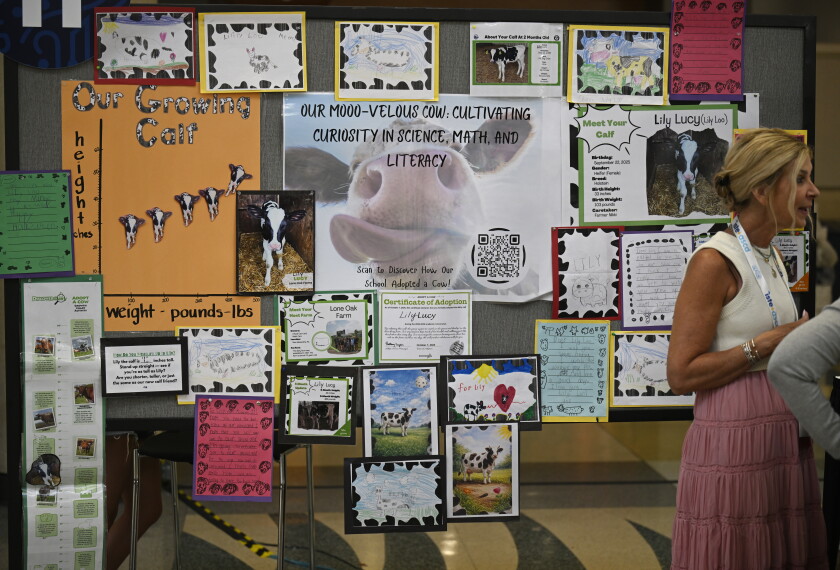
K-2 students at South Fayette Township Elementary School in Pennsylvania used data science to pick a name for a cow they adopted to follow at a local farm. A teacher from the school talked to other educators about how she used the cow to teach about data science, AI, and chemistry during the ISTELive 26 + ASCD Annual Conference in Orlando, Fla., on July 1, 2026.
Marvin Joseph/Education Week
Science Can a Science Museum Reshape Learning? Inside One District's Experiment
A state-of-the-art science museum and a formerly under-resourced elementary school form a rare partnership.
10 min read
DaVinciCentralAllentownPA 051826 SDL020
A 4th grade student vies for the attention of a turtle during her class’s weekly visit to the Da Vinci Science Center on May 18, 2026, as part of the center’s partnership with the Allentown school district’s Central Elementary STREAM Academy.
Scott Lewis for Education Week
Science Spotlight Spotlight on STEM That Sticks: How Schools Spark Curiosity and Build Future Skills
Find out how schools are cultivating enthusiasm for STEM learning through family STEM nights, low-cost innovations, and more!
