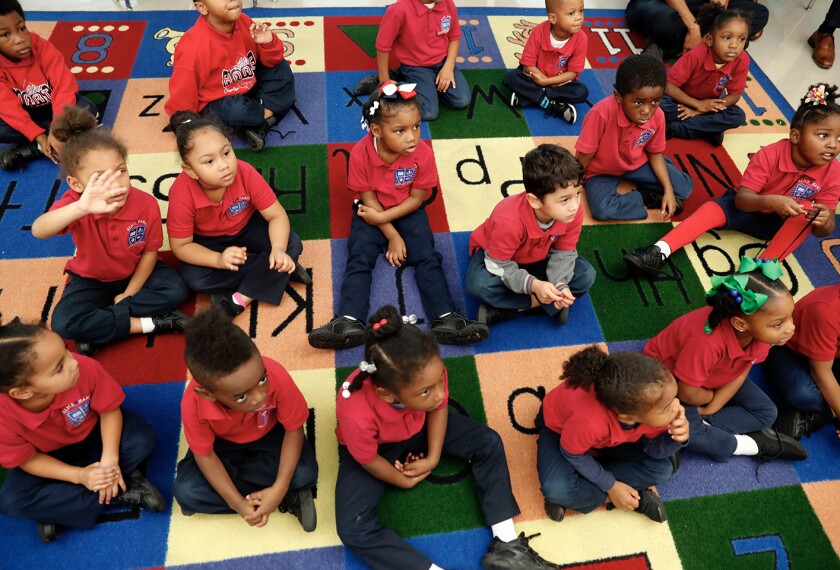
As states continue to increase early-childhood-education opportunities with the goal of getting children ready for school, a new report argues that it’s more important for youngsters to be confident, friendly, and able to follow instructions than to know their numbers, colors, and letters.
Children who are socially and emotionally unhealthy will not only have a tough time making the transition into kindergarten, but they could also be headed for school failure, according to the report released last week by the Child Mental Health Foundations and Agencies Network, a consortium including both government agencies and philanthropic organizations.
For More Information |
| “A Good Beginning: Sending America’s Children to School With the Social and Emotional Competence They Need to Succeed” is available online from the National Institute of Mental Health. (Requires Adobe’s Acrobat Reader.) |
“Social and emotional school readiness is critical to a successful kindergarten transition, early school success, and even later accomplishments in the workplace,” says the report, “A Good Beginning: Sending America’s Children to School With the Social and Emotional Competence They Need to Succeed.”
Drawing from neuroscience, the authors stress that such competence begins in infancy as babies develop secure attachments to their parents or another primary caregiver. From that foundation, children are then able to learn the cognitive skills they’ll need in school, the report argues.
The report cites recent research showing that children who couldn’t follow directions were a bigger problem for kindergarten teachers than those who lacked academic skills. Many new students also had trouble working independently or with a group and had difficulty communicating with teachers and other children.
Besides social and emotional problems, the report says, a wide range of factors put children at risk of school failure. Those include low birth weight and other medical problems, a family’s low socioeconomic status, child abuse, low levels of maternal education, and immigrant or minority status, it says.
Research Needed
More research is needed, the report says, to understand how various risk factors affect school outcomes and how those factors are related to one another. Finding the answers to those questions could generate “more effective preventive and treatment strategies,” it suggests.
Factors that serve to safeguard children against difficulties in school include self-confidence, an easy temperament, living with both parents, having an organized home environment, and having a large number of classroom friends, according to the report. It concludes that, for at-risk children, “parents can play a key role in developing the social and emotional competence of their young children.”
Barbara T. Bowman, the president of the Erikson Institute, a Chicago graduate school for child development, said the report demonstrates “the pendulum swing that is so common” in the field of early- childhood education.
While social and emotional health is important, she said, “that doesn’t mean you ignore the content.”
In fact, Ms. Bowman, who chaired the committee that produced a recent report titled “Eager To Learn: Educating Our Preschoolers,” said that when children reach school age, their confidence stems from “doing the tasks that have been assigned to you by society.”
“By age 4, children are very aware of their performance and how they measure up to other children,” she said.
Dr. Beatrix A. Hamburg, a visiting professor of pediatrics and child psychology at Cornell University’s medical school in New York City and a consultant to the network, said that the growing emphasis on test results and educational accountability may have been “in the back of people’s minds” as the report was being prepared. But the real goal was to focus on improving the mental health of children who come from high-risk backgrounds.
“A Good Beginning” also includes a review of the many federal programs and policies focusing on the health, development, and welfare of young children, such as the Children’s Health Insurance Program, Head Start, and child-nutrition programs.
Like past reports, this one recommends better coordination of programs as well as the expansion of programs that are based on research. “While the federal government is investing substantial resources in this area,” the report says, “policy, practice and research need to be more interwoven.”