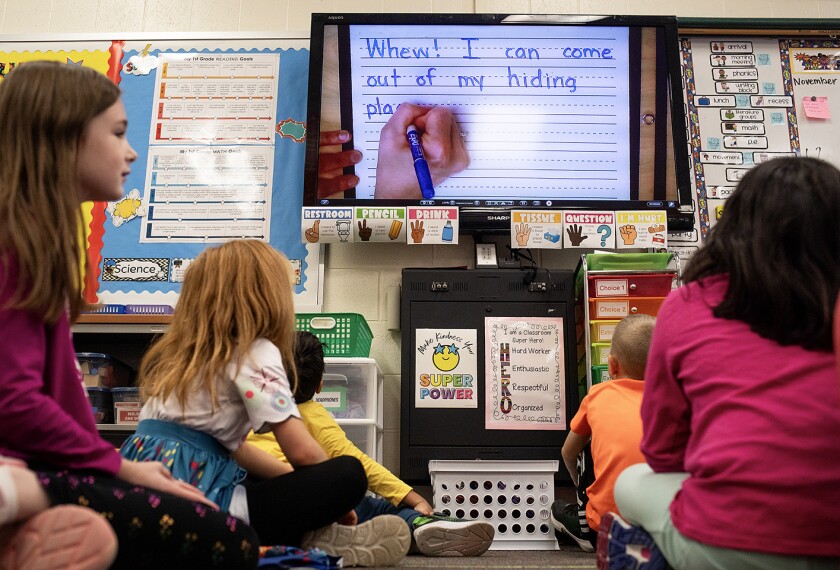
—Photo: Craig Sherod Photography
Bruce Fuller, a sociologist at the University of California, Berkeley, works on how schools and civic activists push to advance pluralistic communities. He is a regular opinion contributor to edweek.org where he trades views with Lance Izumi, on the other side of the political aisle. Read Lance Izumi’s response to this essay.
Teachers suffer no shortage of teachable moments as America’s cultural fabric continues to fray, norms of basic civility tattered daily by our political leaders.
Fellow educators gunned down in Las Vegas. Immigrant families villainized. The right of youths to choose their bathroom hotly debated.
Ripe moments for re-writing lesson plans, yes? Don’t these times cry out for bold educators who fashion safe spaces for students, a place to reveal their fears and confusion, teachers who help anchor our kids amidst the cultural vertigo?
Yes, say many, like Rachel Caldwell, who teaches 4th grade in Charlottesville, Va. After witnessing the swarm of club-wielding white nationalists, one killing a 32 year-old counter-protestor, Caldwell told me she had to “rethink the traditional curriculum, move beyond just meeting the learning standards.”
Yet, many teachers seek to shelter kids from the storm outside, sanitizing their classroom with dispirited curricula, rather than engaging human variety and contention. On race, fellow teachers “don’t want to bring it up, because it would point to injustice, or parents might feel bad,” Caldwell said.
But her kids still struggle to explain the violence. Caldwell overheard one pair—huddled in the gym one recent stormy day—speculating over “who’s the KKK?” A biracial girl approached her in this richly integrated school asking, “Are you white?”
After summoning the courage, how can teachers gently invite kids to place feelings and fright on the table, to mull over essential questions of human difference? Tess Krovetz, another teacher from Charlottesville, works with colleagues to design read-alouds, ways of structuring class meetings, art or media projects—activities that prompt students to express their worries. Teachers must help “give them the language, the words,” Krovetz told me, to bring forth their barely submerged worries percolating just below the surface.
And whose vantage point should educators privilege or discount as they struggle to explain the cultural kaleidoscope that America has become? Which voices to amplify or tacitly muffle is not an abstract question for, say, Latino students whose parents now fear deportation, or a wider swath of kids miffed by why the grown-ups have become so angrily divided. How to delve into gun control when nearby parents hold the Second Amendment so sacred?
Liberal learning requires perspective taking: Why are many working-class whites alienated from urban America? Why do many parents now aim to raise their children in bilingual fashion? To walk in the shoes of others remains central to our humanist ideals, that “cosmopolitan bias” about which the White House now complains.
Many teachers seek to shelter kids from the storm outside, sanitizing their classroom with dispirited curricula."
Perhaps it’s the shades of gray that befuddle teachers most, how to portray in one’s classroom the nation’s boiling brew of cultural tenets and political stances. California’s new history standards have jettisoned a long-sacred assignment for 4th graders: constructing a miniature Franciscan mission, typically from sugar cubes and popsicle sticks.
This institutional crucible—where the clash of religion and race yielded subjugation and violence, along with a hybrid Latino culture—has lost its caché. Recast by state officials as “sites of conflict, conquest, and forced labor,” the curricular document reads, the old missions have become “offensive to many.” So much for that teachable moment, unearthing the roots of America’s contemporary pluralism.
Many teachers do show courage, placing questions of human difference and unequal power front and center. Tanness Walker weathered de-politicized civics in her Los Angeles high school, where “they only taught a unit on slavery.” She now teaches in a Freedom School where young teens delve into “critical history, emphasizing the powerful roles played by Malcolm X, MLK, and Rosa Parks,” she told me when I visited her classroom.
Woven into Walker’s Powerpoint were stark images of white police officers setting German shepherds on black protesters. No shying away from this a-ha moment: “Parents tell me how glad they are that I’m covering all this,” she told me later. Meanwhile, the L.A. city council voted to disappear Columbus from this month’s holiday—better to acknowledge indigenous people, not a questionable Italian-Latino, in southern California?
This is certainly no time for educators to be timid. White nationalists, even the utterances of a U.S. president, serve to clarify what beliefs and behaviors are simply not acceptable in a democratic society.
But how to glue together transcendent ethics in a society where identity politics and individual differences trump that dusty notion of a collective good? We need institutions like schools “to bind communities and families, to hold atomization and despair at bay,” as commentator Ross Douthat puts it.
Educators must boldly engage and learn from this cultural maelstrom, rather than dodging prickly issues because they prompt discomfort or spotlight divergent values. “Sometimes we think school is not a place to ask these big questions,” Caldwell said. “But it should be.”