Opinion
Reading & Literacy Opinion

How We Can Turn the Page on This Failed Reading Strategy

It’s time to bring back whole books
By Carol Jago — June 26, 2026 3 min read
Image of a book with symbols of brain, ideas, time, conversation, connecting ideas.
  • Save to favorites
  • Print

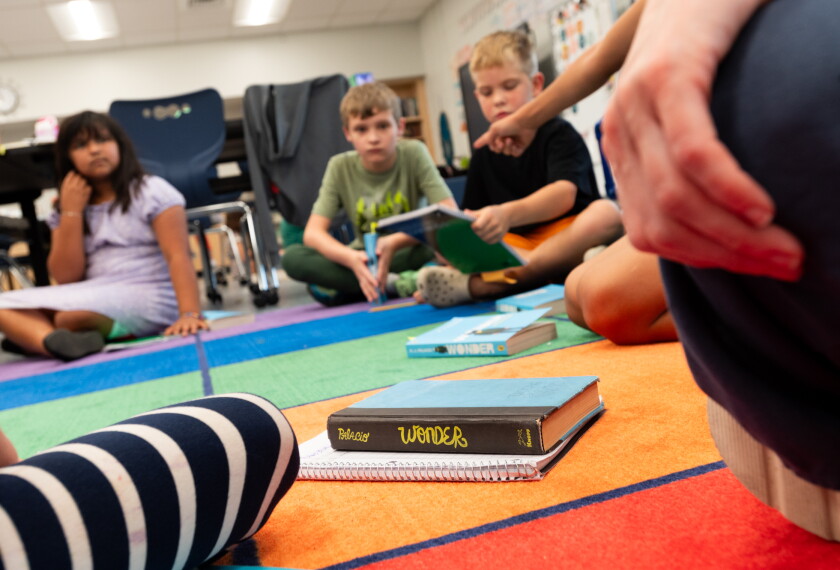
Instead of wringing our hands over dismal reading scores and professors’ complaints that students can’t or won’t read by the time they get to college, we need to do something about the problem. How about getting back to teaching whole books?

Over the past decade, instruction has focused on teaching reading skills with short excerpts. The idea seemed promising. Demonstrate strategies that approximate what proficient readers do on a small piece of text like the ones students meet on an assessment and assume they will emerge competent readers.

As stagnant National Assessment of Educational Progress reading scores demonstrate, the approach hasn’t worked. Why not? Too much practice with strategies and not enough reading. A recent RAND Corp. survey reports that roughly 60% of middle and high school teachers assign three books or fewer in a school year. Three books a year does not a reader make, particularly if those books are classic texts like Julius Caesar or The Scarlet Letter that intimidate many young readers.

The most alarming finding in the study is that teachers in schools serving large populations of students from low-income families are less likely to assign whole books than those who work in more affluent communities. Scandalous.

It’s time to bring back books, but we also need to rethink what it means to teach a work of literature. No more spending eight weeks of class on a single novel; no more reading the whole book aloud to 10th graders. We need fewer quizzes and maybe even less annotating.

Instead teachers and school leaders can:

  • Make time and space inside the school day for reading. This might require scheduling extended time in English/language arts classes.
  • Provide easy access to a wide range of books and encourage reading beyond the school day. Invest in classroom libraries full of contemporary titles. Invite students to take books home over school breaks.
  • Allow for student choice in what they read (and show them how to choose). Talk with students about how they can select a book to read. Is it an author they liked, a genre they enjoy, a compelling cover?
  • Articulate to students what the classics have to teach us. Draw connections between the themes in the books we teach and the issues students care about—for example, how we all have great expectations like Charles Dickens’ Pip or how we are all on a journey to self-discovery like Odysseus.
  • Talk about the books you are reading. Students need to hear teachers, administrators, and librarians talk about how they select, and sometimes reject, their next book.
  • Make classwide conversations about books a daily occurrence. Explore how to make literature circles and Socratic seminars successful classroom routines.
  • Help students set their own reading goals. Invite students to keep a list of books they have read along with a list of books that they look forward to reading.
  • Create a summer reading program that students want to participate in. Include students on the committee that designs the program. When students take part in decisionmaking, they become invested in its success.

I would be a fool to pretend that turning the page on how we grow readers will be easy. But excuses like identifying students as “pandemic babies” or blaming social media are just that, excuses for inaction. After 30-plus years teaching English in middle and high school, I can say with confidence that there have never been any good old days when students all brought their books to class having done the homework reading. Disaffection for schoolwork is not new.

What is new is the cognitive impatience that so many young people exhibit. Hours scrolling—skimming and scanning—on a cellphone has atrophied the reading muscles. Rather than giving in to a gamification of curriculum, we need to dig in and show students how persevering through a whole book can help build their stamina for thinking through complex arguments. Books teach readers to suspend judgment and wait for further developments. They are unique vehicles for exploring what has been, what is, and what could be.

Like Herman Melville’s Bartleby the scrivener, far too many students today would simply prefer not to read. We need to be the adults who know better. Together, teachers, administrators, and policymakers can make schools intellectually stimulating environments where every child feels that they belong.

Related Tags:

Events

This content is provided by our sponsor. It is not written by and does not necessarily reflect the views of Education Week's editorial staff.
Sponsor
Professional Development Webinar
Grow Leaders, Keep Teachers: Leadership Development as a Staffing Strategy
Find out how to turn leadership development into a staffing strategy and grow your next generation of school leaders from within.
Content provided by Frontline Education
This content is provided by our sponsor. It is not written by and does not necessarily reflect the views of Education Week's editorial staff.
Sponsor
Teaching Webinar
Closing the Practice Gap: Essential Insights for Leaders
Three instructional experts will share strategies for making students’ reading and math practice more engaging and impactful this year.
Content provided by Renaissance
This content is provided by our sponsor. It is not written by and does not necessarily reflect the views of Education Week's editorial staff.
Sponsor
School & District Management Webinar
The Principal's Role in Collective Efficacy and Student Outcomes
Learn practical strategies that help principals translate their confidence into stronger collective teacher efficacy and student outcomes.
Content provided by Otus

EdWeek Top School Jobs

Teacher Jobs
Search over ten thousand teaching jobs nationwide — elementary, middle, high school and more.
View Jobs
Principal Jobs
Find hundreds of jobs for principals, assistant principals, and other school leadership roles.
View Jobs
Administrator Jobs
Over a thousand district-level jobs: superintendents, directors, more.
View Jobs
Support Staff Jobs
Search thousands of jobs, from paraprofessionals to counselors and more.
View Jobs

Read Next

Reading & Literacy Middle Schoolers' Reading Scores Are Still Stuck at Post-Pandemic Lows
New data shows that the lowest-performing students are falling the furthest behind.
4 min read
Sixth graders read a passage and give constructive feedback to their partners during Nancy Barajas' class at Fairview Elementary School on May 6, 2026, in Modesto, Calif.
Sixth graders read a passage and give constructive feedback to their partners during Nancy Barajas' class at Fairview Elementary School on May 6, 2026, in Modesto, Calif. New research shows the nation's 6th graders' reading scores have flatlined, and the lowest-performing students are losing ground.
Annie Barker/AP
Reading & Literacy Federal 'Science of Reading' Bill Advances
A Senate committee also passed a proposal to classify dyslexia separately under federal disability law.
5 min read
AT LEFT, US Senator Maggie Hassan (D-NH) listens as US Senator Tim Kane (D-VA) speaks regarding the Special Education Administration Act (S. 5038), and the profit the transfer of certain offices to other Federal Agency (S.5046) Act during a Health, Education, Labor and Pension Executive Session at the Dirksen Senate Office Building on Capitol Hill, Washington, DC on Thursday, July 30, 2026.
U.S. Sen. Maggie Hassan, D-N.H., left, listens as U.S. Sen. Tim Kaine, D-Va., speaks during a Senate Health, Education, Labor, and Pensions committee meeting at the Dirksen Senate Office Building on Capitol Hill in Washington on July 30, 2026. The committee advanced two bills related to reading, as well as another opposing the transfer of certain U.S. Department of Education offices to other agencies.
Demetrius Freeman for Education Week
Reading & Literacy Is Required Summer Reading a Good Idea? What the Research Says
Studies show benefits for summer reading in general. But little evidence supports assigning specific books.
4 min read
The desktop of a student at the Wells Preparatory Elementary School reflects the literature they are studying in Charlotte Owens' fifth grade class on Friday, March 8, 2024, in Chicago. In Chicago Public Schools, the average reading score went up by the equivalent of 70% of a grade level from 2022 to 2023. Math gains were less dramatic, with students still behind almost half a grade level compared to 2019. Chicago officials credit the improvement to changes made possible with nearly $3 billion in federal relief.
The desktop of a student at the Wells Preparatory Elementary School reflects the literature they're studying in Charlotte Owens' fifth grade class on Friday, March 8, 2024, in Chicago. Research supports children reading over the summer—but not specifically assigning reading lists or holding kids accountable for completing them.
Charles Rex Arbogast/AP Photo
Reading & Literacy Opinion Teacher-Tested Strategies for Improving Reading Instruction
How educators are making literacy lessons stick in their classrooms.
1 min read
Collage of an image of three students reading books in a library, a stack of novels, and images of text from the pages of books.
Illustration by Emily Wright for Education Week + Getty