Corrected: An earlier version of this article incorrectly identified when passing PARCC exams becomes a graduation requirement in Maryland.
The first common-core tests designed collaboratively by a group of states are making their debut this month, with 30,000 middle and high school students sitting for exams in mathematics and English/language arts. Millions more students in grades 3-11 will take such tests later in the winter and next spring.
After four years of controversy surrounding the federally funded tests from two multistate consortia, the first administration is a small-scale affair. Only one of the consortia—the Partnership for Assessment of Readiness for College and Careers, or PARCC—is giving tests this fall, and only to a fraction of its students. Tests created by the other group, the Smarter Balanced Assessment Consortium, won’t be given until the spring.
The two groups of states used $360 million in U.S. Department of Education Race to the Top money to design the assessments tied to the Common Core State Standards. Those standards, released in 2010, are the product of an initiative led by groups representing the nation’s state governors and schools chiefs.
The students who are currently taking the PARCC tests are on “block” schedules, in which courses cover an entire year’s study in one semester. The fall testing period includes students in six states: Arkansas, Illinois, Maryland, Mississippi, Ohio, and Rhode Island. Students on traditional schedules will take the PARCC exams during second semester.
Altogether, more than 5 million students are expected to take the PARCC tests in nine states and the District of Columbia in 2014-15.
Time and Technology
PARCC’s test consists of two parts: performance tasks, which will be administered between Dec. 1 and Dec. 19 and involve complex reading, writing, and math tasks; and the end-of-year portion, composed of multiple-choice questions, which will be given between Dec. 15 and Jan. 16. States decide which days within those windows their districts will give the tests.
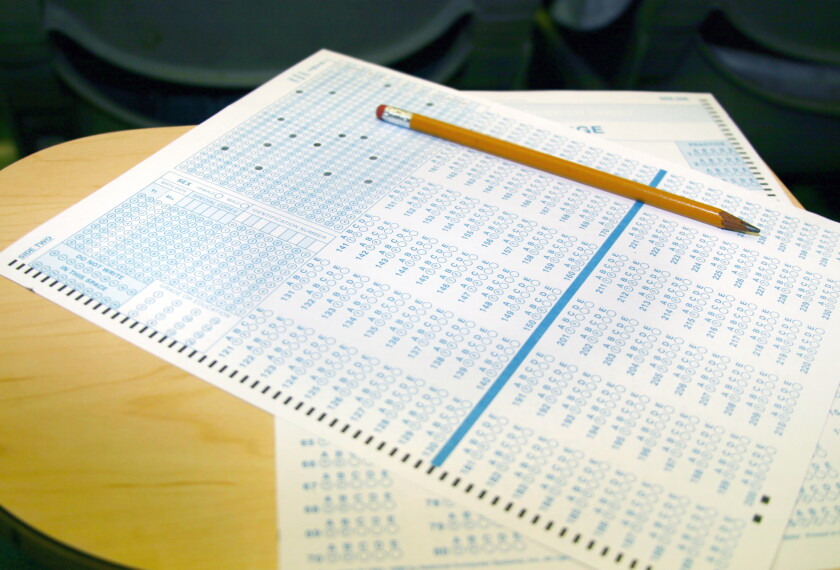
The PARCC assessments were designed to be computer-based, but this fall’s administration uses only the paper-and-pencil version. For the spring administration, schools can decide whether to use the paper or computer version; “well over half” the schools in the PARCC states are planning to go with computers, according to PARCC officials.
Consortium guidelines suggest that schools schedule 50 percent more time for each testing session than the test itself is expected to take. And if two Maryland high schools’ experience with the English 10 and Algebra 2 exams is any indication, many students need all the available time.
“We found that yesterday, with the English, and today, with the math, I’d say about 20 percent of the kids are using pretty much all of the allotted and extended time,” Jack Drew, an assistant principal at Rising Sun High School, in the Chesapeake Bay town of Northeast, Md., said last week.
Louisa A. Welch, the academic dean at Kent Island High School, about 70 miles to the south in Stevensville, Md., said most students at her school took all the time allowed to complete the exams.
“More often than not, students were working pretty hard to finish,” she said. With the state’s previous test, students typically had “more than enough time to complete each session,” she said.
Schools had flexibility in scheduling the assessments. There are three sessions for the performance tasks in English, and two for math.
At Rising Sun, students took one session each day in their regular English and math classes. Mr. Drew said he and his fellow administrators would be discussing whether that’s a good plan to stick with, or whether they should schedule each subject’s sessions back to back, in one day, as the state’s previous test was scheduled.
Juggling Sessions
At Kent Island, students took the tests during their first class period of the day. Ms. Welch said school officials are considering changing that approach because it meant that students missed multiple days of their first-period class. Part of that discussion, she said, will be figuring out how to keep a 90-minute test session from spilling over into the next class block. The 75-minute test sessions didn’t pose that problem during 90-minute class blocks, she said.
Another part of the discussion will explore ways to juggle the time demands of the PARCC test with those of the other state tests that sophomores must take this year, in government and biology, she said.
“It is a lot of testing, on a lot of days,” Ms. Welch said. “We may have to stagger the schedule so kids aren’t missing the same class. We have to think creatively at the school level to make sure we’re doing the best we can by kids.”
Mr. Drew said that seeing so many students work right up until the end of the testing sessions suggested that they were taking the test seriously.
“We were concerned about students accepting the PARCC test,” he said. “But my take on it is that our teachers must have done a good job preparing students, explaining the test, and that students took it seriously and worked hard.”
In Maryland, students have had to pass state exams in English/language arts, math, biology, and government to graduate. But as the state transitions to PARCC, it is phasing in the use of that test as a graduation requirement. Students who take the PARCC exams in 2016-17 will be the first ones required to pass them in order to earn a diploma.
The PARCC consortium plans to set cut scores for the five achievement levels of its test in summer 2015, and send results back to states, districts, and schools late next fall, said PARCC spokesman David Connerty-Marin. The Smarter Balanced consortium announced its cut scores last month, and released projections showing that more than half the students who take the test will fall short of the marks connoting proficiency in math and English/language arts.