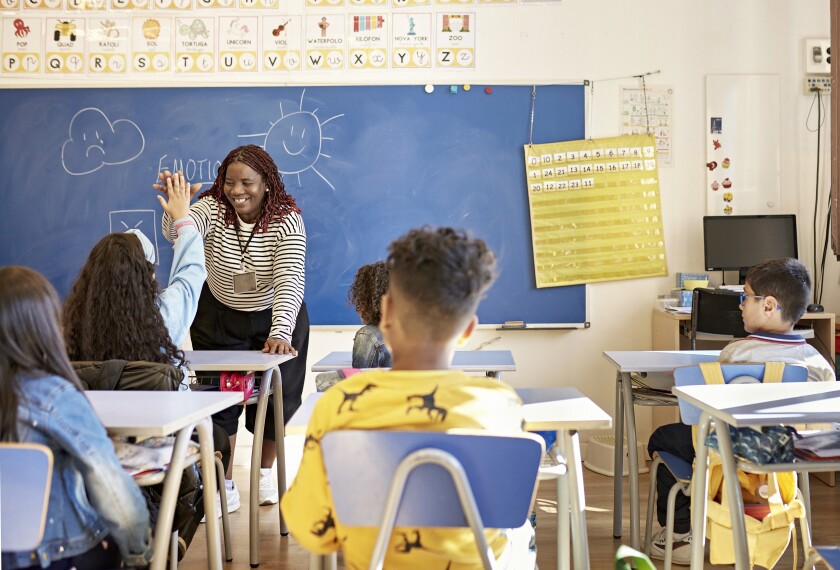
District leaders, teachers, and district-level subject-matter specialists have different priorities when choosing curricular materials for classroom use. Education Week asked a few of them what they look for as they sort through curricular options.
Their responses were edited for clarity and length.
What is the first thing you look for in a free online lesson?
“Rule number one: Start with a complex text. The pieces should fall in from there. ... I know it sounds silly, but if the text is not complex, you’re going to have a harder time teaching it. It is harder to write questions. It is harder to find essential vocabulary. It is harder to have good discussions if you don’t start off with a meaty text. If the text does not meet the requirements for a complex text—it’s got to be on their level, a little above. If they can read it on their own, it’s not complex text. If the book is not, it’s not worth teaching.”
—Meredith Starks, 3rd grade English/language arts teacher, Bellaire Elementary School, Bossier City, La.
“The first thing a classroom educator or principal should be looking for in the user agreement is some recognition of FERPA (The Family Educational Rights and Privacy Act). If you don’t see that, just back away; that’s table stakes. ... Any business that deals with kids should be clear on this.”
—Jim Flanagan, chief learning-services officer, International Society for Technology in Education, Arlington, Va.
How do you find good, reliable sources of free, high-quality materials?
“A surprising place where I think a lot of teachers don’t look is actually museum websites. I find some of my best stuff [there]—like the New York Metropolitan Museum of Art has great stuff. Go to a museum website, click on teacher resources. You’d be pleasantly surprised about everything you can find there for teachers. If it’s a thematically based unit, one of the first places I look is museum websites.”
—Meredith Starks, 3rd grade English/language arts teacher, Bellaire Elementary School, Bossier City, La.
“A few organizations are starting to develop ratings for [secure, high-quality education apps]. The [Software & Information Industry Association] has a privacy pledge. I look at Common Sense Media’s privacy ratings, and IKeepSafe has a badge [for programs that meet different federal and state privacy laws]. There should be expectations that if a vendor is holding student data, they are legally liable to protect student data in these ways; we shouldn’t have to do it all by ourselves by contract.”
—Steve Smith, chief information officer, Cambridge, Mass., public schools
What are common red flags that make you question the quality of online materials or apps?
“When there are not multiple viewpoints for students to review—specifically as it relates to the teaching about the contributions of minority groups to the culture and development of the United States.”
—Daryl Diamond, director of innovative learning, Broward County, Fla., public schools
“I look at the amount of student-centered content versus the amount of teacher-centered content. What’s the teacher’s role? If it’s mostly content written for teachers, that’s a red flag. Schools are not a place where young people should go to watch old people do work.”
—Stefanie Buckner, K-12 math-curriculum specialist, Buncombe County, N.C., public schools
What’s the most common mistake teachers make when choosing online material?
“I don’t think it’s done intentionally—but in the interest of saving time and having so much access—it’s [a teacher] not using a rubric to guide whether a resource is a quality, standards-aligned resource. When you’re competing with Pinterest and Teachers Pay Teachers, which is visual, [teachers may] look at lessons that look very engaging [but may not be a good match for their learning objective].”
—Brian Kingsley, assistant superintendent of academics, Wake County, N. C., public schools
How do you judge whether materials are aligned to the Common Core State Standards?
“I do the problems myself and reference the standards. It tells me what components of the standards are there. We should be looking at alignment. We shouldn’t be just taking a book at face value.”
—Stefanie Buckner, K-12 math-curriculum specialist, Buncombe County, N.C., public schools