Reading & Literacy

Children Still Prefer Print Books to E-Books

By Catherine Gewertz — January 22, 2013 1 min read
  • Save to favorites
  • Print

Children are embracing e-books by the millions, but most say they still would choose the printed version, according to a survey released last week.

Scholastic’s biennial survey of 6- to 17-year-olds found e-books soaring in popularity: Forty-six percent of the 1,074 children said they had read an e-book, compared with 25 percent who said they had in 2010.

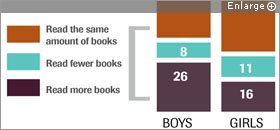
The e-book-reading numbers vary by only a few percentage points by gender or age group. But boys were slightly more likely to say that since they started reading e-books, they’re reading more books overall.

Half the young people said they’d read more books for fun if they had better access to e-books. And it’s clear that those surveyed are doing the lion’s share of e-book reading at home, rather than in school: Three-quarters of the respondents who have read an e-book have done so at home; only one-quarter said they had read an e-book in school.

Impact of E-Reading

Among children who have read an e-book, one in five says he or she is reading more books for fun, especially boys.
BRIC ARCHIVE

Note: Figures may not add up to 100 percent because of rounding.

SOURCE: Scholastic

E-books are particularly good when students are traveling or on the go, they told researchers, or when they don’t want their friends to know what they’re reading.

The survey for the New York City-based educational publisher was conducted online last fall. Questions were put to a nationally representative sample of 2,048 people, including children ages 6 to 17 and their parents.

No Batteries Required

But print books clearly still have a big place in children’s lives. Their responses showed that 80 percent of the books they read for fun are in print. They also prefer the printed form over the e-book for reading at bedtime or sharing with friends, the study found.

Fifty-eight percent said they will always want to read books printed on paper even if e-books are available. Two-thirds of the young people surveyed by Scholastic in 2010 gave the same response.

Asked about the benefits of e-books, children and parents most frequently cited the convenience of carrying all their books around in one place and obtaining books wherever they are. Among the e-book attributes they like the most are dictionaries, built-in note-taking and highlighting features, and skill-building activities.

Print books, on the other hand, got high marks from children and parents for not needing batteries and for the ease of seeing how much of a book has been read. Children, in particular, cited liking to hold a print book more than an electronic device. Parents cited liking to “get away from technology.”


Related Tags:

A version of this article appeared in the January 23, 2013 edition of Education Week as Children Still Prefer Print Books to E-Books

Events

This content is provided by our sponsor. It is not written by and does not necessarily reflect the views of Education Week's editorial staff.
Sponsor
Teaching Webinar
Closing the Practice Gap: Essential Insights for Leaders
Three instructional experts will share strategies for making students’ reading and math practice more engaging and impactful this year.
Content provided by Renaissance
This content is provided by our sponsor. It is not written by and does not necessarily reflect the views of Education Week's editorial staff.
Sponsor
Student Absenteeism Webinar
Attendance Isn't an Attendance Problem
Boost attendance by strengthening relationships, belonging, and support with practical strategies from Doug Fisher & Nancy Frey.
Content provided by Corwin
This content is provided by our sponsor. It is not written by and does not necessarily reflect the views of Education Week's editorial staff.
Sponsor
School & District Management Webinar
The Principal's Role in Collective Efficacy and Student Outcomes
Learn practical strategies that help principals translate their confidence into stronger collective teacher efficacy and student outcomes.
Content provided by Otus

EdWeek Top School Jobs

Teacher Jobs
Search over ten thousand teaching jobs nationwide — elementary, middle, high school and more.
View Jobs
Principal Jobs
Find hundreds of jobs for principals, assistant principals, and other school leadership roles.
View Jobs
Administrator Jobs
Over a thousand district-level jobs: superintendents, directors, more.
View Jobs
Support Staff Jobs
Search thousands of jobs, from paraprofessionals to counselors and more.
View Jobs

Read Next

Reading & Literacy A New Phonics Debate Shows How the 'Science of Reading' Movement Is Evolving
Growing momentum behind 'linguistic' phonics has raised questions about how best to use classroom time.
6 min read
Students at R. Brown McAllister Elementary School use exercises in phonemic awareness during literary instruction on March 19, 2025, in Concorn, N.C.
Students at R. Brown McAllister Elementary School practice exercises in phonemic awareness during literary instruction on March 19, 2025, in Concorn, N.C. Consensus exists that teaching students alphabetics, including phonics and phonemic awareness, is critical for reading—but which methods are the most efficient?
Cornell Watson for Education Week
Reading & Literacy What is 'Linguistic' Phonics and Why Are Some Schools Adopting It?
A new question is emerging in the "science of reading": Is one type of phonics instruction better than another?
8 min read
Julie Celestial, center, teaches her kindergarten class a literacy lesson at Mark Twain Elementary School in Long Beach, California on Tuesday, May 6, 2025 . A new bill could change how literacy is taught in elementary schools by providing transitional kindergarten through fifth-grade teachers with training and textbooks that stress what's known as science of reading, an approach to literacy that focuses heavily on phonics and foundational reading skills to combat California's literacy crisis. Though other states have shifted to this evidence-based reading, California's reading instruction has largely been left to the control of school districts, many of which have not made the switch. The school has begun their shift to a science of reading approach and are seen as an example for other California districts.
Julie Celestial, center, teaches her kindergarten class a literacy lesson at Mark Twain Elementary School in Long Beach, Calif. on Tuesday, May 6, 2025. Proponents of a "speech-to-print" phonics approach say it works more efficiently than other methods. But research evidence is inconclusive.
Allen J. Schaben/Los Angeles Times via TNS
Reading & Literacy Middle Schoolers' Reading Scores Are Still Stuck at Post-Pandemic Lows
New data shows that the lowest-performing students are falling the furthest behind.
4 min read
Sixth graders read a passage and give constructive feedback to their partners during Nancy Barajas' class at Fairview Elementary School on May 6, 2026, in Modesto, Calif.
Sixth graders read a passage and give constructive feedback to their partners during Nancy Barajas' class at Fairview Elementary School on May 6, 2026, in Modesto, Calif. New research shows the nation's 6th graders' reading scores have flatlined, and the lowest-performing students are losing ground.
Annie Barker/AP
Reading & Literacy Federal 'Science of Reading' Bill Advances
A Senate committee also passed a proposal to classify dyslexia separately under federal disability law.
5 min read
AT LEFT, US Senator Maggie Hassan (D-NH) listens as US Senator Tim Kane (D-VA) speaks regarding the Special Education Administration Act (S. 5038), and the profit the transfer of certain offices to other Federal Agency (S.5046) Act during a Health, Education, Labor and Pension Executive Session at the Dirksen Senate Office Building on Capitol Hill, Washington, DC on Thursday, July 30, 2026.
U.S. Sen. Maggie Hassan, D-N.H., left, listens as U.S. Sen. Tim Kaine, D-Va., speaks during a Senate Health, Education, Labor, and Pensions committee meeting at the Dirksen Senate Office Building on Capitol Hill in Washington on July 30, 2026. The committee advanced two bills related to reading, as well as another opposing the transfer of certain U.S. Department of Education offices to other agencies.
Demetrius Freeman for Education Week