Curriculum

Art Museum Woos Younger Generation Via Snapchat, Instagram

By Leo Doran — April 15, 2016 2 min read
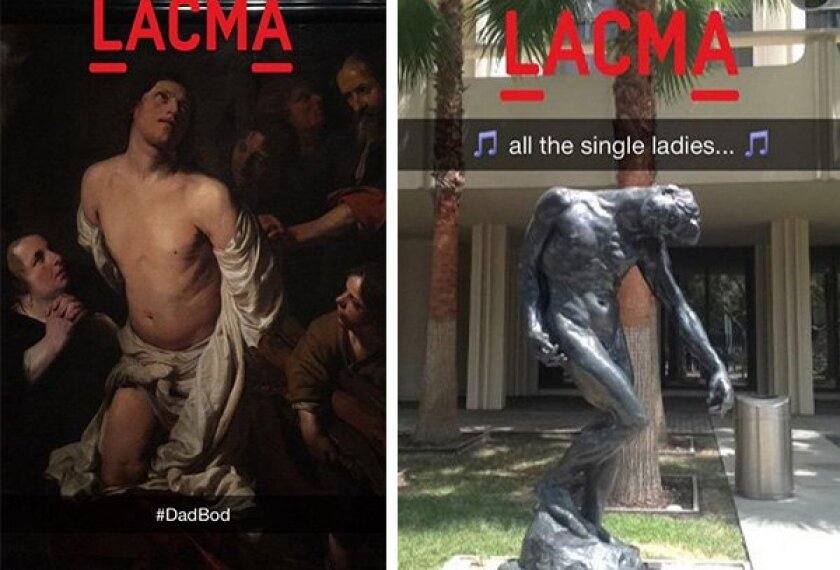
The Los Angeles County Museum of Art takes snapchats -- text or emoji overlays on images -- of works in its collection. The snapchat on the left shows an annotated version of the 1652 oil painting “The Martyrdom of Saint Lawrence” by Salomon de Bray. The one on the right depicts the bronze sculpture “The Shade” by Auguste Rodin.
  • Save to favorites
  • Print

Art museums are often depicted—perhaps unfairly—as stuffy, lumbering institutions that are slow to embrace change. But now, a growing number of those institutions are jumping headfirst into the new-age world of memes, snapchat, and Instagram.

These cultural institutions say they feel obligated to keep up with a generation that has taken an unprecedented interest in visual digital content.

The pervasiveness of memes is shaping not only the language of social media, but also the norms of language itself: The Oxford English Dictionary recently embraced an emoji, the “face with tears of joy” emoji as the 2015 word of the year.

One institution that has exploited the use of online images to engage young people is the L.A. County Museum of Art, or LACMA. The museum’s Snapchat profile, run by Social Media Manager Lucy Redoglia, who has aggressively promoted it, has over 180,000 followers. The average user age on Snapchat is 18.

Her strategy is to mash-up trendy pop culture references with images of artwork from the museum’s collection.

A popular entry included a picture of Auguste Rodin’s 1880 sculpture, “The Shade,” with the caption “all the single ladies.”

Last year, the museum posted an image of the Dutch artist Salomon de Bray’s 1652 “Martyrdom of Saint Lawrence,” with the irreverent hashtag #dadbod superimposed across it.

Redoglia has also arranged longer “snap stories” that animate every line of entire songs (Queen’s “Bohemian Rhapsody” was recently featured).

Images on Snapchat are ephemeral, meaning they are only displayed on a user’s device for 10 seconds before they must be replayed, and the platform does not allow Redoglia to link to any other content. Even so, she says the medium helps translate art into something “more approachable and relatable” for students.

Between 20 and 500 screenshots of each snap are taken by users, many of which are “shared” on social media, and some of them have gone viral, Redoglia said. That sharing generates free advertising to one of the institution’s core demographic audiences.

LACMA is not alone in pushing the boundaries between memes and fine art.

The Metropolitan Museum of Art and the Brooklyn Museum of Art are other leaders in the push to democratize collections in the name of accessibility—the Met having found social media success as far away as China’s Weibo micro-blogging platform. The popular Instagram channel turned fashion label, Fly Art, has also gained a following among millennials by mashing up classic art with contemporary rap lyrics.

But is the breezy treatment of history’s most significant cultural artifacts cheapening their value?

Redoglia said she tries to “keep a balance” between engaging new audiences and respecting the works of art. She points out that her presentation of pieces of art are “more formal” in other social media forums, including Facebook and Twitter.

Redoglia also referred to a recent quote from art historian Bendor Grosvenor in the British newspaper the Independent, who argued in favor of the initiative by saying, “Art can’t be devalued.”

“The Mona Lisa adorns everything from pizza boxes to toothpaste,” Grosvenor observed, “and still it’s regarded as one of the greatest paintings of all time.”

Related Tags:

A version of this article appeared in the April 27, 2016 edition of Education Week

Events

Teaching Profession K-12 Essentials Forum Supporting the New K-12 Workforce: What Teachers Need to Stay at School
 Join this free virtual event to discover what teachers say they need to feel supported to stay in classrooms for the long haul.
College & Workforce Readiness K-12 Essentials Forum Career and Technical Education Takes Its Next Big Step
Join this free virtual event to hear creative approaches to modernize CTE programs and navigate the shift away from a near-exclusive focus on "college preparedness."

EdWeek Top School Jobs

Teacher Jobs
Search over ten thousand teaching jobs nationwide — elementary, middle, high school and more.
View Jobs
Principal Jobs
Find hundreds of jobs for principals, assistant principals, and other school leadership roles.
View Jobs
Administrator Jobs
Over a thousand district-level jobs: superintendents, directors, more.
View Jobs
Support Staff Jobs
Search thousands of jobs, from paraprofessionals to counselors and more.
View Jobs

Read Next

Curriculum See the Retired School Bus That High Schoolers Turned Into a Mobile Makerspace
In a Pennsylvania district, students use a bus specially outfitted for them to work on creative projects.
1 min read
EPHRATAMAKERBUS 042926 SCOTT LEWIS 0030
Students return from the Ephrata, Pa. district's "maker bus" to their classrooms at Fulton Elementary School as teacher Joel Bischoff leads them on April 29, 2026. The Ephrata district parks the mobile makerspace at each of its elementary schools a few weeks at a time to allow students to complete hands-on projects. The district has oriented its teaching around projects that allow students to demonstrate skills like empathy and creativity alongside content knowledge.
Scott Lewis for Education Week
Curriculum Download How to Teach Cursive: Six Practical Tips (Downloadable)
This printable downloadable provides actionable tips for teaching cursive handwriting.
1 min read
School Boy Writing on Paper writing the alphabet with Pencil . Kid, homework, education concept
Albina Gavrilovic/iStock/Getty
Curriculum Opinion What Policymakers Get Wrong About 'High-Quality' Curriculum
Schools can't fix instruction without fixing curriculum, Doug Lemov warns.
10 min read
The United States Capitol building as a bookcase filled with red, white, and blue policy books in a Washington DC landscape.
Luca D'Urbino for Education Week
Curriculum Cursive is Making a Comeback. It Won’t Be Without Challenges
A growing number of states are requiring schools to return to cursive writing instruction.
5 min read
A third-grader practices his cursive handwriting at a school in the Queens borough of New York.
A third-grader practices his cursive handwriting at a school in the Queens borough of New York. At least half of the nation’s states have adopted cursive writing instruction in recent years, reversing a sharp decline in teaching of that skill after the Common Core, launched in 2010, omitted it from its standards.
Mary Altaffer/AP
