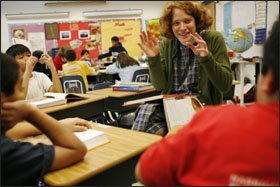
Fifth grader Any Samaria and 4th grader Maliksha Dursunov are both classified as English-language learners, but both can confidently read aloud in English from books at a 1st grade level. And they’re quickly picking up some of Virginia’s required academic skills for reading, such as how to identify a “problem” in a story.
Even so, the three teachers for their reading class of beginning English-learners at Waterman Elementary School in the heart of Virginia’s Shenandoah Valley oppose making the students take the state’s regular reading exam at their official grade levels, as federal officials would require.
After all, Any (pronounced AH-nee) came from Honduras only about a year ago, and Maliksha, a Meskhetian Turk from Russia, arrived less than a year ago. The two still struggle to speak full sentences in English.

“I’ve seen enormous gains since the beginning of the school year,” said Carissa J. Sweigart, a 4th grade teacher for the class, “but we can’t expect them to jump up all those levels of reading” to understand and pass a grade-level standardized test.
So this month, the members of the Harrisonburg City school board unanimously passed a resolution refusing to go along with a federal demand that Virginia schools stop using an English-language-proficiency test instead of the state’s regular reading test to calculate adequate yearly progress, or AYP, for beginning English-learners.
Elsewhere in the state, the Fairfax County school board passed a similar resolution last week and the Prince William County board did earlier this month. The Arlington County and Fairfax City districts are considering doing the same.
Tom Mendez, a Harrisonburg school board member and father of six, believes the federal officials aren’t taking into consideration the different paces at which children acquire English. “Bureaucracy doesn’t make exceptions,” he said. “We see it differently.”
He said it could cripple students’ self-esteem and “set back the learning process” to make beginning English-learners take a test they have no chance of passing.
School board Chairman Michael Walsh added that the testing requirements of the federal education law seem to be based on the idea that children are “square pegs fitting into square holes,” when, in fact, schoolchildren are diverse and not all suited to taking the same test.
Immigrant Influx
In the past decade, Harrisonburg, which has a population of 43,500, has become a magnet for immigrant families drawn to jobs in the poultry and construction industries. More than 1,600 of the school district’s 4,400 students are English-learners. The largest group of newcomers are Latinos, followed by Kurdish and Russian refugees.
District administrators have responded to the influx by standardizing the curriculum for English-language learners, hiring more English-as-a-second-language teachers, employing bilingual parent liaisons and interpreters, and adding classes with intensive instruction for newcomers, such as the reading class with three teachers for 14 students at Waterman Elementary.
The city’s Keister Elementary School was selected by the U.S. Department of Education as a Blue Ribbon School in 2004. That same year, the Bill & Melinda Gates Foundation chose Harrisonburg High School as one of the nation’s 30 model high schools. Among the city’s six schools, which all have a large number of English-learners, only the middle school failed to make the AYP requirements under the No Child Left Behind Act last school year.
Harrisonburg Superintendent Donald J. Ford sees it as an “intrusion” that the federal government is telling Virginia school districts that they have to change their testing policy for English-language learners, against the advice of local educators.
Mr. Ford and the school board members don’t believe that by resisting a change in policy they’ll lose any of the $980,000 in federal funds that the district receives for disadvantaged students under Title I of the NCLB law.
“I do not believe we are breaking the law,” said Mr. Ford. In his view, the district is “voluntarily” not trying to meet the bar set by the federal law for participation in testing, which is 95 percent participation by all students. Under the law, students are tested in reading and mathematics annually in grades 3-8 and once during high school.
About 250 English-learners would be affected if the district were to go along with the federal mandate. By refusing to have all eligible students take the test, school officials acknowledge that the district will not meet the AYP requirements. But the same would happen if all the English-learners were to take the regular reading test, since many would fail, Mr. Ford said.
Officials of the U.S. Department of Education didn’t respond last week to a request for comment on whether Virginia districts that refuse to change their testing policies for English-learners are, in fact, breaking the law.
Mr. Ford and the school board members would rather have Harrisonburg schools fail to meet AYP for having low testing participation than to see the schools fail because some English-learners didn’t pass the regular reading test. He considers it as unfair and morally wrong to give students a reading test they can’t read and understand.
Complex Debate
The Harrisonburg debate is complicated by the fact that some English-language learners in the first two of four proficiency levels can read English to some degree, though they may not yet have caught up with native English-speaking peers. When regulations were being considered for testing English-learners under the 5-year-old federal law, many educators said the decision should be tied to a child’s English-proficiency level. Others advised that students shouldn’t be expected to take a grade-level test in reading until they had attended U.S. schools for up to five years.
In September, U.S. Secretary of Education Margaret Spellings announced that the federal government had produced final regulations requiring English-learners to be included in regular state reading tests after they had attended U.S. schools for a year. (“Spellings Issues Final Regulations for Testing of English-Learners,” Sept. 20, 2006.)
Harrisonburg educators generally agree with Virginia’s existing policy, which is to give the regular reading test to students only at the upper two levels of English proficiency. They applaud the school board in resisting the federal mandate to change that policy.
Learning to Read
Had the Harrisonburg school board not voted otherwise, many of the children in a special class for English-learners at Waterman Elementary school would be affected this school year by the federal mandate for Virginia schools to change how they test such students. (“States Adopt New Tests for English-Learners,” Jan. 24, 2007.) All of them are still at Level 1 or 2 in English proficiency.
Of Maliksha and Any’s reading group of five on an afternoon last week, three children have been in the United States long enough that they would have to take the regular reading test this school year.
During a read-aloud exercise, Any mistook the word “it” for “I” while reading Molly’s Broccoli, written by Deborah Eaton and rated at a 1st grade reading level. She also got stuck on “mole” and “moose,” but could sound out all the other words. On a worksheet, she correctly identified in writing the “problem” in the story: Molly doesn’t want to eat broccoli. Identifying a story’s problem is a concept that might appear on the state’s standardized reading test for her grade.
When Kristin Yoder Kauffman, an ESL teacher, taught the word “smash,” Maliksha asked if it was a “synonym” of the verb “bump.” The concept of synonyms also is something that might be assessed by the regular reading test. But the children obviously had a lot to learn in English. They struggled, for example, to distinguish the “sh” and “ch” sounds in words, and were confused about whether to select “am,” “is,” or “are,” to make a subject and verb agree when crafting a sentence.
Their teachers point out that the No Child Left Behind law does require schools to give all English-language learners—no matter how long they’ve been in U.S. schools—each individual state’s English-language-proficiency test. They believe that requirement is appropriate, and say the results of an English-proficiency test provide useful information about how children are progressing.
Children in the afternoon reading class here aren’t ready, though, to take the regular Virginia standardized paper-and-pencil reading test, said Jenny R. Hartwig, the 5th grade teacher for the class.
“They may understand the concept, but it’s not presented on the test in a way they can pass,” she said.


