
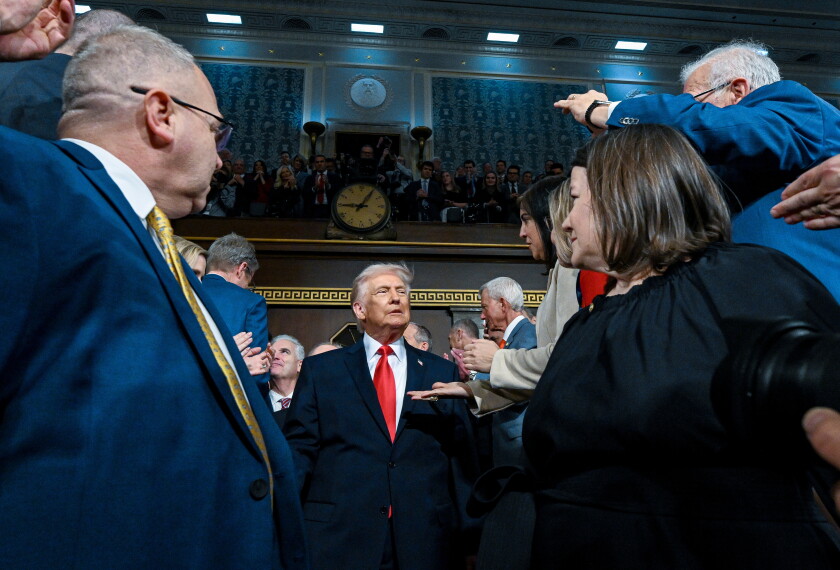
President Donald Trump used his most high-profile speech of the year to laud a K-12 artificial intelligence competition spearheaded by first lady Melania Trump, while remaining silent about his work to hollow out the U.S. Department of Education and dramatically expand federal resources for private school choice.
Trump’s decision to keep those cornerstone K-12 policies out of the State-of-the-Union spotlight comes at the start of a mid-term election year in which Republicans are expected to struggle to maintain their slim majority in the U.S. House of Representatives.
Trump also did not propose any new education policies in the address, leaving his priorities for the next three years unclear following a year in which he’s shaken up the federal education status quo.
The AI competition was announced around the beginning of the school year and praised by some computer science teachers.
“Students and educators in every state have joined the First Lady’s efforts in the presidential AI challenge keeping America’s Next Generation positioned to succeed and strongly succeed in the future,” Trump said.

It’s a relatively modest initiative in the president’s education portfolio, compared with Trump’s decision to cut the department’s staff nearly in half and move administration of key K-12 programs—including Title I grants for disadvantaged students and career-and-technical education programs—to the U.S. Department of Labor.
Trump also did not discuss his administration’s move to revoke a longstanding policy that generally prohibited Immigration and Customs Enforcement and Border Patrol agents from making immigration arrests and carrying out raids at schools and other “sensitive locations,” including places of worship and hospitals, without permission from agency headquarters. The Department of Homeland Security has said it isn’t targeting schools, but that the policy change means criminals can’t “hide in America’s schools to avoid arrest.”
Schools, particularly in Minnesota—the site of a recent immigration enforcement surge—have reported enforcement activity on and near school property, and a drop in student attendance.
And Trump only briefly alluded to his administration’s efforts to use the power of the federal government—including the Education Department’s office for civil rights—to drop a legal hammer on school districts and states that don’t require school officials to notify parents when students adopt a gender identity at school that doesn’t correspond with their sex at birth.
Trump singled out Sage Blair, a Virginia woman whose parents accused school officials of encouraging her gender transition without their consent.
“School officials in Virginia sought to socially transition her to a new gender, treating her as a boy and hiding it from her parents,” Trump said. “Hard to believe, isn’t it?”
AI competition comes amid cuts to STEM programs and research
The AI competition is part of a broader push by the administration to infuse the technology throughout K-12 schooling, even as the Trump administration has nixed programs and made policy moves experts warn could hobble its AI goals.
The competition invited K-12 students and educators to participate in the nationwide competition to “solve real-world problems in their communities using AI-powered solutions.”
Student participants were charged with crafting a proposal for how artificial intelligence technologies could be applied to address a community problem. Educators were also invited to propose new and unique ways to teach an AI concept to their students or create an AI tool to manage an aspect of their classrooms that couldn’t be completed without the emerging technology.
Winners of the state-level competitions are scheduled to be announced early this year. National finalists will be invited to the White House for a three-day showcase in June 2026.
At the same time, the administration terminated more than 400 federal grants last spring that were aimed at advancing STEM education in K-12 schools and universities. It also eliminated the Education Department’s office of educational technology, which was tasked with aiding states and districts with implementing emerging technologies in schools.
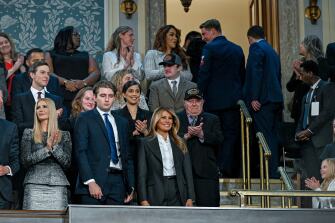
To underscore the administration’s emphasis on AI in K-12, Melania Trump invited as her guest Everest Nevraumont, 10, a student from Alpha Schools, a network of private schools where students spend two hours a day learning reading and math using AI-powered software. The rest of the time, they work on skills like communication and financial literacy.
Everest, who attends Alpha School’s Austin, Texas, campus and won a statewide history competition three times, spoke about how her father used AI to figure out what she should study for a national history contest. (She placed among the top 4th graders in the national competition.) Trump’s education secretary, Linda McMahon, visited Alpha Schools in Austin last fall.
It’s unclear if GOP leaders in Congress share Trump’s enthusiasm for AI in K-12.
Lawmakers have been raising alarm bells about the potential impact of AI tools on children’s mental health. For instance, a bipartisan Senate bill, introduced by Sen. Josh Hawley, R-Mo., and co-sponsored by Sen. Richard Blumenthal, D-Conn., seeks to forbid companies from providing minors with access to AI chatbot companions such as Character.ai and Replika.
And last month, Sen. Ted Cruz, R-Texas, the chairman of the Senate Commerce Committee, argued in a hearing that the time students spend on digital devices in school—even for learning purposes—has contributed to a teen mental health crisis, while dragging down academic outcomes.


