
Federal

Trump Admin. Adds Project 2025 Author to Education Department Staff

The president tried to distance himself from the conservative policy document during last year’s campaign
By Brooke Schultz — June 09, 2025 4 min read
A copy of Project 2025 is held during the Democratic National Convention, Aug. 21, 2024, in Chicago.
  • Save to favorites
  • Print

The U.S. Department of Education has hired a Project 2025 author whose chapter of the conservative policy document proposed dismantling the federal agency, phasing out Title I funding for schools, and scaling back other federal involvement in education.

Lindsey Burke will join the Education Department as deputy chief of staff for policy and programs, the department announced late last week. Burke arrives after 17 years at the Heritage Foundation, a conservative think tank that published the 900-page Project 2025 policy blueprint that became a major source of debate during the 2024 presidential campaign.

As director of the group’s center for education policy, Burke wrote a 44-page chapter on what a conservative president should do with the Department of Education. Her appointment comes as Trump has already begun to embrace plans outlined in the document.

See Also

Kevin Roberts, president of The Heritage Foundation, speaks before Republican presidential candidate former President Donald Trump at the National Religious Broadcasters convention at the Gaylord Opryland Resort and Convention Center on Feb. 22, 2024, in Nashville, Tenn.
Kevin Roberts, president of The Heritage Foundation, speaks before Republican presidential candidate former President Donald Trump at the National Religious Broadcasters convention at the Gaylord Opryland Resort and Convention Center on Feb. 22, 2024, in Nashville, Tenn. Democrats are using the Heritage Foundation's Project 2025 agenda to show what could happen in a Trump presidency while the former president distances himself from it.
George Walker IV/AP
Federal Project 2025: What It Is and What It Means for K-12 If Trump Wins
Libby Stanford, July 8, 2024
4 min read

Though he spent the campaign attempting to distance himself from it, at one point calling the document “absolutely ridiculous and abysmal,” several of its authors are working in his administration. The agenda also articulates a number of education policies Trump has so far followed.

Burke’s chapter on the Education Department proposes a seismic overhaul of the federal education infrastructure—converting funding for students with disabilities and students from low-income communities, the two largest sources of federal education money, to “no-strings-attached” block grants to states that could even flow directly to parents to spend outside of public schools; moving the department’s various services to other federal agencies; and using federal funds to expand school choice.

Project 2025 proposes eliminating Title I grants to states—currently an $18.4 billion funding stream that flows to most schools—after a decade.

In a 2024 interview with Rick Hess, the director of education policy studies at the American Enterprise Institute and an Education Week opinion contributor, Burke said Project 2025 sought to reshape education by making federal investments more accountable—arguing that the federal government isn’t held accountable when systems fall short.

“Providers are simply not held accountable to the people they’re supposed to serve,” she said. “The reforms we outline would recalibrate accountability so that it is directed horizontally to parents and taxpayers rather than vertically to Washington.”

Burke argued abolishing the department wouldn’t mean getting rid of key civil rights protections for students, but “the removal of myriad ineffective programs and inflationary spending”—something Education Secretary Linda McMahon has repeated in appearances before lawmakers.

Lindsey Burke, center for education policy director at the Heritage Foundation, speaks during an event hosted by the foundation on parental control in schools May 15, 2024, in Washington, D.C.

Burke—who previously worked as a fellow at school choice advocacy group EdChoice and on a number of advisory boards regarding education—has penned numerous education policy reports.

Proposals authored by Burke—such as offering school vouchers to military families and overturning or challenging the landmark U.S. Supreme Court ruling that protects undocumented families’ right to a free public education—have been championed by conservative lawmakers, even if they don’t appear in the controversial white paper itself.

Heritage Foundation president Kevin Roberts called Burke “the intellectual backbone of the school choice movement” and “one of the most respected, principled, and effective leaders in the conservative movement.” He said in a statement that her Education Department appointment was “a landmark victory for American education.”

What Trump has already done from Project 2025

Some of Burke’s proposals have already begun to filter into education policy during Trump’s second term.

Trump signed an executive order calling on McMahon to “facilitate” the closure of the Education Department. He rescinded a longstanding memo that largely prevented immigration agents from carrying out arrests and raids at schools and bus stops. He rolled back protections for transgender students under Title IX, the federal anti-sex discrimination law, and made it U.S. policy to only recognize two sexes.

He is also pushing to expand school choice within the limits of his executive authority, including by directing the secretaries of defense and the interior to develop plans for expanding choice at the school systems they oversee.

Both Trump and McMahon have floated other ideas that align with the Project 2025 blueprint—like moving oversight of the Individuals with Disabilities Education Act to the U.S. Department of Health and Human Services and the office for civil rights to the U.S. Department of Justice.

Burke told Hess in 2024 that the white paper “provides a menu of options” for building on Trump’s first term.

“[S]everal Republican presidents have taken and implemented our policy suggestions,” Burke said in the interview. “We remain true to that mission and will continue to offer policy recommendations to conservative administrations, but it is ultimately up to the president to decide which policies to implement.”

Events

This content is provided by our sponsor. It is not written by and does not necessarily reflect the views of Education Week's editorial staff.
Sponsor
Artificial Intelligence Webinar
Managing AI in Schools: Practical Strategies for Districts
How should districts govern AI in schools? Learn practical strategies for policies, safety, transparency, as well as responsible adoption.
Content provided by Lightspeed Systems
This content is provided by our sponsor. It is not written by and does not necessarily reflect the views of Education Week's editorial staff.
Sponsor
Reading & Literacy Webinar
Unlocking Success for Struggling Adolescent Readers
The Science of Reading transformed K-3 literacy. Now it's time to extend that focus to students in grades 6 through 12.
Content provided by STARI
Jobs Virtual Career Fair for Teachers and K-12 Staff
Find teaching jobs and K-12 education jubs at the EdWeek Top School Jobs virtual career fair.

EdWeek Top School Jobs

Teacher Jobs
Search over ten thousand teaching jobs nationwide — elementary, middle, high school and more.
View Jobs
Principal Jobs
Find hundreds of jobs for principals, assistant principals, and other school leadership roles.
View Jobs
Administrator Jobs
Over a thousand district-level jobs: superintendents, directors, more.
View Jobs
Support Staff Jobs
Search thousands of jobs, from paraprofessionals to counselors and more.
View Jobs

Read Next

Federal Will the Ed. Dept. Act on Recommendations to Overhaul Its Research Arm?
An adviser's report called for more coherence and sped-up research awards at the Institute of Education Sciences.
6 min read
The U.S. Department of Education building is pictured on Oct. 24, 2025, in Washington, D.C.
The U.S. Department of Education building in Washington is pictured on Oct. 24, 2025. A new report from a department adviser calls for major overhauls to the agency's research arm to facilitate timely research and easier-to-use guides for educators and state leaders.
Maansi Srivastava for Education Week
Federal Trump Talks Up AI in State of the Union, But Not Much Else About Education
The president didn't mention two of his cornerstone education policies from the past year.
4 min read
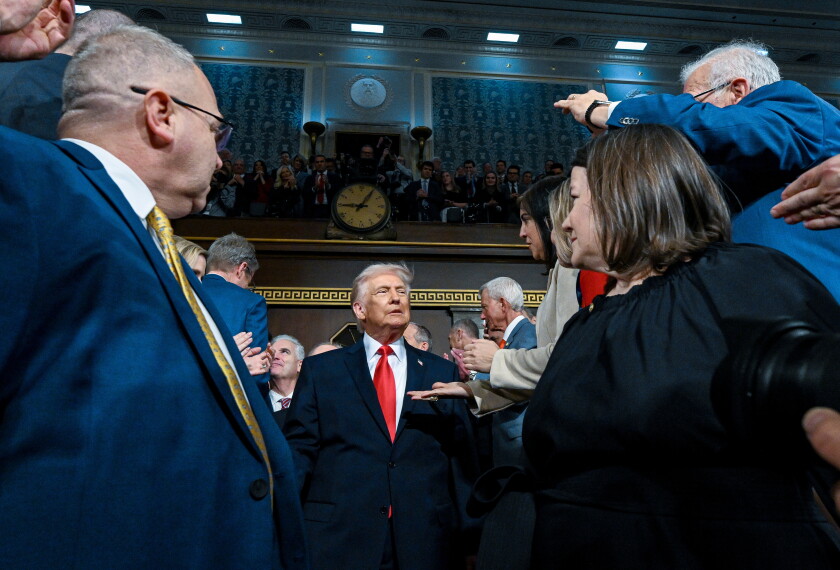
President Donald Trump enters to deliver the State of the Union address to a joint session of Congress in the House chamber at the U.S. Capitol in Washington, Tuesday, Feb. 24, 2026.
President Donald Trump enters to deliver the State of the Union address to a joint session of Congress in the House chamber at the U.S. Capitol in Washington, Tuesday, Feb. 24, 2026. The president devoted little time in the speech to discussing his education policies.
Kenny Holston/The New York Times via AP, Pool
Federal Education Department Will Send More of Its Programs to Other Agencies
Education grants for school safety, community schools, and family engagement will shift to Health and Human Services.
4 min read
Various school representatives and parent liaisons attend a family and community engagement think tank discussion at Lowery Conference Center on March 13, 2024 in Denver. One of the goals of the meeting was to discuss how schools can better integrate new students and families into the district. Denver Public Schools has six community hubs across the district that have serviced 3,000 new students since October 2023. Each community hub has different resources for families and students catering to what the community needs.
A program that helps state education departments and schools improve family engagement policies is among those the Trump administration will transfer from the U.S. Department of Education to the U.S. Department of Health and Human Services. In this photo, school representatives and parent liaisons attend a family and community engagement discussion on March 13, 2024, in Denver to discuss how schools can better integrate new students and families into the district.
Rebecca Slezak For Education Week
Federal New Trump Admin. Guidance Says Teachers Can Pray With Students
The president said the guidance for public schools would ensure "total protection" for school prayer.
3 min read
MADISON, AL - MARCH 29: Bob Jones High School football players touch the people near them during a prayer after morning workouts and before the rest of the school day on March 29, 2024, in Madison, AL. Head football coach Kelvis White and his brother follow in the footsteps of their father, who was also a football coach. As sports in the United States deals with polarization, Coach White and Bob Jones High School form a classic tale of team, unity, and brotherhood. (Photo by Jahi Chikwendiu/The Washington Post via Getty Images)
Football players at Bob Jones High School in Madison, Ala., pray after morning workouts before the rest of the school day on March 29, 2024. New guidance from the U.S. Department of Education says students and educators can pray at school, as long as the prayer isn't school-sponsored and disruptive to school and classroom activities, and students aren't coerced to participate.
Jahi Chikwendiu/Washington Post via Getty Images
