Law & Courts

The Supreme Court’s 2013-2014 Term: Notable Cases for Educators

By Mark Walsh — July 08, 2014 3 min read
  • Save to favorites
  • Print

The justices dealt with several cases of interest to educators, including disputes involving race in college admissions, prayers at government meetings, the rights of public employees, the role of IQ scores in the death penalty, and a case about cellphone privacy that could affect students.

State Prohibition on Race-Conscious Admissions
The court ruled 6-2 in Schuette v. Coalition to Defend Affirmative Action (Case No. 12-682) to uphold a 2006 Michigan ballot initiative that bars race-based preferences in admissions at the state’s universities. No opinion commanded a majority of the court. In a plurality opinion signed by two other members of the court, Justice Anthony M. Kennedy said there was no authority in the U.S. Constitution or in the court’s precedents for the judiciary to set aside Michigan laws that allow voters to decide whether racial preferences may be considered in school admissions.

Prayers at Municipal Meetings
The justices ruled 5-4 to uphold a town’s practice of permitting private individuals to deliver prayers before town council meetings, despite the predominantly Christian and sometimes proselytizing nature of the prayers. The majority said its decision in Town of Greece, N.Y. v. Galloway (No. 12-696) was governed by the high court’s 1983 decision in Marsh v. Chambers, which upheld prayers delivered before the Nebraska legislature. Legal experts disagreed about whether prayers at school board meetings would be permitted under the court’s decision.

Public-Employee Unions
In a case closely watched by the teachers’ unions, the court in Harris v. Quinn (No. 11-681) declined entreaties from “right-to-work” advocates to overrule a key precedent allowing public-employee unions to collect so-called agency fees from workers who refuse to join the union but are covered by a collective-bargaining agreement. Ruling 5-4, the justices refused to extend the 1977 case, Abood v. Detroit Board of Education, to home-health care workers in Illinois whom the court deemed to be only quasi-public employees. Still, the majority cast serious doubt about the future of the Abood precedent.

Government-Employee Speech
The court gave public employees such as teachers and administrators stronger First Amendment speech protections when they testify under oath. The unanimous decision in Lane v. Franks (No. 13-483) came in the case of the head of an at-risk youth program administered by an Alabama community college who was fired after he testified against a state legislator who held a no-show job. The justices said sworn testimony was outside the scope of the administrator’s ordinary job duties and was protected under the First Amendment as speech by a citizen on a matter of public concern.

IQ Scores and the Death Penalty
The court ruled 5-4 in Hall v. Florida (No. 10-10882) that a state may not set an IQ score of 70 or below as the rigid cutoff that would permit it to execute a person with an intellectual disability. The case of a longtime Florida death row inmate whose teachers once classified him as “mentally retarded” was one that invited much debate over the role of IQ scores and the educational and intellectual development of capital defendants. The court said intellectual disability was “a condition, not a number,” and that Florida’s rigid cutoff score failed to take into account the standard error of measurement, in disregard of established medical practice.

Cell Phones
The justices unanimously gave strong Fourth Amendment protection to the contents of cellphones. The decision in Riley v. California (No. 13-132) concerned warrantless police searches of the phones of criminal suspects who were under arrest, but the court’s expansive reasoning could potentially be interpreted to protect students’ digital devices from searches by school administrators. The court’s opinion stressed that cellphone users carry a digital record of nearly every aspect of their lives—“from the mundane to the intimate.”

A version of this article appeared in the July 10, 2014 edition of Education Week as The 2013-2014 Term: Notable Cases

Events

This content is provided by our sponsor. It is not written by and does not necessarily reflect the views of Education Week's editorial staff.
Sponsor
Artificial Intelligence Webinar
Managing AI in Schools: Practical Strategies for Districts
How should districts govern AI in schools? Learn practical strategies for policies, safety, transparency, and responsible adoption.
Content provided by Lightspeed Systems
This content is provided by our sponsor. It is not written by and does not necessarily reflect the views of Education Week's editorial staff.
Sponsor
Artificial Intelligence Webinar
AI in Schools: What 1,000 Districts Reveal About Readiness and Risk
Move beyond “ban vs. embrace” with real-world AI data and practical guidance for a balanced, responsible district policy.
Content provided by Securly
This content is provided by our sponsor. It is not written by and does not necessarily reflect the views of Education Week's editorial staff.
Sponsor
Recruitment & Retention Webinar
K-12 Lens 2026: What New Staffing Data Reveals About District Operations
Explore national survey findings and hear how districts are navigating staffing changes that affect daily operations, workload, and planning.
Content provided by Frontline Education

EdWeek Top School Jobs

Teacher Jobs
Search over ten thousand teaching jobs nationwide — elementary, middle, high school and more.
View Jobs
Principal Jobs
Find hundreds of jobs for principals, assistant principals, and other school leadership roles.
View Jobs
Administrator Jobs
Over a thousand district-level jobs: superintendents, directors, more.
View Jobs
Support Staff Jobs
Search thousands of jobs, from paraprofessionals to counselors and more.
View Jobs

Read Next

Law & Courts Supreme Court’s Gender Identity Ruling Leaves Schools Seeking Clarity
Advocates say they would welcome more from the Supreme Court on gender-notification policies.
7 min read
The Supreme Court is photographed, Friday, Feb. 27, 2026, in Washington.
The Supreme Court is photographed, Friday, Feb. 27, 2026, in Washington. The high court recently ruled that California policies that sometimes limit or discourage schools from disclosing information to parents about children’s gender transitions and expressions at school likely violate parents’ constitutional rights
Rahmat Gul/AP
Law & Courts Supreme Court Backs Parents in School Gender Disclosure Fight
The Supreme Court restored an injunction blocking California policies on student gender transitions
8 min read
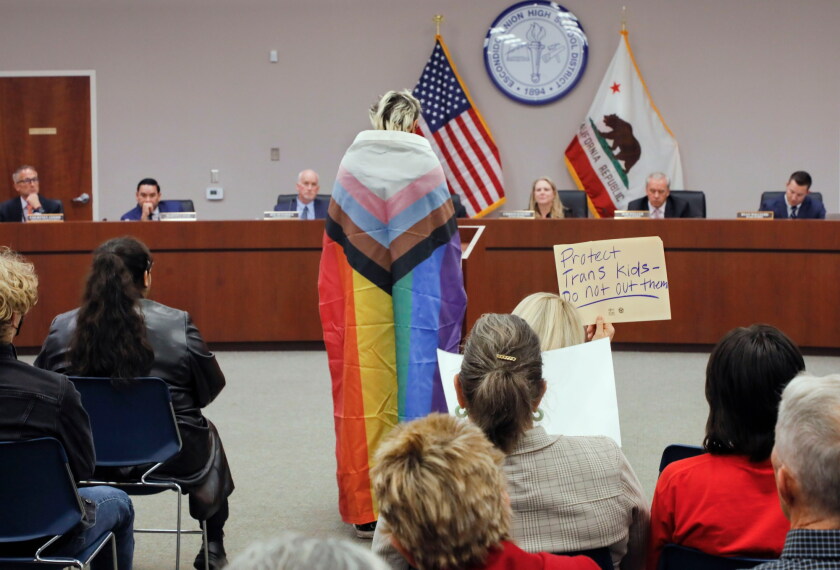
Teacher’s aide Amelia Mester, wrapped in a Pride flag, urges Escondido Union High School District not to have employees notify parents if they believe a student may be transgender in November 2025. A policy on the issue in the city’s elementary school district is the subject of a federal class-action lawsuit in which a judge just sided against the district.
Teacher’s aide Amelia Mester, wrapped in a Pride flag, urges Escondido Union High School District not to have employees notify parents if they believe a student may be transgender at a meeting in November 2025. Two parents and two teachers from the district sued in 2023, challenging California state guidance concerning student gender transitions and parental notification. The U.S. Supreme Court has now reinstated a lower-court decision overturning those state policies.
Charlie Neuman for The San Diego Union-Tribune/TNS
Law & Courts Appeals Court Allows Louisiana Ten Commandments Displays to Proceed
The court said it was premature to rule on the constitutionality of La. Ten Commandments displays.
3 min read
Students work under Ten Commandments and Bill of Rights posters on display in a classroom at Lehman High School in Kyle, Texas, Thursday, Oct. 16, 2025.
Students work under Ten Commandments and Bill of Rights posters on display in a classroom at Lehman High School in Kyle, Texas, Oct. 16, 2025. A federal appeals court has lifted a lower-court injunction blocking a Louisiana law that requires Ten Commandments displays, clearing the way for the law to take effect.
Eric Gay/AP
Law & Courts Social Media Companies Face Legal Reckoning Over Mental Health Harms to Children
Some of the biggest players from Meta to TikTok are getting a chance to make their case in courtrooms around the country.
6 min read
Social Media Kids Trial 26050035983057
Meta CEO Mark Zuckerberg leaves court after testifying in a landmark trial over whether social media platforms deliberately addict and harm children, on Feb. 18, 2026, in Los Angeles.
AP Photo/Damian Dovarganes
