Law & Courts

Supreme Court Turns Down Case Challenging School District’s Transgender Policies

By Mark Walsh — May 20, 2024 3 min read
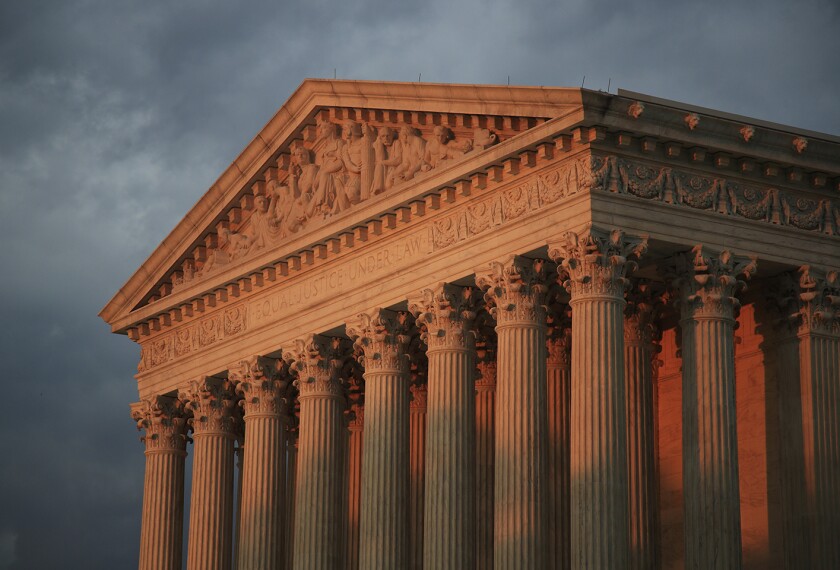
This Oct. 4, 2018, photo shows the U.S. Supreme Court at sunset in Washington. The Supreme Court has declined to take up an appeal from parents in Oregon who want to prevent transgender students from using locker rooms and bathrooms of the gender with which they identify, rather than their sex assigned at birth.
  • Save to favorites
  • Print

The U.S. Supreme Court on Monday declined to take up a case about a Maryland school district’s policies to support transgender students and when parents may challenge them.

The court’s action in Parents 1 v. Montgomery County Board of Education was not a decision on the merits, but the case is emblematic of a widespread national debate over gender identity policies in public schools and parental rights.

“Schools across the country over the past few years have adopted policies similar to that involved here that require school personnel to hide from parents—lying if need be—that the school is assisting their child to transition gender at school,” said the appeal filed by three unidentified parents in their case against the 160,000-student Montgomery County district outside the nation’s capital.

The parents contend that what they call a “parental preclusion policy” calls for school personnel to support gender-transitioning students to change their names, pronouns, and how they “exhibit” their gender without officials consulting or even notifying parents. They argued that the policy violates their 14th Amendment due process right to direct the upbringing of their children.

The school district said in its Supreme Court brief that its “Guidelines for Gender Identity,” adopted in advance of the 2020-21 school year, call for collaboration with parents in developing a gender support plan for a transitioning student.

But when the student’s parents are deemed non-supportive, the guidelines “acknowledge the reality that, ‘in some cases, transgender and gender-nonconforming students may not openly express their gender identity at home because of safety concerns or lack of acceptance,’ and, in light of that reality, indicate that student support and safety is an overarching goal,” the district said, quoting from the guidelines.

The parents’ lawsuit was dismissed in 2022 by a federal district court. Last year, a panel of the U.S. Court of Appeals for the 4th Circuit, in Richmond, Va., ruled 2-1 that the parents lacked standing to sue over the guidelines because none of their children had gender-support plans or had any discussions with school officials about gender transitioning or gender identity issues.

Writing for the majority, Judge A. Marvin Quattlebaum Jr. said the guidelines are “staggering from a policy standpoint” and may be “an overreach into areas that parents should handle.”

But the parents “have not alleged facts that the Montgomery County public schools have any information about their children that is currently being withheld or that there is a substantial risk information will be withheld in the future,” he said.

In dissent, Judge Paul V. Niemeyer said the majority’s view of parental standing was “unfairly narrow” in this case and subjected parents “to a mandatory policy that pulls the discussion of gender issues from the family circle to the public schools without any avenue of redress by the parents.”

Niemeyer also cast doubt on the legality of the district’s guidelines, saying they usurp “the constitutionally protected role” of parents.

School districts’ policies on transgender students facing legal challenges

The parents, backed by the National Legal Foundation of Chesapeake, Va., also had support from several conservative groups and Republican-led states in the Supreme Court. A friend-of-the-court brief filed by West Virginia and 16 other red states said, “Parents must have the right to ask for the courts’ help in securing the fundamental right to know what schools are doing with their kids.”

The parents and the states both cite statistics from the grassroots group Parents Defending Education that more than 1,000 districts nationwide have policies for transgender and gender non-conforming students that “openly state that district personnel can or should keep a student’s transgender status hidden from parents.”

The Montgomery County school district told the court in its brief that the 4th Circuit was correct in ruling that the parent challengers lacked standing. It said there are several cases across the country alleging that school districts denied information about a child’s gender transition to that child’s parents.

If the parents and their supporters “are correct that similar cases are percolating through the lower courts, then the [Supreme] Court should address these issues, if at all, in litigation that presents an actual case or controversy,” the district said.

This is not the only LGBTQ+ controversy in the Montgomery County district. Last week, a separate 4th Circuit panel issued a decision that refused to block the district’s policy preventing parents from opting their children out of LGBTQ+ inclusive “storybooks” used in its elementary schools.

Events

This content is provided by our sponsor. It is not written by and does not necessarily reflect the views of Education Week's editorial staff.
Sponsor
Artificial Intelligence Webinar
Managing AI in Schools: Practical Strategies for Districts
How should districts govern AI in schools? Learn practical strategies for policies, safety, transparency, and responsible adoption.
Content provided by Lightspeed Systems
This content is provided by our sponsor. It is not written by and does not necessarily reflect the views of Education Week's editorial staff.
Sponsor
Student Absenteeism Webinar
Removing Transportation and Attendance Barriers for Homeless Youth
Join us to see how districts around the country are supporting vulnerable students, including those covered under the McKinney–Vento Act.
Content provided by HopSkipDrive
This content is provided by our sponsor. It is not written by and does not necessarily reflect the views of Education Week's editorial staff.
Sponsor
Reading & Literacy Webinar
Two Jobs, One Classroom: Strengthening Decoding While Teaching Grade-Level Text
Discover practical, research-informed practices that drive real reading growth without sacrificing grade-level learning.
Content provided by EPS Learning

EdWeek Top School Jobs

Teacher Jobs
Search over ten thousand teaching jobs nationwide — elementary, middle, high school and more.
View Jobs
Principal Jobs
Find hundreds of jobs for principals, assistant principals, and other school leadership roles.
View Jobs
Administrator Jobs
Over a thousand district-level jobs: superintendents, directors, more.
View Jobs
Support Staff Jobs
Search thousands of jobs, from paraprofessionals to counselors and more.
View Jobs

Read Next

Law & Courts California Sues Ed. Dept. in Clash Over Gender Disclosures to Parents
California challenges U.S. Department of Education findings on state policies over gender disclosure.
4 min read
California Attorney General Rob Bonta speaks to reporters as Arizona Attorney General Kris Mayes, left, and Oregon Attorney General Dan Rayfield, right, listen outside the Supreme Court on Wednesday, Nov. 5, 2025, in Washington. (AP Photo/Mark Schiefelbein)
California Attorney General Rob Bonta speaks to reporters outside the U.S. Supreme Court in Washington on Nov. 5, 2025, with Arizona Attorney General Kris Mayes and Oregon Attorney General Dan Rayfield behind him. Bonta this week sued the U.S. Department of Education, asking a court to block the agency's finding that the state is violating FERPA by <ins data-user-label="Matt Stone" data-time="02/13/2026 4:22:45 PM" data-user-id="00000185-c5a3-d6ff-a38d-d7a32f6d0001" data-target-id="">not requiring schools to disclose</ins> students’ gender transitions <ins data-user-label="Matt Stone" data-time="02/13/2026 4:22:45 PM" data-user-id="00000185-c5a3-d6ff-a38d-d7a32f6d0001" data-target-id="">to</ins> parents.
Mark Schiefelbein/AP
Law & Courts Oklahoma Board Rejects Jewish Charter as Supreme Court Fight Looms
Oklahoma's charter school board rejected the Jewish school as members said their hands were tied.
4 min read
Ben Gamla Charter Schools founder and former U.S. Rep. Peter Deutsch, right, speaks with Brett Farley, executive director of the Catholic Conference of Oklahoma, left, before a Jan. 12 meeting of the Statewide Charter School Board in Oklahoma City. Both are founding board members of an Oklahoma Jewish Charter School.
Ben Gamla Charter Schools founder and former U.S. Rep. Peter Deutsch, right, speaks with Brett Farley, executive director of the Catholic Conference of Oklahoma, before a Jan. 12, 2026, meeting of the Statewide Charter School Board in Oklahoma City. The board rejected the proposed Jewish charter school on Feb. 9, 2026.
Nuria Martinez-Keel/Oklahoma Voice
Law & Courts Religious Charter Schools Push New Cases Toward Supreme Court
Advocates seeking to establish publicly funded religious schools in three states.
9 min read
The U.S. Supreme Court is seen, Wednesday, Jan. 14, 2026, in Washington.
The U.S. Supreme Court is seen on Wednesday, Jan. 14, 2026, in Washington. Religious charter advocates are betting a full Supreme Court will side with their efforts to establish religious charter schools.
Rahmat Gul/AP
Law & Courts Educators Sue Over ICE Activity on School Grounds and Nearby
The challenge targets the Trump administration's revocation of a policy that limited immigration enforcement at schools.
5 min read
A sign reading "Protect Neighbors" is posted near a bus stop as a school bus passes on Friday, Jan. 30, 2026, in Minneapolis.
A sign reading "Protect Neighbors" is posted near a bus stop in Minneapolis on Jan. 30, 2026. A lawsuit from two Minnesota school districts and the state's teachers' union says immigration agents have detained people and staged enforcement actions at or near schools, school bus stops, and daycare centers.
Kerem Yücel /Minnesota Public Radio via AP
