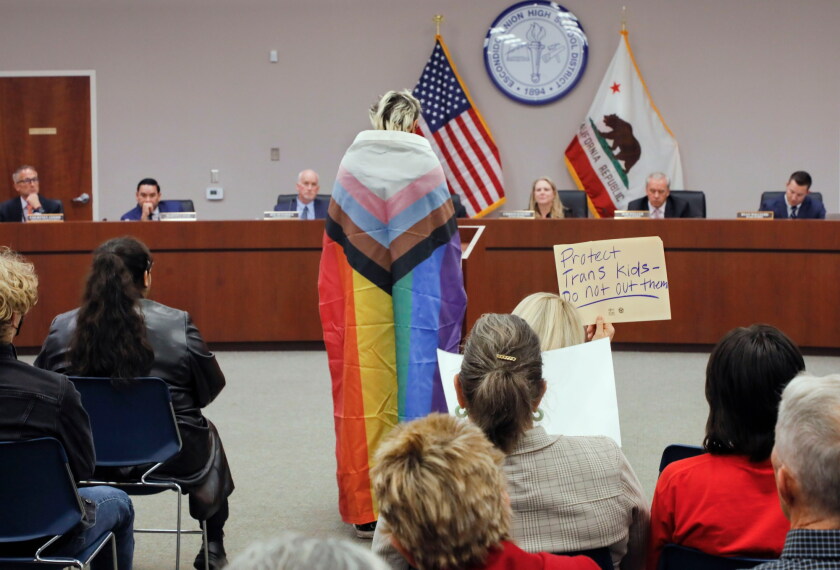
The U.S. Supreme Court is expected on Friday to issue its last merits opinions of the 2024-25 term, with two major education cases among those still out: one on whether parents with religious objections have the right to excuse their children from public school curriculum with LGBTQ+ themes and another challenging the constitutionality of the funding structure for the $4 billion federal E-rate program that provides internet connections in schools.
Chief Justice John G. Roberts Jr. on Thursday announced from the bench that the court would “announce all remaining opinions ready during this term of the court.” That phrasing is standard, as the court typically decides all argued cases before its summer recess. However, on rare occasions, it may postpone a decision in a given case and hear new arguments in the next term.
Here are the pending cases of interest to educators:
LGBTQ+ curriculum opt-out: Mahmoud v. Taylor
In Mahmoud v. Taylor, a group of religious parents are seeking to opt their children out of books and classroom discussions used in elementary grades in a Maryland school district to teach English/language arts and foster inclusion of students who are themselves or have parents who are members of the LGBTQ+ community.
The 160,000-student Montgomery County district initially allowed such opt-outs, but it reversed course in 2023 after concluding the excusals were becoming unworkable. A federal district court and appeals court ruled against the parents’ First Amendment free exercise of religion claims.
At oral arguments in April, a majority of the Supreme Court appeared inclined to side with the parents.
The outcome in this case is widely anticipated among educators and other advocates, especially after another case with wide implications for public education, involving Oklahoma’s effort to approve the nation’s first Roman Catholic charter school, fizzled with a 4-4 deadlock last month in Oklahoma Statewide Charter School Board v. Drummond.
Internet access for schools: Federal Communications Commission v. Consumers’ Research
In Federal Communications Commission v. Consumers’ Research, the court is considering whether the $9 billion Universal Service Fund’s funding structure is unconstitutional. The fund supports multiple programs, including the E-rate program, which directs up to $4 billion annually to help schools and libraries gain internet access.
The challengers, led by the group Consumers’ Research, argued that the funding mechanism is an unconstitutional “delegation” of taxing power to the Federal Communications Commission. And the FCC, in turn, has “sub-delegated” the actual authority to set rates to the private Universal Service Administrative Co., the private entity that collects mandatory contributions from all telecom providers, the challengers argued.
A federal appeals court agreed with those arguments in a decision last summer, though it stopped short of ordering the program dismantled. At oral argument in the Supreme Court in March, some justices appeared supportive of the challengers’ “nondelegation” principles, but the court overall appeared reluctant to issue a decision that would upend the E-rate program.
Online pornography access and privacy: Free Speech Coalition v. Paxton
In Free Speech Coalition v. Paxton, the justices are considering a Texas law that requires pornography websites to verify users’ ages, aimed at restricting access by minors. More than 20 states have similar laws.
The case is being watched by free speech and digital privacy advocates, and some educators. They worry that a ruling upholding the law could potentially make it easier for states to ban or limit books in schools if they are perceived as covering sex or other topics deemed harmful to students.
Birthright citizenship and nationwide injunctions: Trump v. CASA Inc.
In Trump v. CASA Inc., the justices are considering a procedural question: Can a single federal judge issue a nationwide injunction blocking a federal policy, or must courts limit such orders to the parties involved?
The case, which was argued in May, stems from litigation over President Donald Trump’s executive order to end birthright citizenship for children born in the United States to undocumented immigrant parents.
While the court is not expected to rule on the constitutionality of that executive order, the decision on nationwide injunctions could reshape how public-interest lawsuits are filed and how quickly federal education policy can be blocked or enforced.
Educators and policymakers are closely monitoring the case. They argue that ending birthright citizenship might discourage enrollment of some children in public schools or reduce the number of children eligible for Medicaid—potentially lowering the amount of federal special education aid tied to student counts.