Law & Courts

Supreme Court Lets Stand Rulings on Drug Tests, Teaching Materials

By Mark Walsh — October 14, 1998 3 min read
  • Save to favorites
  • Print

The U.S. Supreme Court last week rejected an Indiana family’s challenge to a district’s policy of random drug testing of high school students involved in extracurricular activities.

Acting on more than 1,600 cases on the first day of its new term, the court on Oct. 5 also rejected the appeal of North Carolina teacher Margaret Boring, who was disciplined by school officials after selecting a controversial play for her students to perform.

The high court’s actions were not rulings on the merits of the two cases and set no national precedent. But the denials of review leave intact lower-court rulings that were important victories for school districts on the issues of expanded student drug testing and control over classroom curricula.

It is unlikely that the Supreme Court has given its last word on those two topics, as there are other cases in the legal pipeline that address them.

The drug-testing case involves the 2,800-student Rush County district east of Indianapolis, which in 1996 adopted a policy requiring students in any extracurricular club or activity to consent to random drug tests.

The district was one of several around the country to go one step beyond the drug testing of student athletes upheld by the Supreme Court in the 1995 case of Vernonia School District v. Acton. In that case, the high court said the testing was justified because school officials perceived a drug-abuse problem among the district’s athletes. The court also noted that participants in interscholastic sports have a diminished expectation of privacy because they change clothes and shower in locker rooms.

The Rush County policy was challenged by the parents of William Todd, a student at Rush County High School who was barred from a position that involved videotaping the football team because he refused to consent to random drug testing.

Both a federal district court and a panel of the U.S. Court of Appeals for the 7th Circuit, based in Chicago, upheld the expansion of drug testing to extracurricular activities.

Leadership Roles

The appeals court said the testing was justified because participation in such activities is voluntary and club members, like student athletes, “can take leadership roles in the school community and serve as an example to others.”

Arguing on behalf of the Todd family in Todd v. Rush County Schools (Case No. 97-2021), lawyers for the Indiana Civil Liberties Union told the high court that the 7th Circuit ruling was wrong because nonathlete participants in extracurricular activities do not have diminished expectations of privacy. Unlike athletes, they “do not strip to participate in the activity,” the lawyers said.

The high court justices rejected the appeal without comment.

Other courts have recently signaled that there are limits to student drug testing. A federal district court in Colorado in June struck down random drug testing of students in extracurricular activities--the same type of policy at issue in the Indiana case. And, ruling on a case from a different Indiana district, a 7th Circuit appellate panel recently struck down the Anderson district’s policy of drug testing all students involved in fights on campus.

Controversial Materials

Separately last week, the Supreme Court rejected the appeal of Ms. Boring, who was disciplined by the Buncombe County, N.C., district in 1991 for her selection of the Lee Blessing play “Independence,” a family drama that includes a lesbian daughter and another who is pregnant out of wedlock.

Ms. Boring was transferred to another teaching job because administrators said she failed to follow a controversial-materials policy in staging the play for a student competition.

Both a federal district court and the U.S. Court of Appeals for the 4th Circuit, based in Richmond, Va., rejected Ms. Boring’s lawsuit. The 4th Circuit ruled 7-6 last February that a drama teacher’s selection of a play is a curriculum decision subject to the control of school administrators.

In their appeal in Boring v. Buncombe County Board of Education (No. 97-1835), Ms. Boring’s lawyers argued that teachers have First Amendment protections against being disciplined for expressing controversial ideas in the classroom.

The appeals court’s decision “would permit school authorities to discipline a teacher for selecting curricular materials that are regarded, after the fact, as insufficiently ‘orthodox’ to suit the views of the authorities,” Ms. Boring’s appeal stated.

The justices rejected the appeal without comment.

Related Tags:

Events

This content is provided by our sponsor. It is not written by and does not necessarily reflect the views of Education Week's editorial staff.
Sponsor
Artificial Intelligence Webinar
Managing AI in Schools: Practical Strategies for Districts
How should districts govern AI in schools? Learn practical strategies for policies, safety, transparency, as well as responsible adoption.
Content provided by Lightspeed Systems
This content is provided by our sponsor. It is not written by and does not necessarily reflect the views of Education Week's editorial staff.
Sponsor
Reading & Literacy Webinar
Unlocking Success for Struggling Adolescent Readers
The Science of Reading transformed K-3 literacy. Now it's time to extend that focus to students in grades 6 through 12.
Content provided by STARI
Jobs Virtual Career Fair for Teachers and K-12 Staff
Find teaching jobs and K-12 education jubs at the EdWeek Top School Jobs virtual career fair.

EdWeek Top School Jobs

Teacher Jobs
Search over ten thousand teaching jobs nationwide — elementary, middle, high school and more.
View Jobs
Principal Jobs
Find hundreds of jobs for principals, assistant principals, and other school leadership roles.
View Jobs
Administrator Jobs
Over a thousand district-level jobs: superintendents, directors, more.
View Jobs
Support Staff Jobs
Search thousands of jobs, from paraprofessionals to counselors and more.
View Jobs

Read Next

Law & Courts Birthright Citizenship Case Raises Stakes for Schools and Undocumented Students
Educators are paying close attention to the case on Trump's birthright citizenship order.
10 min read
President Donald Trump signs an executive order on birthright citizenship in the Oval Office of the White House in Washington, Jan. 20, 2025.
President Donald Trump signs an executive order on birthright citizenship in the Oval Office of the White House on Jan. 20, 2025. The order, now before the U.S. Supreme Court, seeks to limit citizenship for some children born in the United States to immigrant parents without permanent legal status.
Evan Vucci/AP
Law & Courts Appeals Court Revives Lawsuit Over 1st Grader’s Black Lives Matter Drawing
A court revived a 1st grader 's claim she was punished for giving a drawing to a Black classmate.
4 min read
Seen is the drawing made by Viejo Elementary School first-grader B.B. that was entered into evidence. B.B. gave the drawing to her classmate, M.C., who is African American. M.C. thanked B.B.
Pictured is a drawing by a 1st grader in California and given to a Black classmate that is at the center of a First Amendment legal challenge over the student's alleged punishment.
U.S. Court of Appeals for the 9th Circuit
Law & Courts Supreme Court’s Gender Identity Ruling Leaves Schools Seeking Clarity
Advocates say they would welcome more from the Supreme Court on gender-notification policies.
7 min read
The Supreme Court is photographed, Friday, Feb. 27, 2026, in Washington.
The Supreme Court is photographed, Friday, Feb. 27, 2026, in Washington. The high court recently ruled that California policies that sometimes limit or discourage schools from disclosing information to parents about children’s gender transitions and expressions at school likely violate parents’ constitutional rights
Rahmat Gul/AP
Law & Courts Supreme Court Backs Parents in School Gender Disclosure Fight
The Supreme Court restored an injunction blocking California policies on student gender transitions
8 min read
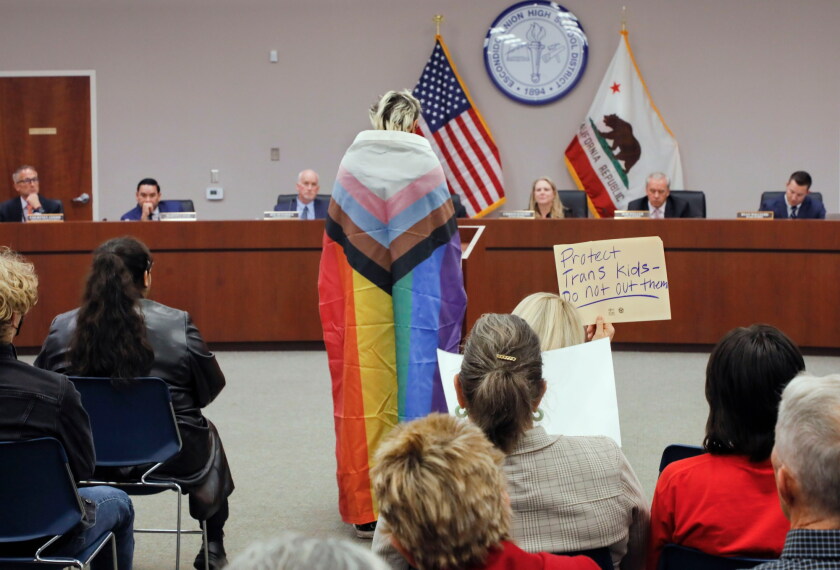
Teacher’s aide Amelia Mester, wrapped in a Pride flag, urges Escondido Union High School District not to have employees notify parents if they believe a student may be transgender in November 2025. A policy on the issue in the city’s elementary school district is the subject of a federal class-action lawsuit in which a judge just sided against the district.
Teacher’s aide Amelia Mester, wrapped in a Pride flag, urges Escondido Union High School District not to have employees notify parents if they believe a student may be transgender at a meeting in November 2025. Two parents and two teachers from the district sued in 2023, challenging California state guidance concerning student gender transitions and parental notification. The U.S. Supreme Court has now reinstated a lower-court decision overturning those state policies.
Charlie Neuman for The San Diego Union-Tribune/TNS