Law & Courts

Sotomayor Wins U.S. Supreme Court Confirmation

Education issues came up in hearings
By Erik W. Robelen — August 06, 2009 1 min read
BRIC ARCHIVE
  • Save to favorites
  • Print

Includes updates and/or revisions.

After confirmation hearings in mid-July that touched only lightly on education, Judge Sonia Sotomayor is heading to the U.S. Supreme Court in time for the term that formally opens in October, after winning approval last week by the full Senate 68-31.

Just nine Republicans joined 57 Senate Democrats and two Independents in voting to confirm Judge Sotomayor. Sen. Edward M. Kennedy, D-Mass., who has brain cancer, was not present.

President Barack Obama’s nominee was backed by some prominent civil rights and education groups, including the two national teachers’ unions.

Judge Sotomayor “understands the judiciary’s role in protecting the rights of all Americans, in ensuring equal justice, and in respecting our constitutional values—all within the confines of the law,” according to a July 27 letter co-signed by the National Education Association, the American Federation of Teachers, and other groups.

But many Senate Republicans challenged her impartiality and faulted how she handled some cases during her 17 years as a federal judge at the appellate and district court levels. As a judge, she has handled a relatively small number of cases dealing directly with K-12 education. (“School Rulings By Sotomayor Eyed Carefully,” June 10, 2009.)

From the Confirmation Hearings

Last month’s confirmation hearings gave then-U.S. Supreme Court nominee Sonia Sotomayor and her questioners a chance to address issues affecting schools and education. Read the highlights here.

Judge Sotomayor is generally viewed as a moderate to liberal, and replaces now-retired Justice David H. Souter, who was considered a part of the court’s liberal bloc.

During three days of hearings before the Senate Judiciary Committee, Judge Sotomayor was asked about an education ruling from her appellate tenure, on allegations by a black child’s family that he had been subjected to racial discrimination at an elementary school. She also touched on two 2003 Supreme Court cases concerning race-conscious admissions policies in higher education, as well as the seminal Brown v. Board of Education decision.

Republican senators focused extensively on the controversial Ricci v. DeStefano appellate ruling that she had joined—and which was reversed in June by the Supreme Court on a 5-4 vote. The U.S. Court of Appeals for the 2nd Circuit had rejected claims of reverse discrimination involving firefighters from New Haven, Conn.

Related Tags:

A version of this article appeared in the August 12, 2009 edition of Education Week as Sotomayor Wins U.S. Supreme Court Confirmation

Events

This content is provided by our sponsor. It is not written by and does not necessarily reflect the views of Education Week's editorial staff.
Sponsor
Teaching Webinar
Closing the Practice Gap: Essential Insights for Leaders
Three instructional experts will share strategies for making students’ reading and math practice more engaging and impactful this year.
Content provided by Renaissance

EdWeek Top School Jobs

Teacher Jobs
Search over ten thousand teaching jobs nationwide — elementary, middle, high school and more.
View Jobs
Principal Jobs
Find hundreds of jobs for principals, assistant principals, and other school leadership roles.
View Jobs
Administrator Jobs
Over a thousand district-level jobs: superintendents, directors, more.
View Jobs
Support Staff Jobs
Search thousands of jobs, from paraprofessionals to counselors and more.
View Jobs

Read Next

Law & Courts What Schools Need to Know About the Supreme Court’s Transgender Sports Ruling
The justices upheld two state laws that bar transgender girls from participating in female sports.
10 min read
A group prays outside of the Supreme Court ahead of the court's ruling on whether transgender girls and women can play on school athletic teams, on June 30, 2026, on Capitol Hill in Washington.
A group prays outside of the U.S. Supreme Court ahead of the court's ruling on whether transgender girls and women can play on school athletic teams, on June 30, 2026, in Washington. The court upheld two state laws barring transgender girls from joining girls' school sports teams.
Jose Luis Magana/AP
Law & Courts Judges Strike Down Trump Admin.'s Student Loan Forgiveness Overhaul
Two judges sided with advocates who said the program risked becoming a tool for political retribution.
3 min read
In this May 5, 2018, file photo, graduates at the University of Toledo commencement ceremony in Toledo, Ohio.
Graduates at the University of Toledo commencement ceremony in Toledo, Ohio, on May 5, 2018. Two judges have ruled against the Trump administration's overhaul of a public service loan forgiveness program for which teachers have qualified.
Carlos Osorio/AP
Law & Courts Supreme Court Upholds Birthright Citizenship, Rejecting Trump's Proposed Limits
The justices relied on the 14th Amendment and federal law to rule that anyone born in the U.S. is a citizen.
4 min read
Members of the Supreme Court sit for a group portrait in Washington, Oct. 7, 2022. Bottom row, from left, Justice Sonia Sotomayor, Justice Clarence Thomas, Chief Justice John Roberts, Justice Samuel Alito and Justice Elena Kagan. Top row, from left, Justice Amy Coney Barrett, Justice Neil Gorsuch, Justice Brett Kavanaugh, and Justice Ketanji Brown Jackson. The Supreme Court justices will take the bench Monday, July 1, 2024, to release their last few opinions of the term, including their most closely watched case: whether former President Donald Trump has immunity from criminal prosecution.
Members of the Supreme Court sit for a group portrait in Washington, Oct. 7, 2022. Bottom row, from left, Justice Sonia Sotomayor, Justice Clarence Thomas, Chief Justice John Roberts, Justice Samuel Alito, and Justice Elena Kagan. Top row, from left, Justice Amy Coney Barrett, Justice Neil Gorsuch, Justice Brett Kavanaugh, and Justice Ketanji Brown Jackson. The high court, on June 30, 2026, rejected President Donald Trump's executive order on birthright citizenship.
J. Scott Applewhite/AP
Law & Courts States Can Ban Transgender Athletes, Supreme Court Decides
The court ruled that state bans in Idaho and West Virginia don’t violate the Constitution or Title IX.
3 min read
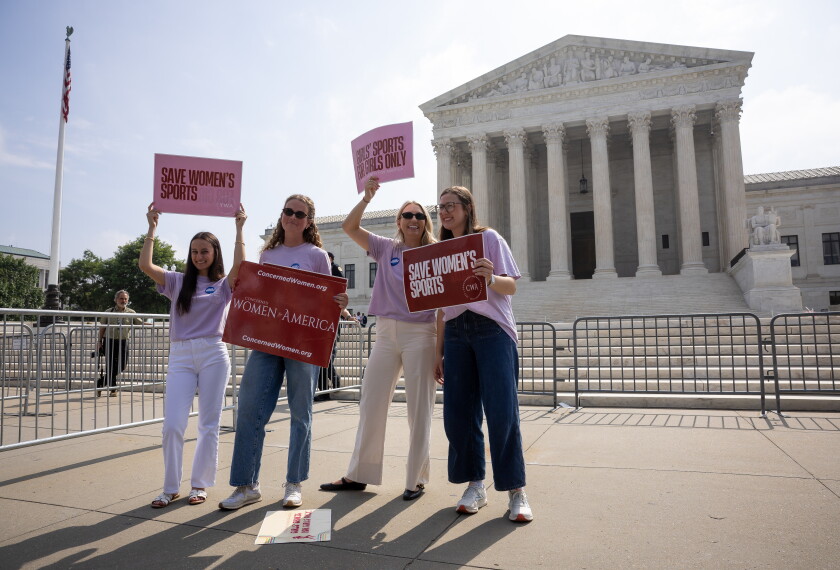
People advocate for a ban on transgender women and girls participating in women's and girls' sports outside the U.S. Supreme Court building as the court announced decisions in Washington, on June 29, 2026.
People advocate for a ban on transgender women and girls participating in women's and girls' sports outside the U.S. Supreme Court building as the court announced decisions in Washington, on June 29, 2026. The Supreme Court ruled on June 30, 2026, that states may enforce laws restricting transgender athletes’ participation on girls’ and women’s sports teams.
Francis Chung/Politico via AP