Law & Courts

Senate Confirms Kagan as U.S. Supreme Court Justice

By The Associated Press — August 05, 2010 3 min read
  • Save to favorites
  • Print

The U.S. Senate on Thursday confirmed Elena Kagan as the 112th justice and fourth woman to serve on the Supreme Court.

The vote was 63-37 for President Barack Obama’s nominee to succeed retired Justice John Paul Stevens. Five Republicans joined all but one Democrat and the Senate’s two independents to support Kagan. In a rarely practiced ritual reserved for the most historic votes, senators sat at their desks and stood to cast their votes with “ayes” and “nays.”

Kagan has extensive experience in education policy, both as dean of Harvard Law School and through work on numerous K-12 issues as a domestic policy aide to President Bill Clinton. Those issues surfaced during her confirmation hearings, as senators asked about memos she had written on education-related documents during her time in the Clinton White House and while she was a law clerk for Supreme Court Justice Thurgood Marshall in the late 1980s. (“Kagan Vows to Shun ‘Political Hat’ on High Court,” July 13, 2010.)

The Kagan papers released by the Clinton Presidential Library in Little Rock, Ark., revealed little about her own views on such issues as education funding, testing, social promotion, and school violence. What was clear from the hundreds of pages of documents, however, was that the White House domestic-policy office, where Kagan worked from 1997 to 1999, was deeply involved in education issues, often coordinating with the U.S. Department of Education. Clinton aides viewed education initiatives—whether ambitious, such as an effort to reauthorize the Elementary and Secondary Education Act, or modest, such as a proposal to promote school uniforms—as something that connected with voters and helped cement the president’s legacy. (“Papers Show Kagan in Loop on Clinton K-12 Policy,” School Law Blog, June 6, 2010.)

During the confirmation hearings, Sen. Jeff Sessions, R-Ala., also challenged Kagan about her handling of military recruiters while she was dean of Harvard Law School, asking whether she was hostile to recruiters in applying Harvard’s non-discrimination policy.

“I respect, indeed, I revere the military,” Kagan told him. “My father was veteran. ... I always tried to make sure I conveyed my honor to the military. In the short period the recruiters had that access through the veterans organization, recruiting actually went up. But I also felt the need to protect the students meant to be protected by [Harvard’s non-discrimination policy], the gay and lesbian students who might want to join the military.” (“Kagan, Sessions Spar on Harvard Recruiting Issue,” School Law Blog, June 29, 2010.)

Kagan isn’t expected to alter the ideological balance of the court, where Stevens was considered a leader of the liberals. But the two parties clashed over her nomination. Republicans argued that Kagan was a political liberal who would be unable to be impartial. Democrats defended her as a highly qualified legal scholar.

She is the first Supreme Court nominee in nearly 40 years with no experience as a judge, and her swearing-in will mark the first time in history that three women will serve on the nine-member court together.

Her lack of judicial experience was the stated reason for one fence-sitting Republican, Sen. Scott Brown of Massachusetts, to announce his opposition to her confirmation Thursday, just hours before the vote. Though calling her “brilliant,” Brown — who had been seen as a potential GOP supporter — said she was missing the necessary background to serve as a justice.

“The best umpires, to use the popular analogy, must not only call balls and strikes, but also have spent enough time on the playing field to know the strike zone,” Brown said.

Related Tags:

Events

This content is provided by our sponsor. It is not written by and does not necessarily reflect the views of Education Week's editorial staff.
Sponsor
Artificial Intelligence Webinar
Managing AI in Schools: Practical Strategies for Districts
How should districts govern AI in schools? Learn practical strategies for policies, safety, transparency, as well as responsible adoption.
Content provided by Lightspeed Systems
This content is provided by our sponsor. It is not written by and does not necessarily reflect the views of Education Week's editorial staff.
Sponsor
Reading & Literacy Webinar
Unlocking Success for Struggling Adolescent Readers
The Science of Reading transformed K-3 literacy. Now it's time to extend that focus to students in grades 6 through 12.
Content provided by STARI
Jobs Virtual Career Fair for Teachers and K-12 Staff
Find teaching jobs and K-12 education jubs at the EdWeek Top School Jobs virtual career fair.

EdWeek Top School Jobs

Teacher Jobs
Search over ten thousand teaching jobs nationwide — elementary, middle, high school and more.
View Jobs
Principal Jobs
Find hundreds of jobs for principals, assistant principals, and other school leadership roles.
View Jobs
Administrator Jobs
Over a thousand district-level jobs: superintendents, directors, more.
View Jobs
Support Staff Jobs
Search thousands of jobs, from paraprofessionals to counselors and more.
View Jobs

Read Next

Law & Courts Appeals Court Halts Ruling Letting Teachers Disclose Students' Gender Identity
A federal appeals court has temporarily paused enforcement of the ruling but has not yet decided whether to grant a longer-term stay.
Kristen Taketa, The San Diego Union-Tribune
3 min read
Students carrying pride and transgender flags leave Great Oak High School in Temecula, Calif., on Sept. 22, 2023, after walking out of the school in protest of the Temecula school district policy requiring parents to be notified if their child identifies as transgender.
Anjali Sharif-Paul/The Orange County Register via AP
Law & Courts Schools Can’t Bar Teachers From Telling Parents If Kids Are Transgender, Judge Rules
The injunction bans any public school employee from misleading parents about their child’s gender presentation at school.
Kristen Taketa, The San Diego Union-Tribune
5 min read
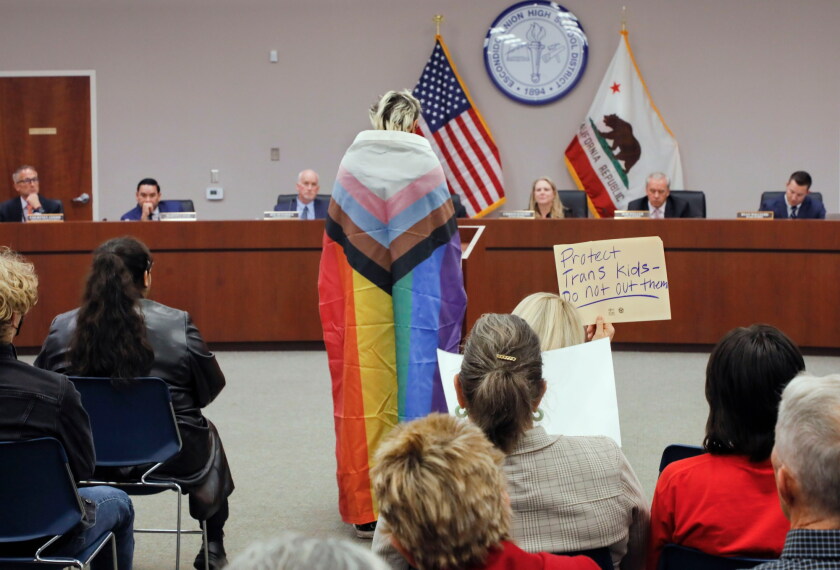
Teacher’s aide Amelia Mester, wrapped in a Pride flag, urges Escondido Union High School District not to have employees notify parents if they believe a student may be transgender in November 2025. A policy on the issue in the city’s elementary school district is the subject of a federal class-action lawsuit in which a judge just sided against the district.
Teacher’s aide Amelia Mester, wrapped in a Pride flag, urges Escondido Union High School District not to have employees notify parents if they believe a student may be transgender. A policy on the issue in the city’s elementary school district is the subject of a federal class-action lawsuit in which a judge just ruled against the district.
Charlie Neuman for The San Diego Union-Tribune/TNS
Law & Courts Federal Appeals Court Upholds 8th Grader's Expulsion Over Gun Comments in Class
Shortly after a nearby mass school shooting, a student allegedly discussed bringing a gun to school.
3 min read
Photo of stone columns.
E+
Law & Courts Trump's Education Policies Spurred 72 Lawsuits in 2025. How Many Is He Winning?
The legal challenges show which policies have had a big impact and how 2026 could go.
5 min read
President Donald Trump holds up an executive order after signing it at an indoor Presidential Inauguration parade event in Washington, Jan. 20, 2025.
President Donald Trump holds up an executive order after signing it at an indoor presidential inauguration parade event in Washington on Jan. 20, 2025. Trump's executive actions prompted legal challenges virtually from the moment he took office, and education-related policies were not immune.
Matt Rourke/AP
