Law & Courts

Schools Fall Short On First Amendment Rights

By Robert C. Johnston — March 21, 2001 3 min read
  • Save to favorites
  • Print

Educators believe they do a good job teaching students about the rights to freedom of religion, speech, the press, assembly, and petition as guaranteed by the First Amendment to the U.S. Constitution. But when it comes to granting students those rights in schools, educators are more wary.

That’s the conclusion of a survey released last week by two national organizations that plan to offer public schools models for how to put their beliefs in the First Amendment into action.

"[Educators] need to be convinced that students can exercise their First Amendment rights with responsibility,” said Gene Carter, the executive director of the Association for Supervision and Curriculum Development in Alexandria, Va. “They want students to learn about freedom, but are concerned about how students practice freedom, especially in the school setting.”

The ASCD announced that it will partner with the First Amendment Center in New York City on the multiyear project.

The goals of the project are:

  • To reach a consensus on guidelines for applying First Amendment rights in public schools;
  • To develop model schools where First Amendment rights are understood and applied;
  • To encourage curricula that deepen students’ understanding of the First Amendment; and
  • To educate school and community leaders on the significance of First Amendment ideals.

“The guiding principles of the First Amendment stand at the heart of our democracy and at the foundation of citizenship in a diverse society,” said Ken Paulson, the executive director of the First Amendment Center, a nonprofit organization that studies free-expression issues.

Information Gap

As part of the effort, 1,802 public school teachers and administrators were surveyed in January by the Center for Survey Research and Analysis at the University of Connecticut.

The poll found that while educators have a greater knowledge of First Amendment rights than does the general public, based on past surveys, roughly one in five couldn’t recall the five freedoms guaranteed by the amendment.

Moreover, 71 percent of the educators said they would not allow students to report on controversial issues in school newspapers without the approval of school officials. Ninety-two percent would not allow students to wear T-shirts with a message that some people might find offensive.

“The efforts to limit or censor student press are extremely frequent,” said Mark Goodman, the executive director of the Student Press Law Center in Arlington, Va. “The lessons we teach by our actions about civics are extremely troubling.”

About six in 10 teachers and administrators did not think students should be allowed to distribute religious materials at schools. About half felt the same regarding political materials.

Carl Esbeck, the director of the Center for Law and Religious Freedom at the Christian Legal Society in Annandale, Va., said his office initiates at least one case a week involving alleged violations of students’ rights to religious expression.

“It could involve use of a bulletin board, literature table, or public address system,” he said. Most of the issues, Mr. Esbeck said, are resolved by an exchange of letters in which his office explains its position on how and when students can use school facilities for religious expression.

His experience appears to be borne out by the survey, which found that 39 percent of administrators and 69 percent of teachers were “not at all familiar” with the guidelines on religious expression in schools distributed by the Clinton administration in 2000.

Mr. Carter of the ASCD said the initiative would move “full-speed ahead beginning this week to develop their guidelines and to find schools across the country that encourage First Amendment ideals.”

A version of this article appeared in the March 21, 2001 edition of Education Week as Schools Fall Short On First Amendment Rights

Events

This content is provided by our sponsor. It is not written by and does not necessarily reflect the views of Education Week's editorial staff.
Sponsor
Artificial Intelligence Webinar
Managing AI in Schools: Practical Strategies for Districts
How should districts govern AI in schools? Learn practical strategies for policies, safety, transparency, and responsible adoption.
Content provided by Lightspeed Systems
This content is provided by our sponsor. It is not written by and does not necessarily reflect the views of Education Week's editorial staff.
Sponsor
Student Absenteeism Webinar
Removing Transportation and Attendance Barriers for Homeless Youth
Join us to see how districts around the country are supporting vulnerable students, including those covered under the McKinney–Vento Act.
Content provided by HopSkipDrive
This content is provided by our sponsor. It is not written by and does not necessarily reflect the views of Education Week's editorial staff.
Sponsor
Reading & Literacy Webinar
Two Jobs, One Classroom: Strengthening Decoding While Teaching Grade-Level Text
Discover practical, research-informed practices that drive real reading growth without sacrificing grade-level learning.
Content provided by EPS Learning

EdWeek Top School Jobs

Teacher Jobs
Search over ten thousand teaching jobs nationwide — elementary, middle, high school and more.
View Jobs
Principal Jobs
Find hundreds of jobs for principals, assistant principals, and other school leadership roles.
View Jobs
Administrator Jobs
Over a thousand district-level jobs: superintendents, directors, more.
View Jobs
Support Staff Jobs
Search thousands of jobs, from paraprofessionals to counselors and more.
View Jobs

Read Next

Law & Courts Supreme Court’s Gender Identity Ruling Leaves Schools Seeking Clarity
Advocates say they would welcome more from the Supreme Court on gender-notification policies.
7 min read
The Supreme Court is photographed, Friday, Feb. 27, 2026, in Washington.
The Supreme Court is photographed, Friday, Feb. 27, 2026, in Washington. The high court recently ruled that California policies that sometimes limit or discourage schools from disclosing information to parents about children’s gender transitions and expressions at school likely violate parents’ constitutional rights
Rahmat Gul/AP
Law & Courts Supreme Court Backs Parents in School Gender Disclosure Fight
The Supreme Court restored an injunction blocking California policies on student gender transitions
8 min read
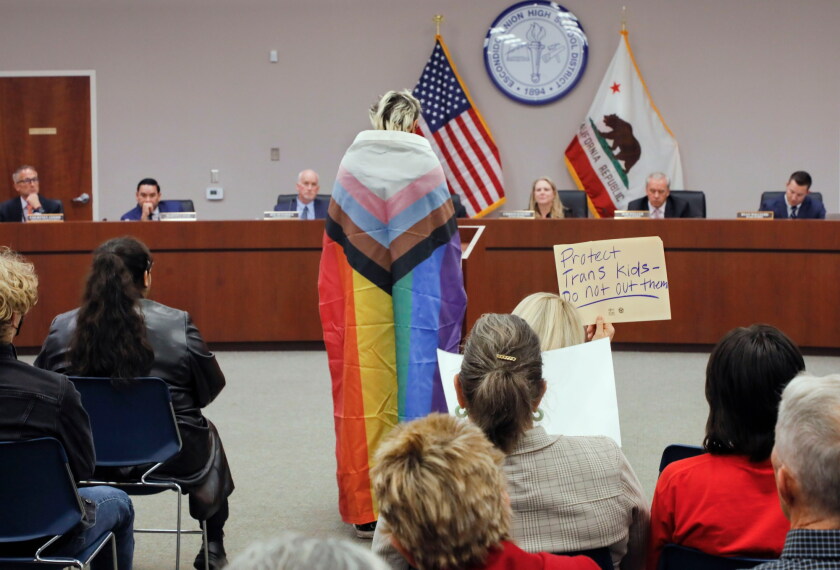
Teacher’s aide Amelia Mester, wrapped in a Pride flag, urges Escondido Union High School District not to have employees notify parents if they believe a student may be transgender in November 2025. A policy on the issue in the city’s elementary school district is the subject of a federal class-action lawsuit in which a judge just sided against the district.
Teacher’s aide Amelia Mester, wrapped in a Pride flag, urges Escondido Union High School District not to have employees notify parents if they believe a student may be transgender at a meeting in November 2025. Two parents and two teachers from the district sued in 2023, challenging California state guidance concerning student gender transitions and parental notification. The U.S. Supreme Court has now reinstated a lower-court decision overturning those state policies.
Charlie Neuman for The San Diego Union-Tribune/TNS
Law & Courts Appeals Court Allows Louisiana Ten Commandments Displays to Proceed
The court said it was premature to rule on the constitutionality of La. Ten Commandments displays.
3 min read
Students work under Ten Commandments and Bill of Rights posters on display in a classroom at Lehman High School in Kyle, Texas, Thursday, Oct. 16, 2025.
Students work under Ten Commandments and Bill of Rights posters on display in a classroom at Lehman High School in Kyle, Texas, Oct. 16, 2025. A federal appeals court has lifted a lower-court injunction blocking a Louisiana law that requires Ten Commandments displays, clearing the way for the law to take effect.
Eric Gay/AP
Law & Courts Supreme Court Strikes Trump Tariffs in Case Brought by Educational Toy Companies
Two educational toy companies were among the leading challengers to the president's tariff policies
3 min read
Members of the Supreme Court sit for a new group portrait following the addition of Associate Justice Ketanji Brown Jackson, at the Supreme Court building in Washington, Oct. 7, 2022. Bottom row, from left, Associate Justice Sonia Sotomayor, Associate Justice Clarence Thomas, Chief Justice of the United States John Roberts, Associate Justice Samuel Alito, and Associate Justice Elena Kagan. Top row, from left, Associate Justice Amy Coney Barrett, Associate Justice Neil Gorsuch, Associate Justice Brett Kavanaugh, and Associate Justice Ketanji Brown Jackson.
Members of the U.S. Supreme Court sit for a new group portrait following the addition of Justice Ketanji Brown Jackson, at the court building in Washington, Oct. 7, 2022. On Feb. 20, 2026, the court ruled 6-3 to strike down President Donald Trump's broad tariff policies, ruling that they were not authorized by the federal statute that he cited for them.
J. Scott Applewhite/AP
