Law & Courts

Samuel Anthony Alito Jr.

November 08, 2005 3 min read
  • Save to favorites
  • Print

Age: 55

Birthplace: Trento, N.J.

Education: Yale Law School, J.D., 1975; Princeton University, A.B., 1972; Hamilton (N.J.) High School East, graduated 1968.

Family: Married to Martha-Ann Bomgardner, with a son, Philip, 19, who attends college, and a daughter Laura, 17, in high school.

Experience: Worked for U.S. Department of Justice, 1977-1990. Positions included assistant to the U.S. solicitor general, in which he argued 12 cases before the U.S. Supreme Court on behalf of the federal government; deputy assistant attorney general in the Justice Department’s office of legal counsel; and the U.S. attorney for New Jersey, where he prosecuted white-collar and environmental crimes, drug trafficking, organized crime, and civil rights violations.

Since 1990, he has been a judge on the U.S. Court of Appeals for the 3rd Circuit, in Philadelphia. Nominee of President George H.W. Bush.

Education Rulings:

Besides being involved in cases on student religious expression and special education, Judge Alito has had noteworthy rulings in these other areas of school law:

See Also

Race and civil rights

Judge Alito joined the 8-4 majority of the full 3rd Circuit court that in 1996 ruled against the Piscataway, N.J., school district’s decision to lay off a white teacher over her black colleague in an action to preserve racial diversity in a high school business education department. Judge Alito joined an opinion that said the race-based decision violated Title VII of the Civil Rights Act of 1964. The Supreme Court agreed to review the much-debated case, but the parties settled before oral arguments took place.

In a 1997 case, Judge Alito joined a majority decision that upheld a Delaware school district’s at-large system of electing school board members against a challenge under the Voting Rights Act of 1965 that the system diluted minority votes. The dissenting judge on the three-member 3rd Circuit panel said the system resulted in the election of few black candidates to the school board.

Sexual abuse of students by school employees

Judge Alito has participated in several cases involving alleged sex abuse of students, and in each he sided with school districts or administrators against claims that they should have prevented such abuse. One such case involved allegations that three Pennsylvania girls, ages 6, 7, and 8, were sexually molested by a school bus driver. Judge Alito joined a three-judge panel that unanimously granted summary judgment to the driver and the private bus company because they were not government parties, and to school officials because they were not deliberately indifferent to the alleged abuse.

Teacher free-speech rights

In 1992, Judge Alito wrote the opinion for a three-judge panel that unanimously rejected a claim by a Pennsylvania teacher that her freedom of speech was violated when she suffered adverse job actions based on her comments in a faculty newsletter that the school’s teachers were being put under stress and had suffered low self-esteem. Judge Alito’s opinion said the teacher’s comments were not on matters of public concern that were protected by the First Amendment.

Student drug testing

In 2000, Judge Alito joined a unanimous ruling by a three-judge panel that dismissed a family’s lawsuit against a New Jersey school district over the drug testing of a high school student. A teacher had suspected that the student, based on her classroom behavior, was under the influence of drugs or alcohol. Administrators required the student to undergo a blood test and a urinalysis at a medical facility, which proved negative. In rejecting the family’s civil rights suit, the 3rd Circuit panel said that the teacher’s suspicion was reasonable, and that the blood test and urinalysis were not unreasonable searches under the Fourth Amendment.

SOURCE: Education Week
A version of this article appeared in the November 09, 2005 edition of Education Week as Samuel Anthony Alito Jr.

Events

This content is provided by our sponsor. It is not written by and does not necessarily reflect the views of Education Week's editorial staff.
Sponsor
Artificial Intelligence Webinar
Managing AI in Schools: Practical Strategies for Districts
How should districts govern AI in schools? Learn practical strategies for policies, safety, transparency, and responsible adoption.
Content provided by Lightspeed Systems
This content is provided by our sponsor. It is not written by and does not necessarily reflect the views of Education Week's editorial staff.
Sponsor
Student Absenteeism Webinar
Removing Transportation and Attendance Barriers for Homeless Youth
Join us to see how districts around the country are supporting vulnerable students, including those covered under the McKinney–Vento Act.
Content provided by HopSkipDrive
This content is provided by our sponsor. It is not written by and does not necessarily reflect the views of Education Week's editorial staff.
Sponsor
Reading & Literacy Webinar
Two Jobs, One Classroom: Strengthening Decoding While Teaching Grade-Level Text
Discover practical, research-informed practices that drive real reading growth without sacrificing grade-level learning.
Content provided by EPS Learning

EdWeek Top School Jobs

Teacher Jobs
Search over ten thousand teaching jobs nationwide — elementary, middle, high school and more.
View Jobs
Principal Jobs
Find hundreds of jobs for principals, assistant principals, and other school leadership roles.
View Jobs
Administrator Jobs
Over a thousand district-level jobs: superintendents, directors, more.
View Jobs
Support Staff Jobs
Search thousands of jobs, from paraprofessionals to counselors and more.
View Jobs

Read Next

Law & Courts Supreme Court’s Gender Identity Ruling Leaves Schools Seeking Clarity
Advocates say they would welcome more from the Supreme Court on gender-notification policies.
7 min read
The Supreme Court is photographed, Friday, Feb. 27, 2026, in Washington.
The Supreme Court is photographed, Friday, Feb. 27, 2026, in Washington. The high court recently ruled that California policies that sometimes limit or discourage schools from disclosing information to parents about children’s gender transitions and expressions at school likely violate parents’ constitutional rights
Rahmat Gul/AP
Law & Courts Supreme Court Backs Parents in School Gender Disclosure Fight
The Supreme Court restored an injunction blocking California policies on student gender transitions
8 min read
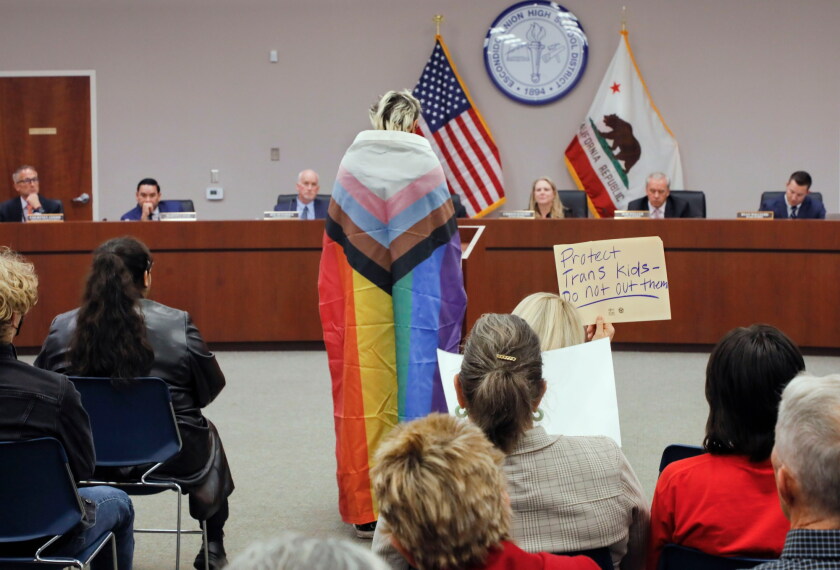
Teacher’s aide Amelia Mester, wrapped in a Pride flag, urges Escondido Union High School District not to have employees notify parents if they believe a student may be transgender in November 2025. A policy on the issue in the city’s elementary school district is the subject of a federal class-action lawsuit in which a judge just sided against the district.
Teacher’s aide Amelia Mester, wrapped in a Pride flag, urges Escondido Union High School District not to have employees notify parents if they believe a student may be transgender at a meeting in November 2025. Two parents and two teachers from the district sued in 2023, challenging California state guidance concerning student gender transitions and parental notification. The U.S. Supreme Court has now reinstated a lower-court decision overturning those state policies.
Charlie Neuman for The San Diego Union-Tribune/TNS
Law & Courts Appeals Court Allows Louisiana Ten Commandments Displays to Proceed
The court said it was premature to rule on the constitutionality of La. Ten Commandments displays.
3 min read
Students work under Ten Commandments and Bill of Rights posters on display in a classroom at Lehman High School in Kyle, Texas, Thursday, Oct. 16, 2025.
Students work under Ten Commandments and Bill of Rights posters on display in a classroom at Lehman High School in Kyle, Texas, Oct. 16, 2025. A federal appeals court has lifted a lower-court injunction blocking a Louisiana law that requires Ten Commandments displays, clearing the way for the law to take effect.
Eric Gay/AP
Law & Courts Social Media Companies Face Legal Reckoning Over Mental Health Harms to Children
Some of the biggest players from Meta to TikTok are getting a chance to make their case in courtrooms around the country.
6 min read
Social Media Kids Trial 26050035983057
Meta CEO Mark Zuckerberg leaves court after testifying in a landmark trial over whether social media platforms deliberately addict and harm children, on Feb. 18, 2026, in Los Angeles.
AP Photo/Damian Dovarganes
