Law & Courts

Ruling May Reignite Debate on School-Board Prayers

By Mark Walsh — May 13, 2014 4 min read
  • Save to favorites
  • Print

Is a school board the same as a town council when it comes opening public meetings with a prayer?

Legal experts disagreed on that question last week after the U.S. Supreme Court upheld prayers before meetings of the town council in Greece, N.Y., that were predominantly delivered by Christian clergy members.

“The town of Greece does not violate the First Amendment by opening its meetings with prayer that comports with our tradition and does not coerce participation by nonadherents,” Justice Anthony M. Kennedy wrote for the 5-4 majority.

Objectors to the prayers in the New York state town of 96,000 were not seeking to end the practice altogether, but were trying to encourage more ecumenical prayers and more religious variety.

Justice Kennedy said the case was governed by the high court’s 1983 decision in Marsh v. Chambers, which upheld prayers delivered before the Nebraska legislature.

“An insistence on nonsectarian or ecumenical prayer as a single, fixed standard is not consistent with the tradition of legislative prayer outlined in the court’s cases,” he said in the May 5 decision in Town of Greece v. Galloway (Case No. 12-696).

Justice Kennedy’s opinion was joined in full by Chief Justice John G. Roberts Jr. and Justice Samuel A. Alito Jr. and in large part by Justices Antonin Scalia and Clarence Thomas.

Sharp Dissent

But Justice Elena Kagan, in a dissent joined by Justices Ruth Bader Ginsburg, Stephen G. Breyer, and Sonia Sotomayor, said town meetings were different from sessions of legislatures because ordinary citizens are there to interact with the council, and in Greece the prayers were directed not just at council members but at everyone present.

“When the citizens of this country approach their government, they do so only as Americans, not as members of one faith or another,” Justice Kagan wrote. “And that means that even in a partly legislative body, they should not confront government-sponsored worship that divides them along religious lines.”

Prayers before public meetings have been an issue for school boards in some places. The two federal appeals courts that have addressed such prayers have barred them as an unconstitutional establishment of religion. Those courts have held that school board meetings were more like school itself, with students frequently present to receive recognition or for other purposes.

“School boards are distinct” from towns and other municipal bodies, said Gregory M. Lipper, a senior litigation counsel with Americans United for Separation of Church and State, a Washington group that represented the prayer challengers in Greece. “Students are often active participants, sometimes as members of the board of education.”

“There would still be at best a significant legal risk to school boards that decided to open their meetings with prayers,” Mr. Lipper said.

Jason P. Gosselin, a Philadelphia lawyer who represented a Delaware school district in a meeting-prayer case a few years ago, had a different interpretation.

“I think this decision supports the view that this practice is permissible” at school board meetings, he said.

Such meetings primarily revolve around the public business of the school district, and students “just occasionally happen to be there,” said Mr. Gosselin, who represented the Indian River school district in Delaware in 2011 before the U.S. Court of Appeals for the 5th Circuit, in Philadelphia. That court ruled against the school board’s prayers.

Room for Disagreement

Both advocates’ views might find ammunition in the Supreme Court’s various opinions in Town of Greece, which did not explicitly address the issue of school board meetings.

Mr. Lipper noted that Justice Kennedy discussed adults, but not necessarily children, as being unlikely to be coerced by a town meeting prayer delivered by someone outside their faith.

“Our tradition assumes that adult citizens, firm in their own beliefs, can tolerate and perhaps appreciate a ceremonial prayer delivered by a person of a different faith,” Justice Kennedy wrote.

And in a part of his opinion not joined by Justices Scalia and Thomas, Justice Kennedy said that town-meeting prayers do not present the same potential for coercion the court found problematic in Lee v. Weisman, the 1992 decision written by him that barred clergy-led prayers at school graduation ceremonies.

“The circumstances the court confronted [in Lee] are not present in this case and do not control its outcome,” Justice Kennedy said.

Mr. Lipper read that to suggest Justice Kennedy would treat all school situations, including school board meetings, as being in a category different from town meetings.

On the other hand, Justice Kennedy wrote of “local legislative bodies” without explicitly excluding school boards.

And Justice Alito, in a concurrence, said that there was nothing unusual “about the occasional attendance of students” at town meetings, intimating that their presence did not raise constitutional concerns.

“I think you could read this to permit prayer in a much broader group of governmental settings,” Mr. Gosselin said.

A version of this article appeared in the May 14, 2014 edition of Education Week as Ruling May Reignite Debate on Prayers at School Board Meetings

Events

This content is provided by our sponsor. It is not written by and does not necessarily reflect the views of Education Week's editorial staff.
Sponsor
Artificial Intelligence Webinar
Managing AI in Schools: Practical Strategies for Districts
How should districts govern AI in schools? Learn practical strategies for policies, safety, transparency, as well as responsible adoption.
Content provided by Lightspeed Systems
This content is provided by our sponsor. It is not written by and does not necessarily reflect the views of Education Week's editorial staff.
Sponsor
Reading & Literacy Webinar
Unlocking Success for Struggling Adolescent Readers
The Science of Reading transformed K-3 literacy. Now it's time to extend that focus to students in grades 6 through 12.
Content provided by STARI
Jobs Virtual Career Fair for Teachers and K-12 Staff
Find teaching jobs and K-12 education jubs at the EdWeek Top School Jobs virtual career fair.

EdWeek Top School Jobs

Teacher Jobs
Search over ten thousand teaching jobs nationwide — elementary, middle, high school and more.
View Jobs
Principal Jobs
Find hundreds of jobs for principals, assistant principals, and other school leadership roles.
View Jobs
Administrator Jobs
Over a thousand district-level jobs: superintendents, directors, more.
View Jobs
Support Staff Jobs
Search thousands of jobs, from paraprofessionals to counselors and more.
View Jobs

Read Next

Law & Courts Supreme Court’s Gender Identity Ruling Leaves Schools Seeking Clarity
Advocates say they would welcome more from the Supreme Court on gender-notification policies.
7 min read
The Supreme Court is photographed, Friday, Feb. 27, 2026, in Washington.
The Supreme Court is photographed, Friday, Feb. 27, 2026, in Washington. The high court recently ruled that California policies that sometimes limit or discourage schools from disclosing information to parents about children’s gender transitions and expressions at school likely violate parents’ constitutional rights
Rahmat Gul/AP
Law & Courts Supreme Court Backs Parents in School Gender Disclosure Fight
The Supreme Court restored an injunction blocking California policies on student gender transitions
8 min read
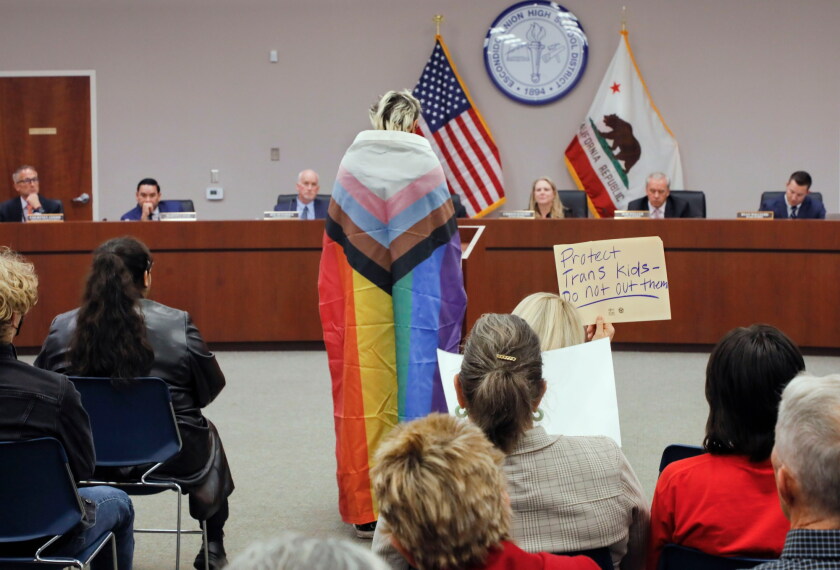
Teacher’s aide Amelia Mester, wrapped in a Pride flag, urges Escondido Union High School District not to have employees notify parents if they believe a student may be transgender in November 2025. A policy on the issue in the city’s elementary school district is the subject of a federal class-action lawsuit in which a judge just sided against the district.
Teacher’s aide Amelia Mester, wrapped in a Pride flag, urges Escondido Union High School District not to have employees notify parents if they believe a student may be transgender at a meeting in November 2025. Two parents and two teachers from the district sued in 2023, challenging California state guidance concerning student gender transitions and parental notification. The U.S. Supreme Court has now reinstated a lower-court decision overturning those state policies.
Charlie Neuman for The San Diego Union-Tribune/TNS
Law & Courts Appeals Court Allows Louisiana Ten Commandments Displays to Proceed
The court said it was premature to rule on the constitutionality of La. Ten Commandments displays.
3 min read
Students work under Ten Commandments and Bill of Rights posters on display in a classroom at Lehman High School in Kyle, Texas, Thursday, Oct. 16, 2025.
Students work under Ten Commandments and Bill of Rights posters on display in a classroom at Lehman High School in Kyle, Texas, Oct. 16, 2025. A federal appeals court has lifted a lower-court injunction blocking a Louisiana law that requires Ten Commandments displays, clearing the way for the law to take effect.
Eric Gay/AP
Law & Courts Supreme Court Strikes Trump Tariffs in Case Brought by Educational Toy Companies
Two educational toy companies were among the leading challengers to the president's tariff policies
3 min read
Members of the Supreme Court sit for a new group portrait following the addition of Associate Justice Ketanji Brown Jackson, at the Supreme Court building in Washington, Oct. 7, 2022. Bottom row, from left, Associate Justice Sonia Sotomayor, Associate Justice Clarence Thomas, Chief Justice of the United States John Roberts, Associate Justice Samuel Alito, and Associate Justice Elena Kagan. Top row, from left, Associate Justice Amy Coney Barrett, Associate Justice Neil Gorsuch, Associate Justice Brett Kavanaugh, and Associate Justice Ketanji Brown Jackson.
Members of the U.S. Supreme Court sit for a new group portrait following the addition of Justice Ketanji Brown Jackson, at the court building in Washington, Oct. 7, 2022. On Feb. 20, 2026, the court ruled 6-3 to strike down President Donald Trump's broad tariff policies, ruling that they were not authorized by the federal statute that he cited for them.
J. Scott Applewhite/AP
