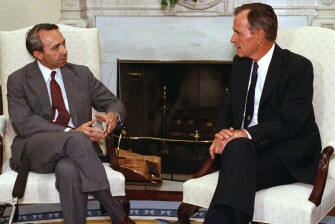
Retired U.S. Supreme Court Justice David H. Souter, a staunch defender of racial equity and the constitutional separation of church and state in education, died Thursday at home in New Hampshire, the court announced on Friday. He was 85.
Souter was appointed by President George H.W. Bush in 1990 to succeed liberal stalwart Justice William J. Brennan Jr. Over the next 19 years, he became a reliably liberal vote in several areas of school law before being succeeded by Justice Sonia Sotomayor in 2009.
He wrote a dissent to a 1995 decision that struck down a broad remedial desegregation plan for the Kansas City, Mo., schools, and in 2007 joined the dissent to a ruling that made it more difficult for school districts to consider race in assigning students to schools.
That same year, Souter was in dissent in a decision upholding the discipline of a student who displayed a “Bong Hits 4 Jesus” banner at an Alaska high school.
In 2009, just before he stepped down from the court, Souter wrote the majority opinion in Safford Unified School District v. Redding, which held that the strip search of a middle school student by school officials looking for drugs was unconstitutional.
“Here, the content of the suspicion failed to match the degree of intrusion,” Souter wrote, adding that requiring students to undress before school officials for the purposes of a search was “fairly understood as so degrading that a number of communities have decided that strip searches in schools are never reasonable.”
Warning about aid to religious schools
Souter was a strong proponent of a strict separation when it came to government embrace of religion in public education or state aid to religious schools.
In a 1992 decision, Lee v. Weisman, Souter joined the 5-4 majority that ruled clergy-led graduation prayers at a middle school violated the First Amendment’s prohibition against government establishment of religion.
“When public school officials, armed with the state’s authority, convey an endorsement of religion to their students, they strike near the core of the establishment clause,” Souter wrote in a concurrence.
In 2002, in Zelman v. Simmons-Harris, Souter wrote a bitter dissent from the court’s decision to uphold an Ohio program that created a pilot voucher program for Cleveland in which parents of that city’s schoolchildren could choose to send them to private religious schools at public expense. The majority said such vouchers were a neutral program resulting in aid to religious schools only through the “true private choice” of parents.

Souter said, “Religious teaching at taxpayer expense simply cannot be cordoned from taxpayer politics” and will lead to “expectable friction” in society.
“The ban on supporting religious establishment has protected free exercise” of religion, Souter added.
Just last month, in Oklahoma Statewide Charter School Board v. Drummond, the court considered similar arguments against the idea that states must fund religious charter schools.
In retirement, Souter regularly sat on panels of the U.S. Court of Appeals for the 1st Circuit, in Boston, including on several education cases. In one of those, he was a member of a unanimous three-judge panel that in 2020 upheld the state of Maine’s exclusion of “sectarian” schools from its program of paying private school tuition for its communities that lacked public high schools.
The Supreme Court reversed that decision in its 2022 ruling in Carson v. Makin, holding that the exclusion violates the free exercise clause. The Carson decision was cited by supporters of religious charters in the Oklahoma case that is pending a decision.
A commitment in retirement to civics education
Souter also became an advocate for civics education in his retirement, though he was not as much in the spotlight on the issue as the late Justice Sandra Day O’Connor, who started the iCivics program after she left the court, or Sotomayor, who sits on the board of directors for iCivics and has been outspoken on the issue.
“Civic education in the United States is not good enough, and we have to do something about it,” Souter said in an address to the American Bar Association in 2009, just months after he had retired, adding that there is a “risk to constitutional government when a substantial portion of the American populace” fails to learn basic civics.
Louise Dubé, the executive director of iCivics, recalled in an interview Friday traveling with O’Connor to New Hampshire in 2014 for a public appearance with Souter about civics.
Dubé was new to working with O’Connor, and the former justice was being a bit hard on her when Souter chimed in to say, “Give the kid a break,” she recalled. “He was incredibly kind and just a very humble person.”
Souter worked on civics efforts in New Hampshire, but he preferred to stay in the background, she said.
“He didn’t want it to be about him,” Dubé said. “It was always about the country.”
In his 2009 address to the ABA, Souter offered an observation that sounds familiar to points being made in recent speeches by current members of the Supreme Court, who appear to be responding to rhetorical attacks on judges by President Donald Trump or members of his administration.
“I’ll ask you to consider the danger to judicial independence when people have no conception of how the judiciary fits within the constitutional scheme,” Souter said.